Scholarships in Netherlands for International Students 2026/2027
Scholarships in Netherlands for International Students 2026/2027 The Netherlands has become one of Europe’s most popular study destinations for a simple reason: a large share of its degree programmes — including the majority of master’s programmes at its research universities — are taught entirely in English, its universities are consistently well ranked, and its post-study ... <a title="Scholarships in Netherlands for International Students 2026/2027" class="read-more" href="https://studygraduate.com/scholarship/scholarships-in-netherlands-for-international-students-2026-2027/" aria-label="Read more about Scholarships in Netherlands for International Students 2026/2027">Read more</a>
📖 Overview
Scholarships in Netherlands for International Students 2026/2027
The Netherlands has become one of Europe’s most popular study destinations for a simple reason: a large share of its degree programmes — including the majority of master’s programmes at its research universities — are taught entirely in English, its universities are consistently well ranked, and its post-study orientation year gives graduates a realistic route into the Dutch and European labour market. For students from Bangladesh, India, Pakistan, Nepal, Nigeria, Indonesia and other non-European countries, the obvious next question is funding. Scholarships in the Netherlands for international students in 2026/2027 are real, varied and competitive — but they work differently from the big government full-ride schemes of some other countries, and honest planning matters more here than almost anywhere else in Europe.
Here is the honest headline first. The Netherlands’ best-known national award, the NL Scholarship, is worth €5,000, paid once, in your first year only. Study in NL, the official Dutch study portal run by Nuffic, states explicitly that it is not a full-tuition scholarship. Non-EEA tuition fees at Dutch research universities commonly run far higher than €5,000 per year, so a Dutch funding plan is almost always a stack: a university excellence scholarship or tuition reduction, possibly plus the NL Scholarship, plus family funds or savings for living costs. The good news is that Dutch university scholarships can be substantial — up to full tuition plus a living contribution at the most competitive end — and this guide maps every major layer of the system so you can build a realistic stack of your own.
Use this guide alongside our scholarships directory and the dedicated companion guide to fully funded scholarships in the Netherlands for 2027, which focuses only on the routes that can cover your full costs.
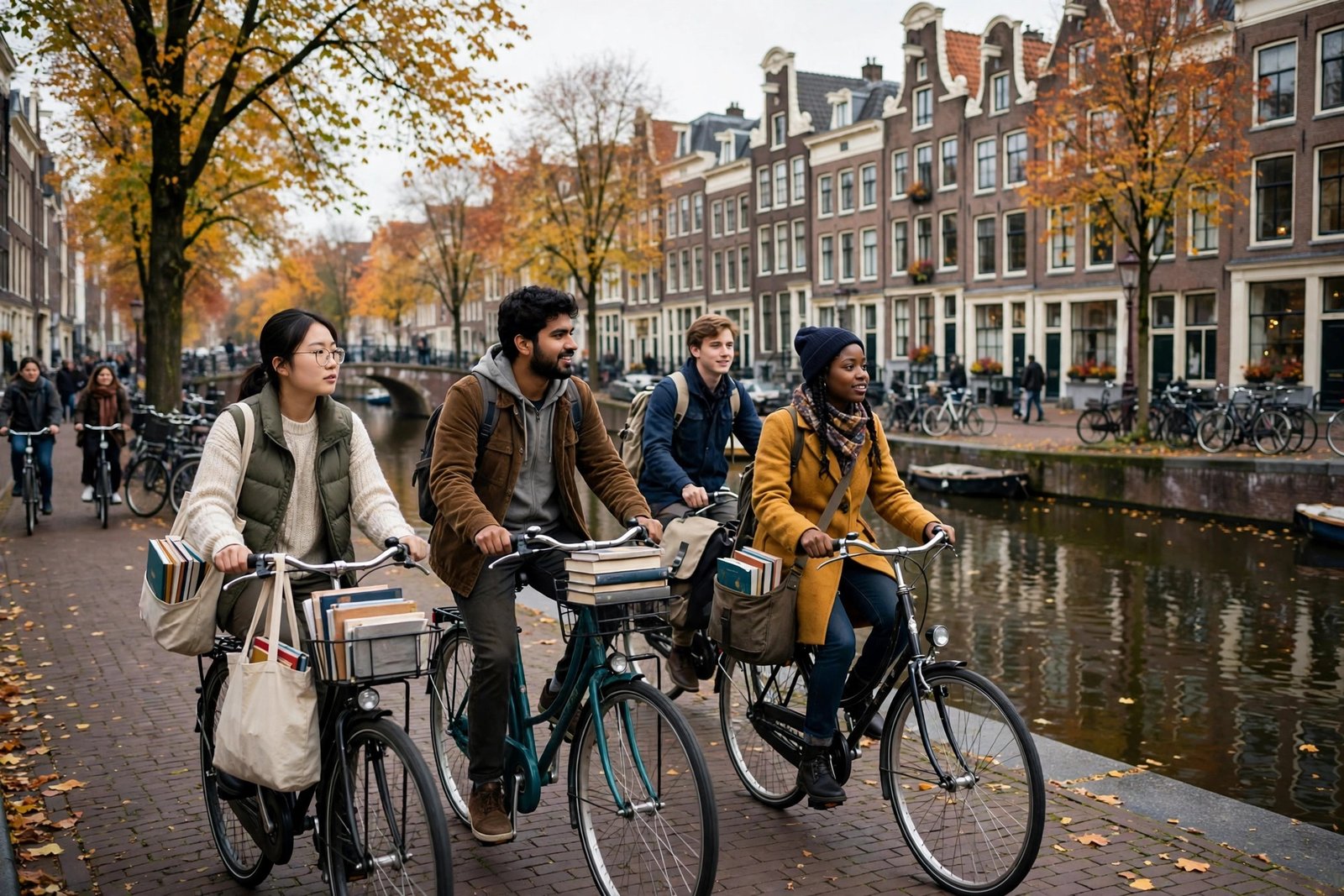
Scholarships in the Netherlands at a Glance
| Scholarship | Value | Level | Key deadline pattern |
|---|---|---|---|
| NL Scholarship (formerly Holland Scholarship) | €5,000, first year only — not full tuition | Bachelor’s & master’s, non-EEA | Set by each institution (commonly 1 February or 1 May) |
| TU Delft Justus & Louise van Effen Excellence | Full tuition + contribution to living expenses | Master’s (2-year MSc) | 1 December |
| University of Twente Scholarship (UTS) | €3,000–€22,000 for one year | Master’s, non-EU/EEA | Application rounds, roughly October–April/May |
| Leiden University Excellence Scholarship (LExS) | €10,000–€19,000 bands towards tuition | Master’s, non-EEA | 1 December for September start (most programmes) |
| University of Amsterdam Merit Scholarships | Varies by faculty; tuition-level awards exist | Master’s (some bachelor’s) | Faculty deadlines, often December–January |
| Eric Bleumink Fund (Groningen) | Tuition, travel, subsistence, books, health insurance | Master’s, listed countries | Apply for master’s by 1 December; nomination only |
| Radboud Scholarship Programme | Partial tuition reduction plus visa/insurance cost coverage | Master’s, non-EU/EEA | Winter deadline set by the university |
| Erasmus Mundus Joint Masters (EU) | €1,400/month + participation costs covered | Master’s (multi-country) | October–January, per consortium |
| Funded PhD positions | Salaried employment (doctoral candidate contract) | PhD | Rolling vacancies year-round |
Every figure in this table is a summary of what the funding bodies and universities publish; each scheme restates its amounts and conditions per cycle. Treat the table as a map, then read the official page for the two or three schemes that fit your profile before you spend money on applications.
Costs First: Tuition and Living Expenses in 2026/2027
You cannot judge a Dutch scholarship without the cost side of the ledger. For 2026–27, the statutory tuition fee paid by EU/EEA students is €2,694 per year — but non-EEA students pay institutional fees set by each university, which are far higher. Based on the programme data published through Study in NL, typical non-EEA ranges are roughly €9,000–€20,000 per year for bachelor’s programmes and €12,000–€30,000 per year for master’s programmes, with business, medicine-adjacent and some technical programmes at the top of the range and many programmes clustered in the middle. Your exact fee is the figure on your programme’s official page; never budget from a range when a precise published fee exists.
Living costs are the second line. Study in NL advises that students spend an average of €1,000–€1,500 per month, including rent, food, transport, insurance and study materials. Amsterdam and Utrecht sit at the top of that range, and the Netherlands has a well-documented student housing shortage: rooms are scarce, waiting lists are long and housing scams targeting new international students are a recognised problem. Start housing applications the moment your admission allows it, never pay a “landlord” who refuses a viewing or a verifiable contract, and treat any room far below market price as a warning sign. For residence-permit purposes, the Dutch Immigration and Naturalisation Service (IND) also requires proof of sufficient funds at a monthly study norm that is updated periodically — check the current norm on the IND website when you apply, because your scholarship letters and bank evidence must satisfy it.
Put together, a one-year master’s at a research university can require roughly €25,000–€45,000 in total documented funding depending on the fee level and city. That is the number your scholarship stack plus personal funds must credibly cover — which is exactly why the €5,000 NL Scholarship, valuable as it is, should be planned as a contribution rather than a solution.
The NL Scholarship: The National Award, Explained Honestly
The NL Scholarship — formerly called the Holland Scholarship — is financed by the Dutch Ministry of Education, Culture and Science together with Dutch research universities and universities of applied sciences. According to the official Study in NL page, the scholarship amounts to €5,000, you receive it in the first year of your studies, and it is not a full-tuition scholarship. It is meant for international students from outside the European Economic Area (EEA) who want to do a bachelor’s or master’s degree in the Netherlands at a participating institution. Read the official criteria on the Study in NL NL Scholarship page before anything else.
NL Scholarship eligibility
- Your nationality is non-EEA.
- You are applying for a full-time bachelor’s or master’s programme at one of the participating Dutch higher education institutions.
- You meet the specific requirements of the institution of your choice — each institution adds its own academic conditions.
- You do not have a degree from an educational institution in the Netherlands.
There is no central NL Scholarship application portal: you apply through your chosen institution, following its own instructions and deadline. Deadlines differ by institution — dates such as 1 February and 1 May are common in published institutional pages — and some institutions run the NL Scholarship together with their own scholarship application, so one form can consider you for several awards. Payment mechanics also vary: institutions pay the €5,000 to you after arrival and enrolment, in some cases in instalments. Because the award is identical in name everywhere but different in process everywhere, the institution’s own NL Scholarship page is the only version of the rules that matters for you.
University Excellence Scholarships: Where the Real Money Is
For most non-EEA master’s students, university-level excellence scholarships are worth more than the national scheme, and several Dutch research universities run serious programmes. Browse the institutions in our universities directory and the rankings explorer as you shortlist, then read each university’s scholarship pages in full.
TU Delft — Justus & Louise van Effen Excellence Scholarships
Delft University of Technology’s flagship award covers full tuition fees plus a contribution towards living expenses for excellent international students admitted to a regular two-year MSc programme. The fund publishes a minimum of 16 scholarships per year — two per faculty — with a total value of roughly €60,000 for non-EU students across the programme in the university fund’s description. The scholarship deadline is early: complete MSc and scholarship applications are due by 1 December for the following September intake. Full conditions are on TU Delft’s official van Effen Excellence Scholarships page. This is the single most valuable named master’s scholarship at a Dutch university, and its December deadline means your file must be ready in the autumn.
University of Twente Scholarship (UTS)
The University of Twente Scholarship offers between €3,000 and €22,000 for one year to excellent non-EU/EEA students admitted to a qualifying master’s programme. Twente publishes an academic benchmark in the region of a GPA equivalent to 7.5 out of 10 and expects recipients to rank among the strongest students of their cohort. The university runs application rounds — in the current cycle the form opened in mid-October and rounds close in the winter and spring — and UTS can in some cases be combined with the NL Scholarship application route at Twente. A second year of funding may be possible under performance conditions; check the current UTS conditions rather than assuming renewal.
Leiden University Excellence Scholarship (LExS)
Leiden’s LExS awards are tuition contributions published in bands of €10,000, €15,000 and higher bands for some programmes (up to €17,500–€19,000 in recent listings), for non-EEA students admitted to eligible full-time master’s programmes. LExS is a contribution towards tuition, not a living-cost scholarship, and the main deadline for a September start falls on 1 December for most programmes. Because Leiden is particularly strong in law, humanities, social sciences and international relations, LExS is one of the most relevant Dutch awards for non-STEM applicants.
University of Amsterdam, Utrecht, Groningen, Radboud, Maastricht and Others
The University of Amsterdam runs faculty-level Amsterdam Merit Scholarships for outstanding non-EU master’s applicants, with values and deadlines set per faculty — some cover tuition plus a living allowance element, others tuition only. Utrecht University offers the Utrecht Excellence Scholarship for a small number of top master’s applicants, combining tuition with, in some cases, living-cost funding. At the University of Groningen, the Eric Bleumink Fund is a nomination-based fellowship for master’s students from a published list of countries that covers tuition fees, travel, subsistence, books and health insurance — one of the few genuinely full-cost master’s awards in the country, with a very small number of recipients. Radboud University’s Radboud Scholarship Programme reduces tuition for selected non-EU/EEA master’s students towards the EU statutory level and covers certain visa and insurance costs — a partial award, but a large effective discount on high institutional fees. Maastricht University and Wageningen University & Research run their own scholarship portfolios, including awards targeted at specific regions and, at Wageningen, excellence programmes linked to its food, agriculture and environment strengths. Universities of applied sciences (such as The Hague, Rotterdam and Hanze UAS institutions) typically offer the NL Scholarship and smaller institutional awards rather than large excellence funds. The universal rule: scholarship value, stacking rules and deadlines live on each university’s own pages, and they change — verify at write-up time, every time.

Funded PhDs and Other Dutch Funding Routes
Doctoral funding in the Netherlands works on an employment model, and this surprises many applicants. Most PhD candidates at Dutch universities are salaried employees (promovendi) hired on advertised research vacancies, typically on four-year contracts with a salary that progresses annually under the Dutch universities’ collective labour agreement, plus pension and social security. You apply for a funded PhD in the Netherlands the way you apply for a research job: find a vacancy on the university’s jobs pages or academic vacancy portals, and apply with a CV, motivation letter and research-relevant documents. There is no central “PhD scholarship application” — and any website asking you to pay for access to Dutch PhD vacancies should be avoided.
Other routes worth knowing: Erasmus Mundus Joint Masters, the EU programme in which Dutch universities participate widely, pays scholarship holders €1,400 per month with participation costs covered by the consortium — see the European Commission’s official Erasmus Mundus page. Nuffic also administers targeted programmes for professionals from specific countries and regions, such as the MENA Scholarship Programme; eligibility is nationality- and employer-specific, and the older Orange Knowledge Programme has ended for new individual scholarship applications, so do not build a plan around it — check the current programme list on Study in NL instead. Finally, some students reduce costs structurally rather than through scholarships: choosing a university of applied sciences with lower fees, starting in a February intake where offered, or working part-time within the rules for non-EEA students (which require a work permit arranged by the employer and cap hours — confirm current rules with the IND before relying on work income).
Eligibility: The Common Pattern Across Dutch Scholarships
Although every scheme publishes its own rules, Dutch scholarship eligibility for non-EEA students follows a recognisable pattern:
- Nationality and fee status: You hold a non-EEA passport and are liable for the institutional (non-EU) tuition fee, not the statutory fee.
- Admission first: Nearly all awards require an application — usually a completed one, often an admission offer — for a full-time bachelor’s or master’s programme at that university. Scholarship deadlines therefore sit on top of admission deadlines.
- Academic excellence: Excellence scholarships expect results well above the admission minimum — top-decile or top-quartile performance in your previous degree, expressed in your grading system. Publish nothing you cannot evidence with transcripts.
- No previous Dutch degree: The NL Scholarship explicitly excludes holders of Dutch degrees, and several university schemes apply similar first-time-in-the-Netherlands conditions.
- English proficiency: You must meet your programme’s English requirement (commonly IELTS or TOEFL at the level the programme publishes) by the scholarship deadline, not after it.
- Full-time enrolment and residence: Awards assume full-time study in the Netherlands and compliance with residence-permit conditions, including the IND financial-proof requirement.
How to Apply: Step by Step
- Shortlist programmes and universities (September–October). Compare fields, fees and scholarship portfolios together. A €22,000-max award at a lower-fee university can beat a €5,000 award at a high-fee one.
- Register in Studielink and apply to the university. Most Dutch degree applications start in Studielink, the national enrolment system, and continue in the university’s own application portal. Start early: document legalisation and transcript evaluation take time.
- Note every scholarship deadline separately. The pattern that catches students out: admission deadlines in spring, scholarship deadlines in December–February. Build your calendar backwards from the scholarship date — the planning resources in our study-abroad tools section can help you track them.
- Submit scholarship applications exactly as instructed. Some are a tick-box plus motivation letter inside the admission portal (the NL Scholarship works this way at many institutions); others are separate forms with dedicated essays and references. Follow the institution’s page, not a blog summary.
- Prepare the residence-permit financial file in parallel. Scholarship award letters, bank statements and sponsor evidence must together satisfy the IND study norm when the university files your permit application.
- Apply for housing immediately after admission. University-linked housing platforms and rooms fill months before September. This step is as deadline-critical as any scholarship.
- Accept, enrol and arrange arrival. Pay any required first fee instalment by the university’s date, complete enrolment, and register with the municipality after arrival to receive your BSN (citizen service number).
Required Documents
- Valid passport (check expiry against your whole planned stay).
- Degree certificates and complete transcripts, with certified translations if not in English, Dutch, German or French (universities publish accepted languages).
- English language test certificate meeting the programme’s published scores, where required.
- Curriculum vitae in the format the university requests.
- Motivation letter or statement of purpose — for scholarships, a dedicated version arguing excellence, fit and (where the scheme asks) financial need.
- Recommendation letters for excellence schemes that request them (TU Delft’s scholarship route, for example, requires a reference as part of the application).
- Financial evidence for the residence permit: scholarship letters, bank statements and sponsor declarations as the IND and university specify.
- For nomination-based awards such as Eric Bleumink: nothing extra to submit — but your admission file itself must be complete and excellent by the December cut-off.
Deadlines and Timeline for 2026/2027
| When | Milestone | Notes |
|---|---|---|
| 1 October | Studielink opens for the next academic year | Start admission applications early |
| October–January | Erasmus Mundus consortium windows | Each consortium sets its own dates |
| 1 December | TU Delft van Effen deadline; Leiden LExS (most programmes); Groningen master’s application cut-off for Eric Bleumink nomination | The single most important scholarship date in the Dutch calendar |
| December–January | UvA faculty merit deadlines; Radboud and Utrecht excellence rounds | Check each faculty/university page |
| 1 February / 1 May | Common NL Scholarship institutional deadlines | Varies by institution — some use one date, some the other |
| October–April/May | University of Twente Scholarship rounds | Multiple rounds; earlier is safer |
| 1 April – 1 May | Typical non-EEA admission deadlines for September start | Scholarship applicants must be months ahead of these |
| Spring–early summer | Residence permit (via university) and housing | IND proof of funds required |
| Late August / 1 September | Academic year starts | Orientation weeks precede teaching |
Dates above reflect the patterns and specific deadlines published by the universities and Study in NL for recent and current cycles; each institution restates its dates per intake. Where a date matters — and all of these do — confirm it on the official page for your intake year. For the funding-first view of the same calendar, read our NL Scholarship 2027 guide and keep exploring options in the study abroad hub.
Selection Criteria and How to Improve Your Chances
- Apply where your grades are genuinely competitive. Dutch excellence panels compare within their own applicant pool. A top-5% record at a mid-fee university with a €15,000–€22,000 award can fund you better than a hopeful application to the most famous scheme.
- Write the motivation letter for the scheme, not the programme. Admission letters argue fit for the course; scholarship letters must argue excellence, the specific value of studying in the Netherlands, and how you will use the degree. Where a scheme considers financial need, state your situation factually with evidence, not adjectives.
- Respect the December wall. The best-funded Dutch deadlines cluster on 1 December. Students who start in November with untranslated documents miss them. Begin document preparation in September.
- Stack deliberately and disclose honestly. Some combinations are allowed (NL Scholarship alongside certain university awards), others are not. Universities publish stacking rules; follow them and declare other awards when asked — undisclosed double funding is grounds for withdrawal.
- Choose the programme strategically. Scholarship budgets attach to programmes and faculties. Two similar programmes at the same university can have different award availability; programme pages state whether the NL Scholarship and excellence schemes apply.
Common Mistakes
- Believing the NL Scholarship is a full scholarship. It is €5,000, once, in the first year. Study in NL says so in plain language.
- Applying for admission in spring for a scholarship that closed in December. Sequence your year around scholarship deadlines.
- Budgeting with the EU statutory fee (€2,694). As a non-EEA student you will almost always pay the institutional fee unless a scholarship reduces it.
- Ignoring the housing crisis until after the visa arrives — then paying a scammer in desperation. Apply for housing at admission stage and verify every contract.
- Counting on part-time work to close a large gap. Non-EEA student work is permit-restricted and hour-capped; it is pocket money, not a funding plan.
- Building a plan on the ended Orange Knowledge Programme or other closed schemes found in old blog posts. Check the current Nuffic/Study in NL programme list.
- Submitting a generic motivation letter reused across universities — panels read for institution- and scheme-specific reasoning.
Frequently Asked Questions
How much is the NL Scholarship and is it fully funded?
The NL Scholarship is €5,000, received in the first year of your studies only. Study in NL states clearly that it is not a full-tuition scholarship. Against typical non-EEA master’s fees of roughly €12,000–€30,000 per year plus €1,000–€1,500 per month in living costs, it is a useful contribution that must be combined with other funding.
Who can apply for scholarships in the Netherlands?
Most Dutch scholarships target non-EEA international students applying to full-time bachelor’s or master’s programmes at participating institutions, with no previous Dutch degree for the NL Scholarship specifically. Excellence scholarships add academic thresholds set by each university. Funded PhD positions are open to any nationality and are applied for as jobs.
What is the deadline for Netherlands scholarships in 2026/2027?
There is no single deadline. The most valuable cluster falls on 1 December (TU Delft van Effen, Leiden LExS for most programmes, Groningen’s Eric Bleumink admission cut-off). NL Scholarship deadlines are set by each institution, commonly 1 February or 1 May. Twente runs rounds from autumn to spring. Always confirm the date for your intake on the institution’s official page.
Can I study in the Netherlands for free?
Effectively yes, through a small number of routes: full-cost awards such as TU Delft’s van Effen Scholarship and Groningen’s Eric Bleumink Fund, Erasmus Mundus Joint Masters with Dutch partners, and salaried PhD positions. These are highly competitive. For most students, “affordable Netherlands” rather than “free Netherlands” is the realistic target: an excellence award plus the NL Scholarship plus planned personal funds.
How much does it cost to study in the Netherlands without a scholarship?
For 2026–27, non-EEA institutional tuition typically ranges from about €9,000–€20,000 per year (bachelor’s) and €12,000–€30,000 per year (master’s) depending on the university and programme, and Study in NL estimates living costs at €1,000–€1,500 per month. EU/EEA students pay the statutory fee of €2,694 for 2026–27, but that rate does not apply to most non-EEA applicants.
Can international students work in the Netherlands while studying?
Non-EEA students may work part-time only under permit rules: your employer must hold a work permit for you, and hours are capped (full-time in June–August or a maximum of 16 hours per week during the academic year, under the rules published for student employment). EU/EEA students face no such cap. Confirm the current rules with the IND and your university before relying on work income — it should never be the core of a funding plan.
Is IELTS required for Dutch scholarships?
Scholarships follow the programme’s admission requirements. Most English-taught programmes require IELTS, TOEFL or an accepted equivalent at the published level unless you qualify for an exemption (for example, a previous degree taught entirely in English at a recognised institution, where the university grants one). You must normally satisfy the requirement by the scholarship deadline.
Can I stay in the Netherlands after graduation?
Graduates of Dutch institutions can apply for the orientation year (zoekjaar) residence permit, which gives one year to look for work or start a business in the Netherlands, and Dutch graduates benefit from reduced salary thresholds for the highly skilled migrant route afterwards. Rules and fees are set by the IND — check them when you plan, and treat post-study rights as a policy that can change rather than a guarantee.
Sources & Verification
- Study in NL (Nuffic) — NL Scholarship official page: €5,000 amount, first-year payment, “not a full-tuition scholarship”, non-EEA eligibility and no-prior-Dutch-degree condition.
- Study in NL (Nuffic): student living-cost estimate of €1,000–€1,500 per month and programme-level tuition data used for the non-EEA fee ranges.
- TU Delft / Delft University Fund — Justus & Louise van Effen Excellence Scholarships: full tuition plus living contribution, minimum 16 awards per year (two per faculty).
- University scholarship publications (Twente UTS €3,000–€22,000; Leiden LExS tuition bands; Groningen Eric Bleumink Fund coverage; Radboud Scholarship Programme) — amounts and deadlines as published for current cycles; verify per intake.
- European Commission (Erasmus+) — Erasmus Mundus Joint Masters: €1,400 monthly scholarship contribution with participation costs covered by consortia.
Disclaimer: Scholarship amounts, tuition fees, deadlines and immigration rules change every cycle. This article is an information guide published by StudyGraduate, an independent information portal — not a university, Nuffic, the IND or an agency. Nothing here promises or guarantees selection, admission, funding or a residence permit. Always confirm every figure and date on the official Study in NL, university and IND pages for your own intake before applying or paying any fee.
✅ Eligibility Criteria
- Check the official website for full eligibility criteria for your country
🎁 Benefits
- See the official website for the complete list of benefits
⚙️ Application Process
- 1Check your eligibility on the official site
- 2Prepare your documents and statements
- 3Submit the online application before the deadline
- 4Complete interviews or assessments if shortlisted
- 5Await the final selection announcement
📅 Important Dates
Deadlines vary by country and intake. Check the official website for country-specific dates.
📄 Required Documents
- Valid passport
- Academic transcripts & certificates
- Statement of purpose
- Letters of recommendation
- CV / resume
Commonly required — confirm the exact list on the official site.
❓ Frequently Asked Questions

Ready to Take the Next Step?
Explore more scholarships and study opportunities around the world.
Browse Scholarships →