Scholarships for Muslim Students 2026 — Fully Funded List
Scholarships for Muslim Students 2026 — Fully Funded List If you are a Muslim student searching for funding, the most useful fact in this guide may also be the most surprising: almost every major government scholarship in the world is religion-neutral. Fulbright does not ask your faith. Chevening does not ask your faith. DAAD, Erasmus ... <a title="Scholarships for Muslim Students 2026 — Fully Funded List" class="read-more" href="https://studygraduate.com/scholarship/scholarships-for-muslim-students-2026-fully-funded-list/" aria-label="Read more about Scholarships for Muslim Students 2026 — Fully Funded List">Read more</a>
📖 Overview
Scholarships for Muslim Students 2026 — Fully Funded List
If you are a Muslim student searching for funding, the most useful fact in this guide may also be the most surprising: almost every major government scholarship in the world is religion-neutral. Fulbright does not ask your faith. Chevening does not ask your faith. DAAD, Erasmus Mundus, Australia Awards and the Commonwealth schemes select citizens of eligible countries on merit, need or development criteria — and Muslim students win them in large numbers every year because eligibility follows nationality, not religion. Alongside those open competitions, however, there is a smaller set of programmes that genuinely are designed with Muslim students and Muslim-majority countries in mind: the Islamic Development Bank’s scholarship family, which includes a programme created specifically for Muslim communities in countries that are not IsDB members; government scholarships from Muslim-majority states such as Türkiye, Malaysia, Brunei and Qatar that welcome international students of all backgrounds while offering an environment many Muslim students find comfortable; and university scholarships in those countries with no faith test at all. This guide keeps those categories separate, because confusing them leads to real application errors — students applying to programmes whose eligibility is actually nationality-based, or overlooking a programme written precisely for their community.
Everything named below was checked against official funder or university sources, and where a programme’s eligibility is nationality-based rather than faith-based, this guide says so plainly. StudyGraduate is a neutral information portal: it reports eligibility rules as funders publish them and endorses no religious position. Use this page with our scholarships directory and study abroad guides to build a shortlist that matches your passport first and your preferences second — because in scholarship funding, your passport is what opens the door.

At a Glance: The Verified List
| Programme | Who it is really for | Levels | Funding model |
|---|---|---|---|
| IsDB SPMC | Muslim students in non-member countries (e.g. India, Sri Lanka, Kenya, Philippines, Nepal) | Undergraduate | Interest-free loan (Qard Hasan), repaid to a local Education Trust after employment |
| IsDB–ISFD | Students from 21 Least Developed IsDB Member Countries (incl. Bangladesh) | Bachelor’s and TVET diplomas | Interest-free loan model |
| IsDB M.Sc. Programme | Graduates of 20 Least Developed Member Countries, institution-nominated | Master’s in science & technology | Grant |
| IsDB Merit Scholarship (MSP) | Researchers from all 57 member countries, employer-nominated | PhD and post-doctoral | Grant |
| Türkiye Burslari | All nationalities except Turkish citizens — religion-neutral | Bachelor’s, master’s, PhD, research | Full government scholarship |
| Malaysia International Scholarship | Citizens of eligible recipient countries — religion-neutral | Master’s and PhD | Tuition plus monthly living allowance |
| Brunei Darussalam Government Scholarship | Foreign students worldwide — religion-neutral | Diploma, bachelor’s, master’s | Full government scholarship |
| Qatar University International Students Scholarship | International undergraduate applicants with ~95% school average | Undergraduate | Tuition, housing, stipend, annual airfare |
Notice the pattern in the second column. Only the IsDB family contains a faith element at all, and even there it operates through country categories: the SPMC exists for Muslim communities in non-member countries, while the member-country programmes are defined by citizenship of IsDB member states. Everything else on the list is open competition. A strong Muslim applicant should therefore run two application tracks in parallel — the IsDB track if their country category fits, and the open global track (Türkiye, Malaysia, Brunei, Qatar, plus religion-neutral giants such as DAAD and Erasmus) where their chances are decided by grades and essays alone.
1. IsDB Scholarship Programmes — The Core Route
The Islamic Development Bank (IsDB), headquartered in Jeddah, has run scholarship programmes since 1983 and describes them as a human-capital pillar of its strategy. Its official programme documentation sets out four distinct schemes, and mixing them up is the most common IsDB application error. The Bank’s own SPMC documentation explains that the Scholarship Program for Muslim Communities in Non-Member Countries (SPMC) was created because Muslim communities in countries that are not IsDB members “generally lag behind in education, especially in technical education”, and its objective is to give “academically meritorious and financially needy young Muslim students” the chance to complete undergraduate degrees and serve their communities. Read the Bank’s description in its official SPMC programme document (isdb.org). SPMC students study at recognised universities in their own country, in fields such as medicine, engineering, agriculture, computer science and education. Crucially, SPMC funding is structured as an interest-free loan (Qard Hasan): after graduation and employment, you repay in instalments to a local IsDB Education Trust, so that the money funds the next generation from your community. That is a fair and transparent model — but you must know before signing that it is a loan, not a grant.
For citizens of IsDB member countries, the relevant schemes are different. The IsDB–ISFD Scholarship Program, run with the Islamic Solidarity Fund for Development, supports bachelor’s degrees and technical/vocational diplomas for financially disadvantaged students from 21 Least Developed Member Countries — a list that includes Bangladesh — with tuition, a monthly stipend linked to local living costs, book and clothing allowances, medical cover and, where study abroad is involved, air tickets and an installation allowance; it too operates on the interest-free loan model. The M.Sc. Scholarship Program funds two-year master’s degrees in science and technology for graduates of 20 Least Developed Member Countries at highly ranked universities in member countries; it is a grant, but applications are institutional — a university or research institution must nominate you. The Merit Scholarship Program for High Technology (MSP), running since 1992, funds PhD study (up to three years) and post-doctoral research (six to twelve months) in applied science and high-technology fields for staff of institutions across all 57 member countries, again by employer nomination rather than individual application. Age limits are firm and measured at the closing date: 24 for the undergraduate programmes, 30 for the M.Sc., 35 for PhD study and 40 for post-doctoral research. Across all four schemes, applicants must show financial need, strong grades in science subjects, language proficiency for their medium of instruction, medical fitness, and must not hold another scholarship simultaneously or be IsDB staff or a close relative of staff. Recent calls have opened through the IsDB scholarship portal with a late-January closing date (31 January 2026 for the 2026–27 postgraduate call); if the next cycle’s dates are not yet published when you read this, prepare against the same January window and confirm on isdb.org.
2. Türkiye Burslari — Fully Funded, Open to Everyone
Türkiye Scholarships (Türkiye Burslari) is the Turkish government’s flagship award: university and programme placement, full tuition, a monthly stipend, accommodation, health insurance, a one-year Turkish language course and a once-off flight ticket at the start and on graduation. On the current official scale the monthly stipends run from 6,500 TL to 13,000 TL depending on level — undergraduate, master’s, doctoral and research categories — and you should confirm the exact figure for your level on the official portal, as rates are revised. The programme is explicitly open to citizens of all countries (Turkish citizens and those who have lost Turkish citizenship are excluded), with minimum academic achievement of 70% for undergraduate applicants, 75% for master’s and PhD applicants and 90% for health sciences, and age limits of under 21 (undergraduate), under 30 (master’s) and under 35 (PhD). Applications run through the Türkiye Scholarships Application System, typically from mid-January to late February — the 2026 call closed on 20 February 2026 — followed by evaluation, interviews in the summer and results around August. Apply only via the official site, turkiyeburslari.gov.tr. Türkiye is a Muslim-majority country where halal food, mosques and prayer facilities are part of everyday life, which many Muslim students value — but let the record be clear: the scholarship itself has no religious test, and students of all faiths hold it. Pair this section with our country coverage in the StudyGraduate guides if Türkiye is on your list.
3. Malaysia International Scholarship (MIS)
Malaysia pairs a Muslim-majority society with an English-medium university system and some of Asia’s lowest student living costs, which is why it appears on so many Muslim students’ shortlists. The Malaysia International Scholarship, an initiative of the Malaysian Government administered through the Ministry of Higher Education, funds full-time master’s and PhD study at selected Malaysian public and private universities. Its published benefits are tuition fees paid directly to the university plus a monthly living allowance of RM1,500. Eligibility is nationality-based — citizens of the MIS recipient-country list, which spans ASEAN, Commonwealth and other partner countries — with an age cap of 40 for master’s and 45 for PhD applicants, a minimum CGPA of 3.00 or Second Class Upper (Honours) at bachelor’s level for master’s applicants (the ministry’s pages have also stated 3.5 in some cycles, so check the current call carefully), and English proficiency evidenced by IELTS (6.0–6.5 depending on the cycle’s published table) or an English-medium prior degree. Research applicants submit a proposal of at least 1,000 words. MIS has no religious criterion; it is listed here because Malaysia’s environment suits many Muslim students and because the scheme is genuinely fully funded at postgraduate level. Because conflicting figures circulate between cycles, treat the ministry’s current-cycle PDF as the only authority and never rely on a blog summary — including, where they differ, older summaries of this very scholarship.
4. Brunei Darussalam Government Scholarship
The Government of Brunei Darussalam Scholarship for Foreign Students, administered by Brunei’s Ministry of Foreign Affairs, funds diploma, undergraduate and master’s study at five institutions: Universiti Brunei Darussalam, Universiti Islam Sultan Sharif Ali (UNISSA), Universiti Teknologi Brunei, Kolej Universiti Perguruan Ugama Seri Begawan and Politeknik Brunei. The published package waives tuition and university fees, provides economy air tickets to Brunei at the start and home at the end, a monthly personal allowance of BND500, a meals allowance of BND150 per month, an annual book allowance of BND600, accommodation in a residential college, a baggage allowance on completion (BND250 within ASEAN, BND500 beyond) and comprehensive insurance for the scholarship duration. Applicants must be no older than 25 (diploma/undergraduate) or 35 (master’s) on 1 July of the starting year, with English at GCE O Level Credit 6, IGCSE English grade C, IELTS 6.0 or TOEFL 550. The 2026/27 call ran from mid-December 2025 to mid-February 2026; the next call is expected on a similar calendar but had not been confirmed at the time of writing — verify on the Ministry of Foreign Affairs site. Note honestly what the scheme does not offer: there is no PhD under this scholarship (Universiti Brunei Darussalam runs a separate graduate research scholarship), and the award is open to foreign students of any faith — Brunei’s Islamic character is context, not an eligibility rule.
5. Qatar University and Gulf University Scholarships
Qatar University’s International Students Scholarship is one of the Gulf’s most complete undergraduate packages, published on the university’s own scholarship types page (qu.edu.qa): exemption from tuition and textbook fees, a 500 QR monthly salary, student housing (two students per room) with transport to and from campus, an annual round-trip air ticket, and a residence permit under university sponsorship. The bar is high — a high school average of at least 95%, final university acceptance, and continuity conditions including a minimum cumulative GPA of 3.0 and at least 12 credit hours per semester. The same official pages note that graduate (master’s and PhD) scholarship provision at Qatar University is limited and changes by cycle, so postgraduate applicants should check the current position rather than assume a package exists. Elsewhere in the Gulf, universities in Qatar and the United Arab Emirates run their own merit and need-based awards, typically published on each university’s admissions pages; eligibility is academic and nationality-based, not faith-based. Treat any third-party page promising a generic “Qatar government scholarship for Muslims” with suspicion and go straight to the university.
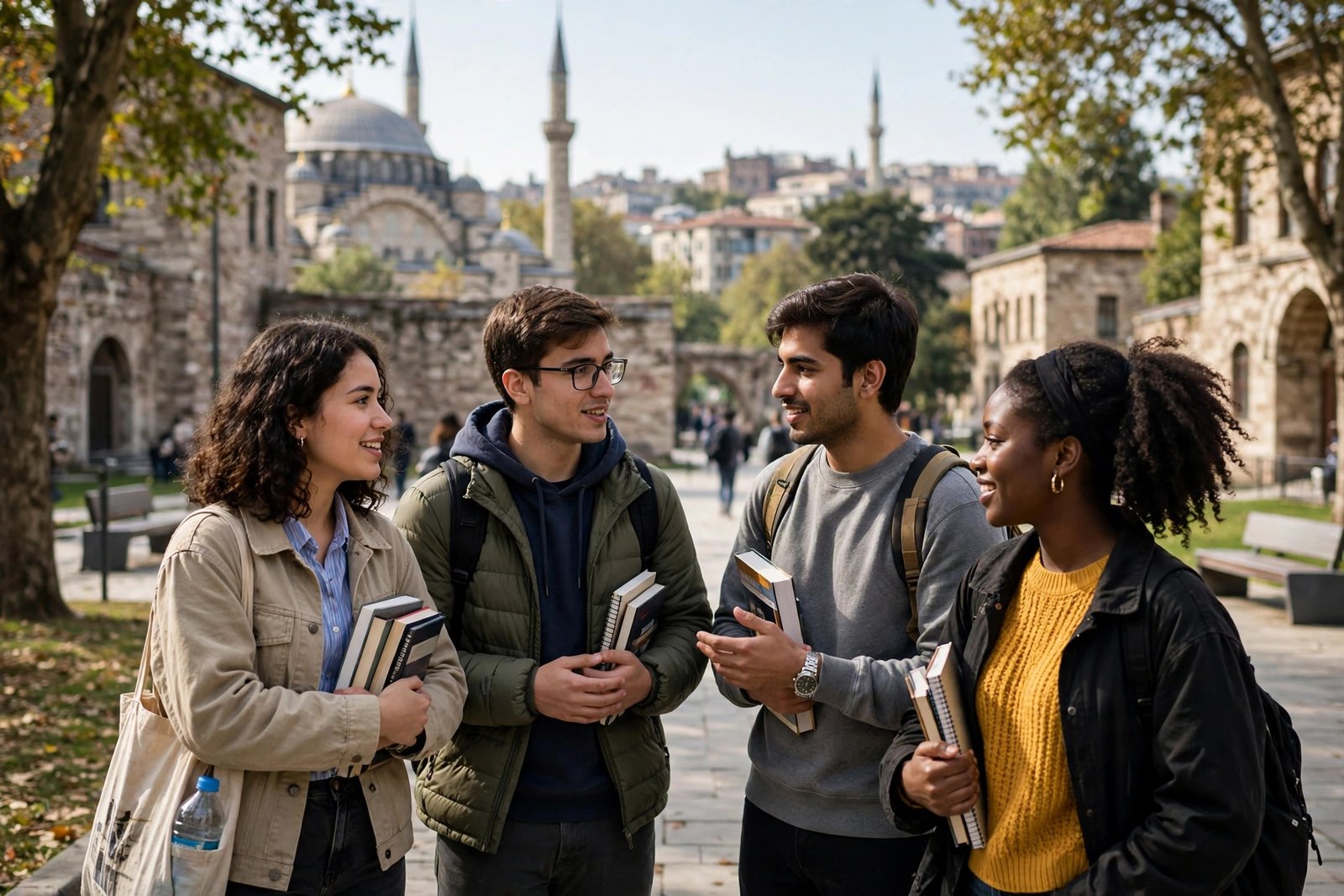
6. The Religion-Neutral Giants — Do Not Overlook Them
A list “for Muslim students” that stopped at Muslim-linked funders would quietly harm Muslim students, because the largest fully funded awards on earth are open to them on the same terms as everyone else. Germany’s DAAD pays €992 per month at master’s level under EPOS and €1,300 (rising to €1,400 from February 2026) at doctoral level — see the DAAD guide. The Eiffel Excellence Scholarship in France pays €1,200 per month at master’s level and €2,100 at doctoral level from January 2026 and covers international travel, though not tuition. Erasmus Mundus joint master’s degrees pay a monthly scholarship across two or more European countries — see the Erasmus Mundus guide. Australia Awards and the Research Training Program (AUD 34,315 in 2026; AUD 35,550 in 2027) fund students from partner countries, and Canada’s CGRS-D pays CAD 40,000 per year for 36 months to doctoral researchers at Canadian universities. Muslim students from Bangladesh, Pakistan, Indonesia, Nigeria and elsewhere hold these awards every cycle. Your faith is neither a key nor a barrier in any of them; your grades, experience and essays are the whole contest. Browse global rankings to choose target universities, including options such as the University of Melbourne and UNSW Sydney, on academic fit rather than on marketing aimed at any community.
Eligibility: Reading the Rules Correctly
Three eligibility questions decide every application in this guide. First: what is your country’s IsDB status? Citizens of member countries use the member-country schemes; Muslim students in non-member countries — India is the largest example, alongside Sri Lanka, Kenya, the Philippines, Nepal and others on the SPMC country list, which changes by cycle — use SPMC for undergraduate study at home. Citizens of the Least Developed Member Countries, including Bangladesh, have the widest IsDB access (ISFD, M.Sc. and MSP tracks). Second: do you meet the academic floors — science-subject grades for IsDB undergraduate schemes, 70–90% thresholds for Türkiye depending on level and field, CGPA 3.00+ for Malaysia, 95% for Qatar University’s international scholarship? Third: can you accept the funding model? SPMC and ISFD are interest-free loans repaid to a local trust after employment; M.Sc. and MSP are grants but require institutional nomination, so a lone application sent directly to Jeddah goes nowhere — your university or employer is part of the application. Across all programmes: you generally cannot hold two scholarships at once, IsDB staff and their close relatives are excluded from IsDB schemes, and age limits are applied at the closing date without exceptions.
How to Apply, Step by Step
Step 1. Fix your category in writing: passport, IsDB country status, level, field. Step 2. Build a two-track list — IsDB (if eligible) plus at least three open awards (Türkiye, Malaysia, Brunei, Qatar, DAAD or Erasmus) — and record each official deadline from the funder’s own site. Step 3. For M.Sc. and MSP, secure your nominating institution early; nomination deadlines inside universities precede the IsDB deadline by weeks. Step 4. Prepare documents once, properly: certified transcripts and certificates, passport, language scores, references, and certified English or French translations where the funder requires them. Step 5. Apply only through official portals — the IsDB scholarship portal, the Türkiye Scholarships Application System, the MIS online system, Brunei’s Ministry of Foreign Affairs portal, Qatar University admissions. None of these charges an application fee for the scholarship itself; anyone charging you to “submit” is not the funder. Step 6. Prepare for interviews, which Türkiye and IsDB counterpart organisations both use, by being ready to explain your field, your results and — for IsDB schemes — how you will serve your community after graduation, a commitment written into those programmes’ design. Step 7. If you win an IsDB loan-based award, read the repayment undertaking in full before accepting; you are agreeing to repay a local Education Trust after employment, in easy instalments, so future students from your community can be funded.
Required Documents
Expect: a valid passport or national ID; secondary and degree certificates with full transcripts; evidence of language proficiency in the medium of instruction; two references (academic or institutional); a CV; a study or research proposal (mandatory for research degrees and for MSP/M.Sc. tracks); proof of financial need for IsDB schemes; medical fitness documentation after selection; and, for nominated programmes, the nomination letter from your institution and any governor’s-office endorsement your country requires. Documents not in the funder’s working languages need certified translations. Names must match across documents exactly.
Deadlines and Timeline
| Programme | Typical window | Notes |
|---|---|---|
| IsDB programmes | Call opens late in the year; recent postgraduate call closed 31 January 2026 | Confirm the current cycle on isdb.org; SPMC runs through national counterpart organisations |
| Türkiye Burslari | Mid-January to late February (2026 call closed 20 February 2026) | Interviews in summer; results around August; Turkish language year precedes the degree |
| Malaysia International Scholarship | Varies by cycle | Check the Ministry of Higher Education’s current call; figures differ between cycles |
| Brunei Government Scholarship | Mid-December to mid-February (2026/27 pattern) | Apply to both the MFA portal and the chosen university |
| Qatar University | Follows QU admission rounds (Fall and Spring) | Scholarship application sits inside the admissions process |
| DAAD EPOS / Erasmus Mundus | Course-specific, mostly autumn deadlines | Each course or consortium sets its own date — check the course page |
Where a 2027-cycle date had not been published at the time of writing, this guide gives the last cycle’s pattern and labels it as such. Build your calendar from the official page for your cycle, not from this or any other summary.
Tips to Strengthen Your Application
Apply on both tracks. Eligibility for IsDB says nothing about your chances at DAAD or Türkiye; serious applicants file three to five well-matched applications. Match the field lists. IsDB funds development-priority fields — medicine, engineering, agriculture, technology, education and related sciences; a brilliant application in an unfunded field still fails. Write the community-service element honestly. For SPMC and ISFD, commitment to serve your community after graduation is part of the programme’s stated purpose — describe real service and concrete plans, not slogans. Keep grades in science subjects strong. Undergraduate IsDB assessment looks at your major science results specifically. Use official information sessions. IsDB counterpart organisations, Türkiye’s scholarship outreach and university webinars explain each cycle’s exact expectations, free of charge.
Common Mistakes
The costliest mistake is inventing eligibility that does not exist: there is no general “Muslim scholarship” at Western universities, and emailing a university asking for one wastes the one enquiry that could have asked about real merit aid. Second is confusing IsDB’s loan and grant schemes — accepting SPMC or ISFD funding without understanding the repayment undertaking, or applying individually to MSP/M.Sc. programmes that only accept institutional nominations. Third is applying to the wrong country category: SPMC is for non-member countries and funds study in your own country, not a ticket abroad — applicants who miss that sentence misunderstand the entire programme. Fourth is using unofficial Türkiye or Malaysia “agents” or paying portal fees; every application route in this guide is free and direct. Fifth is relying on recycled stipend figures: Türkiye’s stipends, Malaysia’s thresholds and IsDB’s country lists are revised between cycles, and last year’s screenshot is not evidence.
Frequently Asked Questions
Are there scholarships exclusively for Muslim students?
Very few, and the main one is specific: the IsDB’s SPMC funds Muslim students in non-member countries for undergraduate study in their own country, as an interest-free loan. The other IsDB schemes are defined by member-country citizenship. Most scholarships Muslim students win — Türkiye, Malaysia, Brunei, Qatar, DAAD, Erasmus — are open to all faiths.
Is the IsDB scholarship free money?
It depends on the scheme. SPMC and IsDB–ISFD operate as interest-free loans (Qard Hasan) repaid after graduation and employment to a local IsDB Education Trust. The M.Sc. and Merit (MSP) programmes are grants but require institutional nomination. Read your scheme’s terms before accepting.
Can a Muslim student from India apply to IsDB?
Yes — through SPMC, the programme designed for Muslim communities in non-member countries, provided India is on the current cycle’s SPMC country list and you meet the age (24 or under), grades and financial-need criteria. SPMC funds undergraduate study at recognised universities in India, not overseas.
Does Türkiye Burslari require applicants to be Muslim?
No. Türkiye Scholarships is open to citizens of all countries except Türkiye itself, with academic thresholds (70% undergraduate, 75% graduate, 90% health sciences) and age limits. It is a Turkish government scholarship, not a religious one.
What does Qatar University’s international scholarship cover?
Per the university’s official page: tuition and textbook fee exemptions, a 500 QR monthly salary, student housing with campus transport, an annual round-trip air ticket and a residence permit under QU sponsorship — for undergraduates with a high school average of at least 95% who maintain a 3.0 GPA.
Can I hold an IsDB scholarship and another scholarship together?
Generally no. IsDB conditions exclude applicants receiving another scholarship during the study period, and most other funders impose the same rule. If you win two awards, you will normally have to choose one.
I am over the IsDB age limit. What are my options?
The open track has no single age wall: Malaysia allows master’s applications up to 40 and PhD to 45; Türkiye’s limits are under 30 (master’s) and under 35 (PhD); DAAD and Erasmus assess applications on academic grounds with programme-specific rules. Age limits are applied strictly where they exist, so match programmes to your actual age at the deadline.
Do I need to study Islamic studies to get these scholarships?
No. IsDB’s priority fields are development sciences — medicine, engineering, agriculture, computing, education and similar — and the other programmes fund all faculties. Islamic studies is one eligible field among many at institutions such as UNISSA in Brunei, not a requirement anywhere in this guide.
Sources & Verification
Checked against official sources: Islamic Development Bank programme documentation, including the SPMC programme document (isdb.org) for purpose, loan structure and community-service commitment, and IsDB programme summaries for the ISFD, M.Sc. and MSP schemes and their age limits; the official Türkiye Scholarships portal (turkiyeburslari.gov.tr) for coverage, thresholds, age limits and the January–February application window; Malaysian Ministry of Higher Education scholarship pages for MIS benefits (tuition plus RM1,500 monthly allowance), age caps and GPA requirements; Brunei Ministry of Foreign Affairs scholarship terms for the BND500/BND150 allowances, BND600 book allowance and age limits; and Qatar University’s official scholarship types page (qu.edu.qa) for the international students scholarship package and 95% requirement. DAAD and Eiffel figures follow the verified rates used across this programme (EPOS €992/month; doctoral €1,300 rising to €1,400 from February 2026; Eiffel €1,200/€2,100 from January 2026). Verified October 2026.
Disclaimer: StudyGraduate is an independent information portal, not an agency, funder or religious body, and it takes no position on matters of faith. Eligibility rules, country lists, stipend rates and deadlines change between cycles — always confirm the details on the official funder website before applying. Nothing here promises or implies selection, admission or visa approval, which rest solely with the funders, universities and authorities concerned.
✅ Eligibility Criteria
- Check the official website for full eligibility criteria for your country
🎁 Benefits
- See the official website for the complete list of benefits
⚙️ Application Process
- 1Check your eligibility on the official site
- 2Prepare your documents and statements
- 3Submit the online application before the deadline
- 4Complete interviews or assessments if shortlisted
- 5Await the final selection announcement
📅 Important Dates
Deadlines vary by country and intake. Check the official website for country-specific dates.
📄 Required Documents
- Valid passport
- Academic transcripts & certificates
- Statement of purpose
- Letters of recommendation
- CV / resume
Commonly required — confirm the exact list on the official site.
❓ Frequently Asked Questions

Ready to Take the Next Step?
Explore more scholarships and study opportunities around the world.
Browse Scholarships →