Scholarships for Ghanaian Students in UK 2026/2027
Scholarships for Ghanaian Students in UK 2026/2027 Ghanaian students are one of the UK’s longest-standing international communities, and for 2026/2027 the funding routes are unusually clear. Ghana appears on the eligible-country lists of both of the UK government’s flagship schemes — Chevening and the Commonwealth Scholarships — and on the British Council’s GREAT Scholarships country ... <a title="Scholarships for Ghanaian Students in UK 2026/2027" class="read-more" href="https://studygraduate.com/scholarship/scholarships-for-ghanaian-students-in-uk-2026-2027/" aria-label="Read more about Scholarships for Ghanaian Students in UK 2026/2027">Read more</a>
📖 Overview
Scholarships for Ghanaian Students in UK 2026/2027
Ghanaian students are one of the UK’s longest-standing international communities, and for 2026/2027 the funding routes are unusually clear. Ghana appears on the eligible-country lists of both of the UK government’s flagship schemes — Chevening and the Commonwealth Scholarships — and on the British Council’s GREAT Scholarships country list, which reserved ten £10,000 awards for Ghana in the 2026 programme. Add university scholarships at institutions across England, Scotland and Wales, and a well-prepared Ghanaian applicant has more genuine full-funding routes into the UK than into almost any other destination. This guide explains each route with the amounts, deadlines and eligibility rules verified against official sources, and shows you how to sequence the applications so that one deadline does not quietly destroy another.
Two honest notes before we begin. First, the flagship schemes are competitive and they are mostly for master’s study: Chevening funds one-year taught master’s degrees, Commonwealth Master’s Scholarships fund full-time taught master’s degrees, and GREAT Scholarships support one-year postgraduate study. Undergraduate funding in the UK for Ghanaian students exists mainly as partial university awards, so school-leavers should budget accordingly. Second, both flagship schemes are built around returning home: Chevening requires scholars to return to Ghana for at least two years after their studies, and Commonwealth Scholars sign an undertaking to return home before their student visa expires. These are development scholarships, and the selection panels read your application looking for the impact you will make in Ghana afterwards.
Start your research in the scholarships directory, compare institutions in the university directory, and use the rankings pages to understand how UK universities compare before you commit to the three course choices that schemes like Chevening ask for.
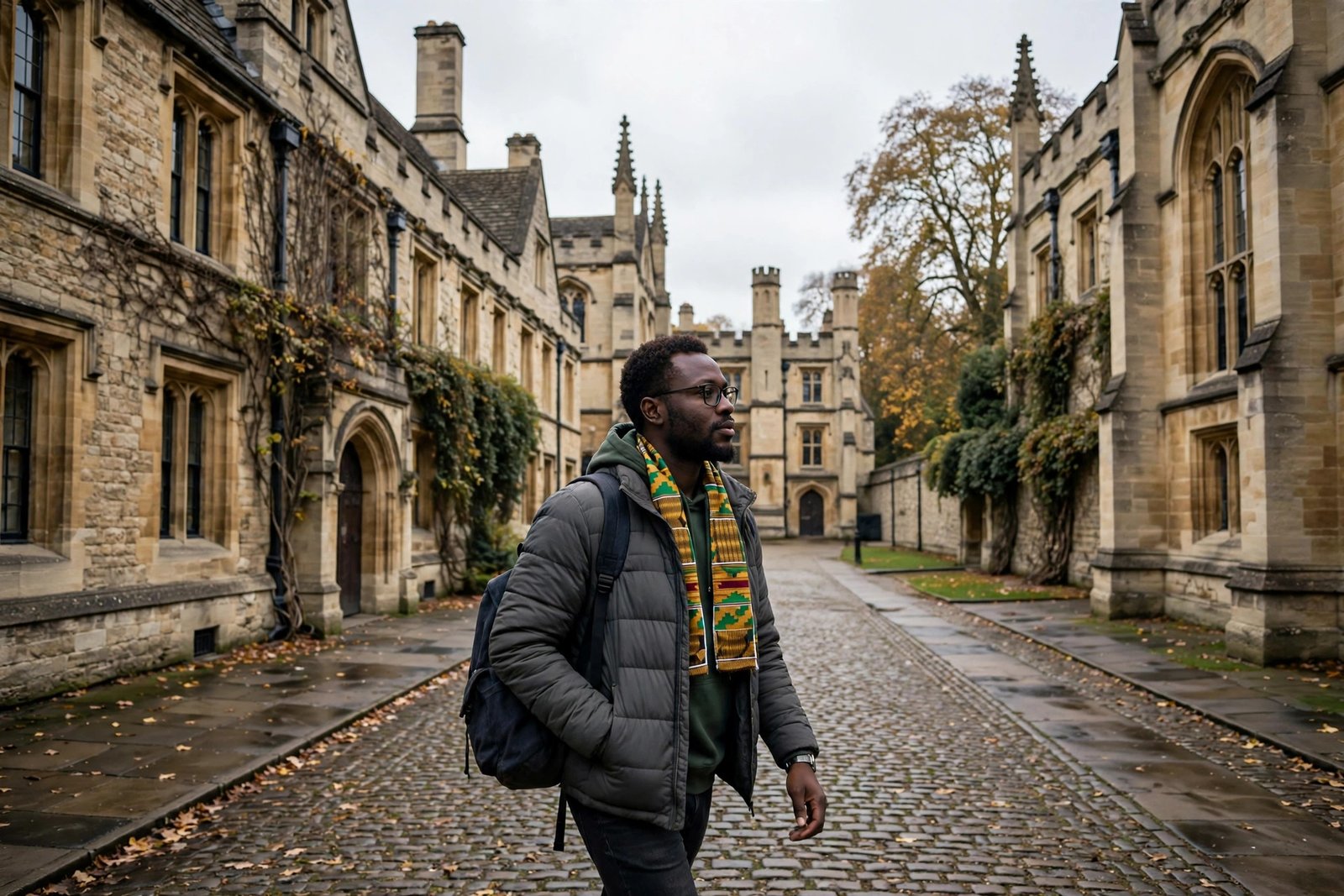
Scholarships for Ghanaian Students in the UK at a Glance
| Scholarship | Level | What it covers | Key dates / notes for Ghana |
|---|---|---|---|
| Chevening Scholarship | One-year master’s | Tuition, monthly stipend, economy return airfare, visa cost, arrival and departure allowances | 2027/28 applications opened 4 Aug 2026 and closed 6 Oct 2026; interviews Mar–Apr 2027; results from mid-June 2027 |
| Commonwealth Master’s Scholarship | Full-time taught master’s | Full tuition, approved return airfare, stipend £1,712/month (£2,000 in London), study travel grant, child allowance where eligible | 2027/28 applications close 16:00 BST, 20 Oct 2026; requires a nominator; results by July 2027 |
| Commonwealth Shared Scholarships | Selected master’s courses | Tuition, airfare and stipend, jointly funded by the CSC and the university | Ghana is on the eligible-country list; apply through participating universities for listed courses |
| GREAT Scholarships (British Council) | One-year postgraduate | £10,000 towards tuition fees | Ghana had 10 awards in the 2026 programme; apply through participating universities |
| University scholarships and bursaries | Undergraduate and postgraduate | Partial tuition awards; values vary by university | Deadlines set by each university; many assessed from your admission application |
Why Ghanaian Students Are Well Placed in the UK
Ghana’s position rests on verifiable lists, not optimism. The Commonwealth Scholarship Commission’s current eligible-country list for Master’s Scholarships includes Ghana by name, and Ghana also appears on the Shared Scholarships list. Chevening maintains a dedicated Ghana country page, and Ghanaian citizens meeting the scheme’s criteria — a degree that allows entry to a UK master’s, at least two years of work experience, and a commitment to return home — can apply in each cycle. The British Council’s GREAT Scholarships 2026 bidding announcement listed Ghana among its target countries, with each scholarship worth £10,000 (£5,000 from the British Council and £5,000 from the participating university). English-medium education in Ghana also removes one friction point: while each UK university sets its own English requirements, Ghanaian applicants often study on the same academic terms as home students in terms of language preparation, though you must still check whether your chosen course asks for a test score from you specifically.
Eligibility in Detail
Chevening (Ghana)
To apply for Chevening from Ghana you must be a Ghanaian citizen, hold an undergraduate degree that enables you to gain a place on a UK postgraduate programme, have at least two years (2,800 hours) of work experience, apply to three different eligible UK university courses, and receive an unconditional offer from one of those choices by the deadline Chevening sets (8 July 2027 for the 2027/28 cycle). You must not hold British or dual British citizenship, and you must agree to return to Ghana for at least two years after your award ends. The 2027/28 application window ran from 4 August 2026 to 6 October 2026; if you are reading this after that window, use the same calendar to prepare for the next cycle, because Chevening’s rhythm — August opening, early-October close, spring interviews, June results — is stable across years. Interviews for Ghanaian candidates are held at the British High Commission in Accra.
Commonwealth Master’s Scholarships (Ghana)
The Commonwealth Scholarship Commission (CSC) requires you to be a citizen of an eligible Commonwealth country — Ghana is listed — or a refugee or British Protected Person from one, and to be permanently resident in an eligible country. By September 2027 you must hold a first degree of at least upper second-class (2:1) standard, or a lower second-class degree plus a relevant postgraduate qualification. You must be unable to afford UK study without the scholarship, be available to start in September 2027, and submit all supporting documents in the required format by the deadline. There is no age limit, and the CSC does not require an IELTS test for the scholarship itself, although your university may set English conditions for admission. One critical structural point: the CSC does not accept direct applications for Master’s Scholarships in the sense of a standalone award — you must also apply to a nominator, either Ghana’s national nominating agency or one of the approved NGOs and charitable bodies, and nominators run their own selection and may set earlier closing dates before they forward nominations to the CSC by December 2026.
Shared and GREAT Scholarships
Commonwealth Shared Scholarships are tied to specific courses at participating universities; Ghana is eligible, and you apply through the university for a listed course. GREAT Scholarships require you to be a passport holder and resident of Ghana, hold an offer for a one-year postgraduate course at a participating university, and show motivation and engagement in your subject area; each award contributes £10,000 to tuition, so you still need a plan for living costs.
What the Flagship Awards Actually Pay
Chevening covers tuition fees, a monthly living stipend (the rate depends on whether you study in or outside London and is reviewed annually), economy return airfare to Ghana, the cost of one visa application, an arrival allowance and a departure allowance. It does not pay for dependants’ flights or visas, so families must budget separately. Commonwealth Master’s Scholarships provide approved tuition fees in full, approved return airfare, a stipend of £1,712 per month — or £2,000 per month if your university is in the London metropolitan area — a study travel grant, and, for scholars who are widowed, divorced or single parents, a child allowance of £622 per month for the first child and £154 per month for the second and third child under 16 living with you in the UK. These stipend figures are the CSC’s current published rates; the Commission may review them, and your Confirmation of Award states the rates that apply to you.
For self-funded or partially funded study, the UK Student visa financial requirement is the number that governs your planning. GOV.UK currently requires you to show £1,529 per month (for up to nine months) for courses in London and £1,171 per month outside London, plus your first year’s course fees as stated on your Confirmation of Acceptance for Studies (CAS), with the money held for at least 28 consecutive days ending within 31 days of your application. Note that these figures were updated from the £1,483/£1,136 rates that applied from January 2025 — always use the live GOV.UK page, because summaries elsewhere lag behind. Ghana is not on the differential evidence list, so Ghanaian applicants should expect to provide full financial evidence with the visa application.

How to Apply: A Step-by-Step Plan
- Choose your three master’s courses early. Chevening asks for three different eligible courses; Commonwealth asks you to name preferred universities and courses in order. Use programme pages at universities such as the University of Oxford and the University of Cambridge alongside strong specialist institutions, and check each course is a full-time taught master’s that the scheme will fund (the CSC, for example, does not fund MBAs).
- Apply to the universities in parallel. Scholarship selection does not replace admission. Apply for the courses themselves well before scholarship deadlines, because both Chevening and the CSC expect you to hold offers on their timetable.
- Submit Chevening online in the August–October window. The 2027/28 window closed on 6 October 2026. Write the four essays (leadership, networking, studying in the UK, career plan) around evidence from your work in Ghana, and keep your access code safe.
- Submit the Commonwealth application on CSC Central and to your nominator. The CSC deadline for 2027/28 is 16:00 BST on 20 October 2026 — 3:00 pm in Ghana. Contact your nominator early; their internal deadline may be earlier, and nominations reach the CSC by December 2026.
- Apply for GREAT and university awards through each university. These are separate applications with separate deadlines, typically in the spring before a September start.
- Prepare the visa file once you have your CAS. Hold the required funds for the full 28-day period at the current GOV.UK rates, and keep scholarship award letters with your evidence.
Required Documents
For Commonwealth Master’s applications, the CSC requires a copy of a valid passport or national ID showing your photograph, date of birth and citizenship; full transcripts of all higher education qualifications, including to-date transcripts for courses still in progress, with certified translations if they are not in English; and references from at least two individuals, in PDF, signed and on institutional letterhead or sent from an email that clearly shows the sender’s details — uploaded by the deadline, because late or missing documents make an application ineligible. Chevening requires your passport, degree certificate and transcripts, and details of two referees, with the unconditional offer to follow by its July deadline. For the Student visa, expect to provide your CAS, passport, financial evidence covering fees plus the monthly amounts above, and a tuberculosis test certificate from an approved clinic where required. Ghanaian applicants should also keep certified copies of degree certificates from their university and be ready to explain any name differences between documents.
Deadlines and Timeline for 2026/2027
| Date | Milestone |
|---|---|
| 4 August 2026 | Chevening applications for 2027/28 opened |
| 6 October 2026 | Chevening applications closed (11:00 UTC — 11:00 am in Ghana) |
| 20 October 2026, 16:00 BST | Commonwealth Master’s applications close on CSC Central (3:00 pm in Ghana); check your nominator’s earlier internal deadline |
| December 2026 | Nominators send Commonwealth shortlists to the CSC |
| Mid-February 2027 | Chevening interview shortlist announced |
| March–April 2027 | Chevening interviews, including at the British High Commission, Accra |
| From mid-June 2027 | Chevening results announced |
| By July 2027 | Commonwealth Master’s results sent to applicants |
| 8 July 2027, 17:00 BST | Chevening deadline to hold at least one unconditional UK university offer |
| September/October 2027 | Studies begin in the UK |
Selection Criteria and How to Improve Your Chances
The Commonwealth Scholarship Commission assesses applications on candidate merit including academic experience, the quality of the study plan, and — weighted heavily — the potential impact on the development of your home country. Its application form makes this concrete: a four-part Development Impact statement covering how your proposed study relates to development issues locally, nationally and globally, how you will apply the skills afterwards, what will change as a result and over what timeframe, and how that impact could be measured. Ghanaian applicants who do well write specifically: a named sector, a named problem in Ghana, a course whose modules answer it, and a realistic five-year plan. Chevening reads for leadership and influence, networking, why the UK and why these courses, and a career plan that returns value to Ghana. Both schemes reward evidence over adjectives — projects led, budgets handled, people trained, measurable outcomes — and both are weakened by generic claims about “giving back”.
Practical steps that move the needle: secure referees who know your work in detail and give them your draft impact statement early; align your course choices with one coherent story rather than three unrelated ambitions; apply to your universities early enough that offers are in hand within the schemes’ timetables; and for Commonwealth, engage your nominator months ahead, because the nomination stage is a competition of its own. If you are also weighing destinations, our guides to scholarships for Kenyan students in the UK, scholarships for Nigerian students in the UK and fully funded scholarships for African students show how the same schemes read for neighbouring countries.
Common Mistakes Ghanaian Applicants Make
- Applying only to the CSC and forgetting the nominator. A Commonwealth Master’s application without a nominator application cannot proceed; nominators may also close earlier than 20 October.
- Missing that Chevening needs an unconditional offer by 8 July 2027. Late university applications turn a successful Chevening selection into a lost award.
- Choosing an MBA or a part-time course for Commonwealth. The CSC funds one-year full-time taught master’s programmes and does not fund MBAs.
- Weak transcripts uploads. Missing pages or missing to-date transcripts make a Commonwealth application ineligible outright.
- Budgeting with old visa figures. The Student visa requirement is now £1,529 per month in London and £1,171 outside London on GOV.UK; older pages still show £1,483/£1,136.
- Treating GREAT as full funding. £10,000 towards tuition is valuable, but living costs and the remaining fees need a documented plan and a 28-day funds record for the visa.
- Paying an agent who promises a Chevening or Commonwealth award. Both schemes state that applying is free and selection cannot be bought; no third party can secure an award for you.
FAQs
Are Ghanaian students eligible for Chevening?
Yes. Chevening maintains a dedicated Ghana country page and Ghanaian citizens are eligible, provided they hold a degree that allows entry to a UK master’s, have at least two years (2,800 hours) of work experience, apply to three eligible courses, secure an unconditional offer by the scheme’s deadline, and agree to return to Ghana for at least two years afterwards. The 2027/28 window closed on 6 October 2026; watch chevening.org for the next cycle.
How much is the Commonwealth Scholarship stipend for 2027?
The Commonwealth Scholarship Commission’s current published rate is £1,712 per month, or £2,000 per month for universities in the London metropolitan area, alongside full tuition fees, approved return airfare and a study travel grant. Rates are quoted at current levels and may be reviewed; your Confirmation of Award confirms the rates that apply to you.
What is the Commonwealth Master’s deadline for Ghanaian applicants?
Applications for 2027/28 close at 16:00 BST on Tuesday 20 October 2026 on CSC Central — that is 3:00 pm in Ghana. You must also apply to a nominator, which may set an earlier deadline, so contact Ghana’s nominating agency or an approved NGO nominator well in advance.
Do I need IELTS for a Commonwealth Scholarship?
The CSC does not require applicants to take an IELTS test for the scholarship itself. Your university, however, sets its own English conditions for admission, so check the course page and meet any condition in your offer.
How much money must I show for a UK Student visa from Ghana?
Under the current GOV.UK rules, your first year’s course fees (as shown on your CAS) plus £1,529 per month for up to nine months if your course is in London, or £1,171 per month outside London, held for at least 28 consecutive days ending within 31 days of your application. Scholarship award letters can form part of this evidence for funded students.
Can I stay in the UK after a Commonwealth Scholarship?
Commonwealth Scholars sign an undertaking to return home before their student visa expires, and switching to a graduate or other visa to remain in the UK is not permitted under the award conditions. Chevening likewise requires return home for at least two years. Apply only if that commitment fits your plans.
Are there UK scholarships for Ghanaian undergraduates?
Fully funded undergraduate routes are rare. The realistic options are partial university scholarships and bursaries, which reduce tuition rather than cover everything, plus careful budgeting against the Student visa financial requirement. Postgraduate applicants from Ghana have far stronger options through Chevening, Commonwealth and GREAT.
What are GREAT Scholarships worth for Ghanaian students?
Each GREAT Scholarship is worth £10,000 towards tuition fees for a one-year postgraduate course at a participating university. Ghana was a target country with ten awards in the 2026 programme, jointly funded by the British Council/GREAT campaign and the universities; you apply through the university where you hold an offer.
Fields of Study and Choosing Where to Apply
Both flagship schemes organise choice around development themes rather than prestige. The Commonwealth Scholarship Commission frames its awards under six development themes — including science and technology for development, strengthening health systems, promoting innovation and entrepreneurship, and strengthening peace, security and governance — and Ghanaian applicants should choose courses that sit visibly inside a theme and answer a Ghanaian need: renewable energy and grid engineering for the energy sector, public health and health-systems courses for the Ghana Health Service and teaching hospitals, agricultural and food-security programmes, digital economy and data courses, and education leadership. Chevening does not restrict subjects in the same way, but its Ghana selection looks for candidates whose course choice advances shared UK–Ghana priorities, so a Ghanaian applicant in climate policy, creative industries, finance or governance should be able to explain that link in one sentence.
Course choice also has a hard technical edge. For Commonwealth, your three preferences are fixed at selection: the CSC will not change your university or course order afterwards except in exceptional circumstances, and if it cannot place you at the institutions you listed, the scholarship may not proceed — so include a realistic second and third choice at universities that have a part-funding agreement with the CSC, and apply for admission to those courses yourself in good time. For Chevening, your three courses can be at one university or three, but at least one must produce an unconditional offer by 8 July 2027. Ghanaian applicants often strengthen their file by mixing one ambitious choice with two strong, well-matched programmes where their grades and experience are clearly competitive, rather than naming three ultra-competitive courses and risking the offer deadline.
Budgeting Beyond the Scholarship
Even fully funded scholars face start-up costs: passport renewal, document certification, medical or TB testing where required, travel to Accra for interviews and biometrics, winter clothing on arrival (the Commonwealth scheme includes a warm clothing element within its arrangements for scholars from tropical countries, and Chevening pays an arrival allowance), and the first weeks before stipend payments settle into a monthly rhythm. GREAT scholars and self-funded students face the fuller version of this planning: tuition balance, the £1,529 or £1,171 monthly visa requirement held for 28 days, accommodation deposits, and flights. Build a simple month-by-month budget for your first term, keep the scholarship award letter together with bank evidence so a caseworker can reconcile the two, and remember that funds held for the visa must remain available — spending the evidenced money before you travel undermines the application you have just made.
Ghanaian applicants should also think a year beyond the award itself. Scholarship alumni networks — Chevening’s global alumni community and the Commonwealth Scholarship alumni association — are part of what the schemes are buying: they expect scholars to stay engaged, mentor later applicants and take visible roles in their sectors back home. Mentioning a realistic intention to do this, grounded in organisations you already belong to in Ghana, is more persuasive than promising it in the abstract. It also shapes your course choice: a programme with a strong Ghanaian and West African alumni presence gives you referees, collaborators and employers for the decade after the scholarship, which is precisely the horizon both selection panels are assessing when they read your career plan.
Sources & Verification
Facts in this guide were verified at the time of writing against official sources: the Commonwealth Scholarship Commission’s Commonwealth Master’s Scholarships page (eligible countries including Ghana, 20 October 2026 deadline, £1,712/£2,000 stipend, documents and nomination rules) at cscuk.fcdo.gov.uk and its Shared Scholarships pages; Chevening’s Ghana country page at chevening.org and the official 2027/28 application timeline; the British Council’s GREAT Scholarships 2026 announcement (Ghana among target countries, £10,000 per award); and GOV.UK’s Student visa money page at gov.uk/student-visa/money (£1,529 London / £1,171 outside London, 28-day rule). Useful planning tools are in our tools section and test preparation pages.
Disclaimer: Scholarship amounts, deadlines and visa requirements change between cycles. Always confirm the current details on the official Chevening, CSC, British Council and GOV.UK pages before applying. StudyGraduate is an information portal, not an agency; we cannot promise selection, admission or a visa outcome for any applicant.
✅ Eligibility Criteria
- Check the official website for full eligibility criteria for your country
🎁 Benefits
- See the official website for the complete list of benefits
⚙️ Application Process
- 1Check your eligibility on the official site
- 2Prepare your documents and statements
- 3Submit the online application before the deadline
- 4Complete interviews or assessments if shortlisted
- 5Await the final selection announcement
📅 Important Dates
Deadlines vary by country and intake. Check the official website for country-specific dates.
📄 Required Documents
- Valid passport
- Academic transcripts & certificates
- Statement of purpose
- Letters of recommendation
- CV / resume
Commonly required — confirm the exact list on the official site.
❓ Frequently Asked Questions

Ready to Take the Next Step?
Explore more scholarships and study opportunities around the world.
Browse Scholarships →