Nursing Scholarships in Australia for International Students 2026–2027
Nursing Scholarships in Australia for International Students 2026–2027 Nursing is one of the most practical study choices an international student can make in Australia — and one of the most misunderstood when it comes to money. The misunderstanding runs in both directions. Optimists assume that because Australia needs nurses, nursing degrees must be cheap or ... <a title="Nursing Scholarships in Australia for International Students 2026–2027" class="read-more" href="https://studygraduate.com/scholarship/nursing-scholarships-in-australia-for-international-students-2026-2027/" aria-label="Read more about Nursing Scholarships in Australia for International Students 2026–2027">Read more</a>
📖 Overview
Nursing Scholarships in Australia for International Students 2026–2027
Nursing is one of the most practical study choices an international student can make in Australia — and one of the most misunderstood when it comes to money. The misunderstanding runs in both directions. Optimists assume that because Australia needs nurses, nursing degrees must be cheap or automatically funded; they are not. Pessimists assume scholarships are only for PhD researchers; they are not either. The truthful picture is a layered one: a small number of genuinely full scholarships (above all the Australian Government’s Australia Awards), a broad middle layer of university fee-reduction scholarships that cover a percentage of tuition, research funding for the small group who take nursing into a master’s by research or PhD, and — unique to nursing — a professional registration system that decides whether your degree can turn into a licence to practise at all.
This guide covers nursing scholarships in Australia for international students for the 2026–2027 cycle at every level: the Diploma of Nursing, the Bachelor of Nursing, graduate-entry master’s degrees for students whose first degree is in another field, coursework master’s degrees for already-registered nurses, and research degrees. It is written for international students — including applicants from Bangladesh, India, Pakistan, Nepal, the Philippines, Indonesia, Nigeria and Kenya, who make up a large share of Australia’s nursing classrooms. Read the registration section as carefully as the money sections: in nursing, the scholarship is only half the plan. You can survey the full funding landscape in our scholarship directory, shortlist institutions in the university directory, and compare related fields through our guide to nursing scholarships for international students worldwide.
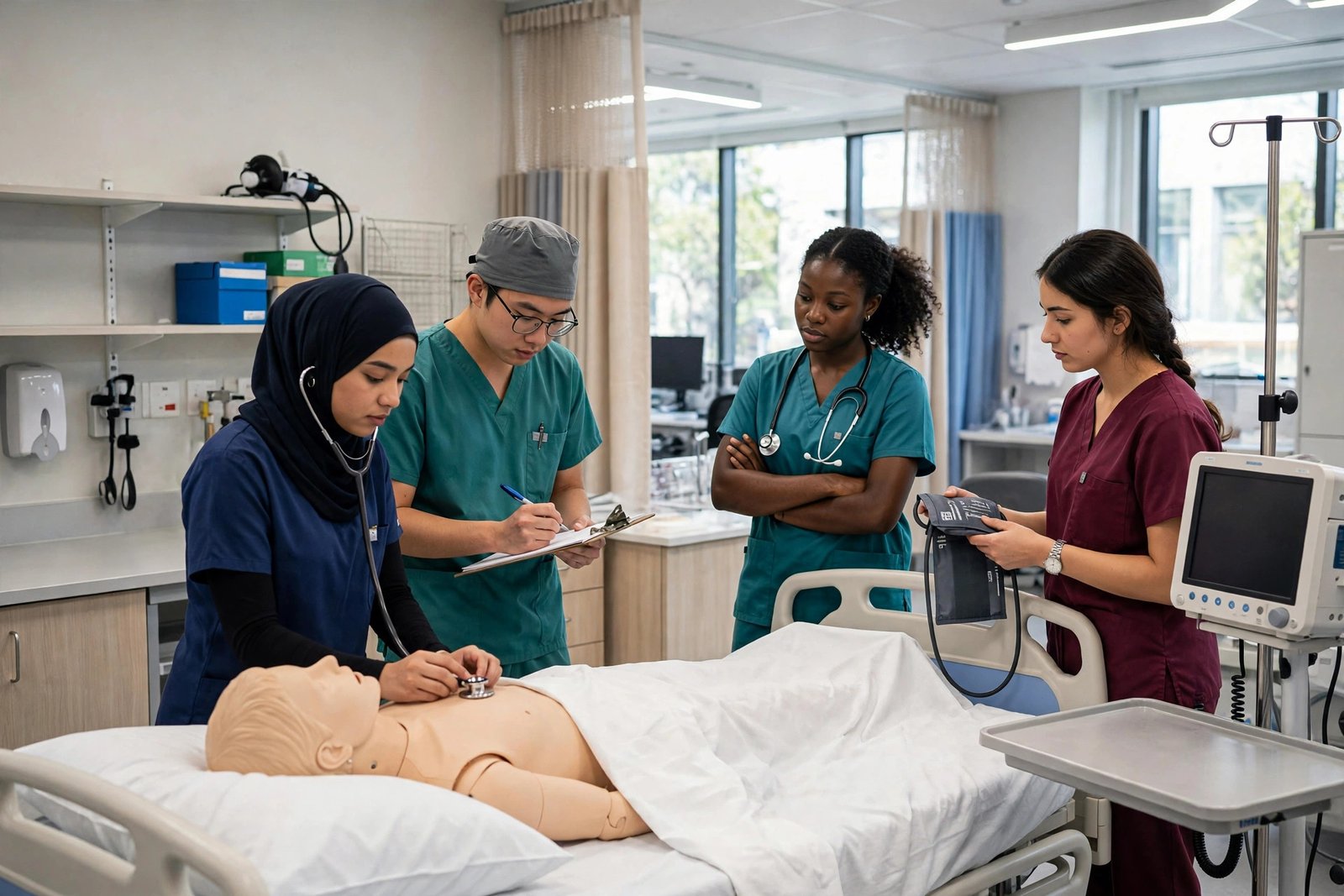
Nursing scholarships in Australia at a glance
| Scholarship / route | Level | What it covers | Who it fits | Key timing |
|---|---|---|---|---|
| Australia Awards Scholarships (Australian Government, DFAT) | Bachelor’s, master’s & PhD at participating universities | Full tuition, return airfare, establishment allowance, fortnightly contribution to living expenses, OSHC, introductory academic programme | Citizens of participating countries applying from their home country, with a development-impact case | Applications open 1 Feb and close 30 Apr each year (country rules vary) |
| Research Training Program (RTP) | Master’s by research & PhD only | Fee offset plus stipend at the base rate of AUD 34,315 (2026) / AUD 35,550 (2027); universities may pay more, up to the published maximum | Nursing graduates pursuing research — e.g. aged care, chronic disease, workforce studies | University rounds, mostly mid-to-late 2026 for 2027 starts |
| University international scholarships (e.g. Melbourne International Undergraduate Scholarship) | Undergraduate & coursework postgraduate | A percentage fee remission for the duration of the degree (Melbourne: 25% for recent intakes, 20% for students commencing in 2027) | High-achieving international applicants; usually automatic consideration with the course application | Tied to course application rounds for each semester |
| Faculty and nursing-school scholarships | All levels | Smaller fixed amounts or percentage reductions, set faculty by faculty | Students enrolled in a specific nursing programme | Set by each faculty — check at offer stage |
| Destination Australia | — | Closed. Federal funding ceased on 1 July 2024; it is not an open route for 2026–2027 | No new applicants | Do not plan around it, whatever older websites say |
Notice what the table does not contain: a national “nursing scholarship” open to every international nursing student, because Australia does not run one. Your funding will come from one of the layers above, and for most students it will be the university layer — a percentage off tuition rather than a full ride. That makes the arithmetic in the benefits section below the most important part of this guide: a 20–25% remission on a nursing degree is real money, but it is not full funding, and your visa financial evidence must still cover the rest.
Eligibility: admission, registration and scholarship rules are three different gates
Nursing applicants face three separate eligibility systems, and confusing them is the root of most bad decisions in this field.
Gate 1 — university admission. For the Bachelor of Nursing you need secondary schooling equivalent to Australian Year 12, usually with science preparation, and English at the level the university sets for nursing — for accredited nursing programmes this is typically higher than for a business degree, commonly around IELTS 7.0, because the programme leads to registration. Graduate-entry master’s degrees (such as a Master of Nursing Science or Master of Nursing Practice) require a bachelor’s degree in any field, sometimes with a human anatomy/physiology prerequisite. Coursework master’s degrees for registered nurses require an existing nursing qualification and, often, registration or clinical experience in your home country.
Gate 2 — professional registration with the Nursing and Midwifery Board of Australia (NMBA), through Ahpra. To work as a registered nurse or enrolled nurse in Australia you must graduate from an NMBA-approved programme and meet the Board’s registration standards, including its English language skills standard. Under the standard as updated in April 2026, the IELTS Academic benchmark is an overall 7.0 with at least 7.0 in listening, reading and speaking and 6.5 in writing; the Board also accepts OET, PTE Academic, TOEFL iBT and Cambridge English with their own score requirements, and there is an exemption pathway for applicants whose schooling and nursing qualification were taught and assessed solely in English in a recognised country. The practical consequence: choose an approved programme and treat English as a degree-long project, not a one-off admission hurdle — the score you need at registration is higher than the score many universities ask for at entry to non-nursing degrees. Always confirm the current score table on the official Ahpra/NMBA publications before you book a test, because the Board revised its score mapping in April 2026.
Gate 3 — the scholarship’s own rules. Australia Awards applicants must be citizens of a participating country, apply from that country, meet their country programme’s age, work-experience and priority-field rules, and accept the scholarship’s conditions — including the requirement to return home for at least two years after the award. Recent participating-country lists include Bangladesh, Nepal, Pakistan, Sri Lanka, Indonesia, the Philippines, Vietnam, Nigeria, Ghana, Kenya and many Pacific nations, but the list is set per intake on the official site; if your country is not listed for your intake, the award is simply not available to you that year. RTP eligibility turns on research merit and on the university’s own round rules. University percentage scholarships turn on your academic results and, in some cases, your country of citizenship — Melbourne’s undergraduate scholarship, for example, is restricted to citizens of countries under a World Bank GDP-per-capita threshold and requires an unconditional offer.
Two further nursing-specific requirements surprise applicants. First, clinical placements are compulsory and unpaid, and before your first placement you must complete compliance checks — typically a police check, immunisation records and a state Working with Children Check — at your own cost and on the university’s timetable. Second, those placements run in blocks across the degree, which limits how much paid work you can realistically do alongside study; budget on the visa work-hour limit as a ceiling, not a target.
Benefits: what the money actually looks like
Australia Awards is the only route in this guide that is designed to make a nursing degree cost you nothing. The official benefit set is: full tuition fees, return economy air travel, a one-off establishment allowance on arrival, a Contribution to Living Expenses paid fortnightly at a rate set by the Department of Foreign Affairs and Trade (DFAT), an Introductory Academic Program before your course starts, Overseas Student Health Cover (OSHC) for the scholarship’s duration, pre-course English training where DFAT judges it necessary, supplementary academic support, and fieldwork support for eligible research students. Because nursing is a health and care-economy priority in many partner countries, nursing and related health degrees regularly appear in country priority lists — check yours. Our full walkthrough of the programme is the guide to Australia Awards Scholarships 2027.
RTP is narrower but generous within its niche: it funds higher degrees by research only. A nursing academic or clinician-researcher taking a PhD can receive a full fee offset plus a living stipend. The Australian Government’s base stipend rate is AUD 34,315 per year for 2026, rising to AUD 35,550 for 2027, with a published maximum of AUD 53,608 (2026) / AUD 55,537 (2027) — universities set their actual rate between base and maximum, and some add OSHC and relocation allowances, so compare university pages rather than assuming the base rate. Details are in our RTP scholarship guide.
University percentage scholarships are the realistic core for most nursing students. The pattern repeats across the sector: an automatic or application-based fee remission — commonly in the 15–25% range for international coursework students at many universities, with the exact value, duration and renewal conditions published on each university’s scholarships page. At the University of Melbourne, for instance, the Melbourne International Undergraduate Scholarship has offered a 25% fee remission for recent intakes and moves to 20% for students commencing in 2027, with automatic consideration once you hold an unconditional offer — and note that Melbourne’s route into nursing is its graduate Master of Nursing Science, so undergraduates should read the fine print of any “undergraduate” award against the degree they will actually take. Multiply the percentage by the full remaining tuition before you celebrate: 20% off a three-year nursing degree still leaves 80% of tuition, plus living costs, OSHC, placement compliance costs and travel, to be funded and evidenced.
What no scholarship here does: pay for your dependants’ costs in any routine way, guarantee you clinical placement income (placements are unpaid), or guarantee registration, a job or a visa outcome after graduation. Post-study work and migration settings for nurses change with government policy; treat any website that sells a nursing degree as a guaranteed migration outcome as a warning sign, and use the planning material in our study-abroad hub to check the current official position.

Programmes and fields: choosing the right nursing degree
Diploma of Nursing (Enrolled Nurse). A vocational qualification, commonly around 18–24 months, leading to registration as an enrolled nurse who works under the direction of a registered nurse. Scholarship support at this level is the thinnest — some TAFEs and private providers offer small international bursaries — so model the full cost honestly.
Bachelor of Nursing (Registered Nurse). The standard three-year route to RN registration and the degree most Australia Awards and university-scholarship nursing students take. Clinical placement hours are substantial and increase each year. This is the level where percentage scholarships have the largest absolute value, because the tuition base is largest.
Graduate-entry master’s (Master of Nursing Science / Nursing Practice). A two-year route for graduates of other disciplines to become registered nurses. It is intensive — the same registration outcome in compressed time — and a popular choice for career-changers from Bangladesh, India and the Philippines whose first degrees are in science, allied health or even unrelated fields. Check each programme’s prerequisite subjects (human anatomy and physiology is the common one) a full year ahead, because bridging subjects take a semester to complete.
Coursework master’s for registered nurses. Degrees in areas such as advanced practice, critical care, emergency, mental health, midwifery (where separately structured), nursing education and health leadership. These build a career; they do not create initial registration for someone who is not already a nurse. Funding is mostly the university percentage layer, plus employer support for nurses already working in Australia.
Research degrees (Master’s by Research and PhD). The RTP route above. Nursing research in Australia is strong in aged care, chronic disease management, patient safety, digital health and workforce studies — and it connects naturally to public health, which is why many nurse-researchers also read our guide to public health scholarships in Australia.
How to apply, step by step
- Decide your registration goal first. Enrolled nurse, registered nurse via a bachelor’s, registered nurse via a graduate-entry master’s, specialist via a coursework master’s, or researcher via a PhD — the degree, the cost and the funding layer all follow from this one decision. Confirm the programme is NMBA-approved on the official approved-programmes list.
- Check your country against the Australia Awards list. If your country participates and nursing (or health) is a priority field for your intake, the 1 February – 30 April window becomes your most important deadline of the year. Read your country profile in full — age limits, work-experience expectations and priority fields differ by country.
- Apply for the degree. Submit course applications to two or three universities whose nursing programmes, locations and fee levels fit your budget at the scholarship-adjusted price, not the headline price. Note each university’s international scholarship rules at the same time — many are automatic with the offer, but some require a separate form or an early acceptance date.
- Plan English as a two-stage project. Stage one is the admission score your university requires. Stage two is the NMBA registration standard (IELTS Academic overall 7.0, with 7.0 in listening, reading and speaking and 6.5 in writing, under the April 2026 score update — or the Board’s accepted equivalents). If your current English is well below the registration benchmark, factor in language preparation time and cost before, not after, you enrol.
- Prepare placement compliance early. Gather immunisation records and any required vaccinations, and be ready for police and Working with Children checks once you are in Australia. Universities run hard deadlines for compliance before placements; missing one can delay your progression by a semester.
- Build the visa financial file. Your student visa application must evidence tuition, living costs at the rate published by the Department of Home Affairs at the time you apply, OSHC and travel — minus only the scholarship amounts that are documented in writing. A percentage scholarship letter is evidence for that percentage, not for the whole degree.
- Accept, enrol, and keep the scholarship conditions. Percentage scholarships normally require you to maintain a minimum grade average and full-time enrolment; Australia Awards carries academic-progress and return-home conditions. Read the conditions document before you sign — it, not the marketing page, is your contract.
Required documents (typical)
- Passport and, where relevant, previous visa history
- Academic transcripts and completion certificates, with certified English translations
- English test results meeting your university’s nursing entry requirement
- For graduate-entry master’s: evidence of prerequisite subjects (e.g. human anatomy/physiology) or a plan to complete them
- For Australia Awards: your country programme’s application form, referee reports, CV, and (for many countries) a statement of how your study supports your home country’s development priorities
- For RTP/research: research proposal, CV, and evidence of research output or experience
- Financial evidence for the student visa (bank records, sponsor evidence, scholarship letters)
- After enrolment: immunisation record, police check and Working with Children Check for clinical placements
Deadlines & timeline
| Milestone | Date | Notes |
|---|---|---|
| Australia Awards applications open | 1 February each year | Next window expected 1 Feb 2027 for the following intake — confirm your country profile |
| Australia Awards applications close | 30 April each year | Some countries set earlier internal dates; late applications are not considered |
| University course + scholarship rounds, Semester 1 2027 | Applications through late 2026 | Nursing intakes are commonly Semester 1 (Feb/Mar); some universities add a mid-year intake — check each programme |
| RTP rounds for 2027 research starts | University-set, mostly mid-to-late 2026 | Apply through the university’s graduate research school, not to the government |
| NMBA registration application | Final semester of your degree | English evidence must meet the Board’s standard current at that time |
| Destination Australia | Closed — funding ceased 1 July 2024 | Listed here only so you can ignore websites still promoting it |
How to improve your chances
- For Australia Awards, write to your country’s priorities, not your own biography. Selection panels score the development case: what health problem at home your nursing or health degree addresses, what role you will return to, and why Australia is the right place to prepare for it. A clinically excellent application with no return-home logic loses to a slightly weaker one with a credible plan.
- Choose placement-rich, approved programmes. A scholarship is worth little if the degree does not lead to registration. Verify NMBA approval, and look at how the university structures placements — early, well-supervised placements are where international students either settle or struggle.
- Lift English before you arrive. Every point of English headroom converts into placement confidence and registration safety. Students who arrive already near the registration benchmark (overall 7.0) can focus on nursing; students who arrive at the admission minimum spend the degree catching up on two fronts at once.
- Apply to more than one layer. Run Australia Awards (if eligible), two or three university applications with their automatic scholarships, and — if you are a researcher — an RTP round in the same season. The layers have different judges and different criteria; a “no” from one says nothing about the others.
- Use the planning tools. Our study-abroad tools, including the cost-of-living calculator and deadline tracker, help you model the real post-scholarship budget city by city — Sydney and Melbourne are not priced like Adelaide, Brisbane or regional campuses, and regional study sometimes carries its own university incentives (check each university’s current offers, and note that the old Destination Australia programme is closed).
Common mistakes
- Budgeting as if Destination Australia still exists. It closed to new funding from 1 July 2024. Any budget or agent pitch that includes it in 2026–2027 is out of date.
- Confusing admission English with registration English. Getting an offer does not mean you can register at graduation. The NMBA standard is separate, higher for many students, and was re-mapped in April 2026 — plan for the score in force when you graduate.
- Enrolling in a programme that is not NMBA-approved. Only approved programmes lead to registration. A cheaper, unapproved “nursing” diploma is an expensive dead end if your goal is to practise.
- Treating a 20% scholarship as “funded.” Percentage awards reduce tuition; they do not touch living costs, OSHC, compliance costs or the remaining 80%. Visa refusals for insufficient evidenced funds happen to scholarship holders who make this mistake.
- Forgetting placement costs and lost work hours. Unpaid placement blocks, uniforms, vaccinations, checks and travel to placement sites are real costs of a nursing degree, and placement weeks are not weeks you can fill with paid shifts.
- Applying for Australia Awards from the wrong place or with the wrong passport. You must be a citizen of a participating country and apply from that country; applying while already studying in Australia on another visa generally makes you ineligible. Check your country profile before assuming.
FAQs
Are there fully funded nursing scholarships in Australia for international students?
The clear fully funded route is the Australia Awards Scholarship: full tuition, return airfare, an establishment allowance, a fortnightly living-expense contribution and OSHC, for citizens of participating countries who meet their country programme’s rules. Outside Australia Awards, nursing funding is mostly partial — university percentage fee reductions — or research-only through RTP.
What IELTS score do I need to study nursing in Australia — and to work as a nurse afterwards?
They are different tests of the same language. Universities set their own entry scores for NMBA-approved nursing programmes, typically around IELTS 7.0. Registration with the NMBA requires you to meet the Board’s English standard: under the April 2026 update, IELTS Academic overall 7.0 with at least 7.0 in listening, reading and speaking and 6.5 in writing, or an accepted alternative test (OET, PTE Academic, TOEFL iBT, Cambridge) at the Board’s mapped scores, or an English-medium education exemption. Confirm the current table on Ahpra’s official publications before booking a test.
Can I study nursing in Australia if my first degree is not in nursing?
Yes — graduate-entry master’s degrees (such as the Master of Nursing Science and Master of Nursing Practice models) are designed for graduates of other fields and lead to registered nurse registration in about two years. Check prerequisite subjects, commonly human anatomy and physiology, well in advance, and confirm the specific programme is NMBA-approved.
How much is the RTP stipend for a nursing PhD in 2026–2027?
The Australian Government’s base RTP stipend rate is AUD 34,315 per year in 2026 and AUD 35,550 in 2027; universities may pay up to the published maximum (AUD 53,608 in 2026; AUD 55,537 in 2027) and decide their own rate, fee offset and allowances. RTP covers research degrees only — it does not fund a Bachelor of Nursing or a coursework master’s.
Is the Destination Australia scholarship still available for nursing students?
No. Destination Australia’s federal funding ceased on 1 July 2024 and it is closed to new applicants. Some universities run their own regional-campus incentives, which are separate university offers — check the university’s current scholarships page and do not rely on the closed programme’s name or amounts.
Does Australia Awards cover nursing, and when do applications open?
Yes — nursing and health fields appear in many countries’ Australia Awards priority lists, and the award covers full tuition, airfare, living-expense contributions and OSHC. Applications open on 1 February and close on 30 April each year for most participating countries, through the official Australia Awards site and your country profile; some countries vary the details, so your country page governs.
Can I work as a nurse in Australia straight after graduating?
Only after you are registered. Graduation from an NMBA-approved programme makes you eligible to apply for registration with the Board through Ahpra; you must meet all registration standards, including English, before you can practise as a registered or enrolled nurse. Registration is a professional decision, not an automatic consequence of your degree or scholarship — and no scholarship can promise it, or promise a visa or job outcome.
Are clinical placements paid?
No. Placements in Australian nursing degrees are compulsory, supervised learning and are unpaid. You must also meet compliance requirements — police checks, immunisation and a Working with Children Check — before attending, and you should budget for those costs and for reduced paid-work capacity during placement blocks.
Sources & Verification
- Australian Government Department of Education — Research Training Program student FAQs (fee offset, stipend and allowances; base stipend AUD 34,315 for 2026 and AUD 35,550 for 2027): education.gov.au
- Australia Awards — official country programme pages (benefits: full tuition, return airfare, establishment allowance, living-expense contribution, OSHC; applications 1 February – 30 April): australiaawardsphilippines.org (Philippines country programme; check your own country’s profile on the official Australia Awards site)
- Nursing and Midwifery Board of Australia — Registration standard: English language skills (effective 18 March 2025, with the Board’s accepted tests and exemption pathways; score mapping updated April 2026): NMBA English language skills registration standard (PDF)
- IELTS Australia — nursing registration and migration English guidance (IELTS Academic 7.0 overall; 7.0 listening, reading and speaking; 6.5 writing): ielts.com.au
Before you apply, re-check the two pages that decide your plan: your Australia Awards country profile (if you are eligible) and your chosen university’s scholarships page — then browse related fields in our guides section and the test-preparation pages for the English side of the plan.
Disclaimer: Scholarship amounts, stipend rates, English score requirements and deadlines change every cycle. Everything above was checked against official sources in October 2026, but you must confirm the current rules on the official programme, university and Ahpra/NMBA pages before applying. StudyGraduate is an information portal, not an agency; we cannot promise or guarantee admission, scholarship selection, professional registration or visa approval.
✅ Eligibility Criteria
- Check the official website for full eligibility criteria for your country
🎁 Benefits
- See the official website for the complete list of benefits
⚙️ Application Process
- 1Check your eligibility on the official site
- 2Prepare your documents and statements
- 3Submit the online application before the deadline
- 4Complete interviews or assessments if shortlisted
- 5Await the final selection announcement
📅 Important Dates
Deadlines vary by country and intake. Check the official website for country-specific dates.
📄 Required Documents
- Valid passport
- Academic transcripts & certificates
- Statement of purpose
- Letters of recommendation
- CV / resume
Commonly required — confirm the exact list on the official site.
❓ Frequently Asked Questions

Ready to Take the Next Step?
Explore more scholarships and study opportunities around the world.
Browse Scholarships →