Music Scholarships for International Students 2026–2027
Music Scholarships for International Students 2026–2027 Music scholarships work differently from almost every other kind of student funding, and understanding that difference early will save you a wasted application cycle. For most subjects, a scholarship committee reads your grades and your essays. For music, the decisive evidence is your playing, singing, composing or production work ... <a title="Music Scholarships for International Students 2026–2027" class="read-more" href="https://studygraduate.com/scholarship/music-scholarships-for-international-students-2026-2027/" aria-label="Read more about Music Scholarships for International Students 2026–2027">Read more</a>
📖 Overview
Music Scholarships for International Students 2026–2027
Music scholarships work differently from almost every other kind of student funding, and understanding that difference early will save you a wasted application cycle. For most subjects, a scholarship committee reads your grades and your essays. For music, the decisive evidence is your playing, singing, composing or production work — usually assessed through an audition, a recorded portfolio, or both. A violinist with modest school marks but an outstanding audition can win a full-fees conservatoire award, while a straight-A student whose audition is under-prepared will win nothing. This guide explains how music scholarships for international students actually work in 2026–2027: conservatoire audition awards in the UK and USA, the remarkable full-tuition conservatoires, Germany’s DAAD music scholarships, and the general government schemes — Fulbright, Chevening, Commonwealth, Eiffel and others — that musicians can also use when the field rules allow.
The audience for this guide is international students from Bangladesh, India, Pakistan, Nepal, Nigeria, Indonesia and beyond who are preparing for undergraduate, master’s or doctoral study in classical performance, composition, conducting, jazz, contemporary music, music production, music education or music research. Two warnings belong at the front. First, music funding is rarely called “fully funded” honestly: many awards cover tuition only, and you will still need to prove you can pay for housing, food, instrument insurance, travel and visa costs. Second, some famous schemes do not fit musicians in their current form — for example, the France Excellence Eiffel Scholarship’s seven eligible fields do not include music performance, and the AAUW International Fellowships’ most recent cycle focuses on STEM fields. We flag those traps explicitly below, because a realistic plan built on conservatoire awards plus one or two general schemes is far stronger than a hopeful plan built on schemes you cannot enter. Browse the wider scholarships directory and the university directory as you shortlist schools.

Music Scholarships at a Glance
| Scholarship or route | Level | What it pays (verified) | How it is decided |
|---|---|---|---|
| Curtis Institute of Music (Philadelphia, USA) | Undergraduate & graduate | Full-tuition scholarship for every admitted student; published value USD 55,995/year undergraduate and USD 69,527/year graduate for 2026–27; need-based aid also available for living costs | Audition only — admission is based on artistic promise; about 160 students in total |
| Yale School of Music (USA) | Graduate only | Full-tuition award plus a living fellowship for all admitted students (except those funded by another agency) | Audition and interview; highly selective, around 100 students admitted per year |
| Royal College of Music, London (UK) | Undergraduate & postgraduate | Scholarships range from a contribution towards fees up to full fees; more than 50% of students receive some support; ABRSM international awards at RCM cover full tuition plus a £5,000/year stipend for the selected international scholars | Every auditionee is automatically considered — no separate scholarship application; merit at audition (portfolio/interview for composers) |
| DAAD Study Scholarship — Performing Arts / Music (Germany) | Postgraduate | €992/month, travel allowance on application, one-off study allowance, insurance payments; possible rent subsidy and family allowance | Application to DAAD with artistic portfolio/audition materials; a German university place in the arts is mandatory in the scheme structure; DAAD does NOT cover tuition fees |
| Berklee College of Music (USA) & Berklee Valencia | Undergraduate & graduate | Merit-based scholarships awarded through the audition and interview process; Berklee Valencia publishes USD 1.5 million in merit- and need-based scholarships for graduate students | All applicants to full-time degree/diploma programmes are automatically considered for merit scholarships; no separate application for Boston undergraduate awards |
| General government schemes (Fulbright, Chevening, Commonwealth, MEXT, GKS, Australia Awards) | Mostly postgraduate | Varies by scheme — the strongest cover tuition, living stipend and travel | Academic record, leadership and essays; music is normally an eligible field, but check your country call |
| Australia RTP (research degrees in music) | Master’s by Research & PhD | Base stipend AUD 34,315/year (2026) / AUD 35,550/year (2027) plus tuition fee offset; universities may pay more | For research projects in musicology, composition or performance research — not for standard coursework performance degrees |
Eligibility: Who Can Apply?
For conservatoire scholarships, eligibility has two layers. The first is admission eligibility: the right prior qualification (a strong school-leaving qualification for undergraduate music degrees, a bachelor’s degree — usually in music — for master’s programmes, and a master’s for doctoral study), English-language evidence for your visa and course, and, for many UK conservatoires, an audition in the main round, which the Royal College of Music schedules in November–December. The second layer is scholarship eligibility, and here the news is good: at schools like the RCM, every student who auditions for a performance or composition course is considered for a scholarship automatically, with eligibility based on merit at audition or, for composers, the strength of the portfolio and interview. There is no separate form to miss — but there is also no second chance if your audition is weak, because the scholarship decision is made from that same performance.
Government schemes add their own rules on top. DAAD’s postgraduate music and performing arts scholarships are for graduates who have completed a first degree in the field and normally expect you to take up a postgraduate programme at a German university of the arts or a university with an arts profile; funding usually starts on 1 October of the following year. Fulbright, Chevening and Commonwealth awards are country-specific: you must be a citizen of an eligible country, meet that scheme’s work-experience or academic rules, and apply through your home-country call. Research-degree funding such as Australia’s RTP requires admission to a higher degree by research with a supervisor. And note the exclusions honestly: Eiffel’s eligible fields (biology and health; ecological transition; mathematics and digital; engineering sciences; French history, language and civilisation; law and political science; economics and management) do not include music, and AAUW’s latest published cycle is STEM-focused — so a music student should treat both as closed doors for 2026–2027 unless the official rules change, however many outdated blog posts suggest otherwise.
What Do Music Scholarships Cover — and What Do They Not?
Read every music award as a list of what is missing, not just what is included. Curtis is the clearest model of a tuition-only guarantee: tuition is free for all students — the published scholarship value for 2026–27 is USD 55,995 for undergraduates and USD 69,527 for graduate students — and Curtis separately offers need-based aid towards living expenses, but housing, food, fees and health insurance in Philadelphia are still real costs that you must plan and evidence. Yale School of Music goes one step further by pairing its full-tuition award with a living fellowship for admitted students, which is why it is one of the most competitive graduate destinations in the world. In the UK, RCM scholarships vary by design, “from a contribution towards your tuition fees right up to full fees”, so an offer letter saying “scholarship awarded” can mean anything from a few thousand pounds to your entire tuition — check the amount, the duration and the renewal conditions, not the headline. The ABRSM international scholarships tenable at the Royal Schools are unusually complete for the UK: at the RCM they cover full tuition fees plus a £5,000 per annum stipend for living expenses for the two selected international students (one undergraduate, one postgraduate), with nominations made from audition performance — but with so few awards, no applicant should treat them as a plan rather than a prize.
Germany deserves special attention from musicians on a budget. DAAD’s performing arts scholarship pays €992 per month plus insurance contributions, a one-off study allowance and a travel allowance on application, with possible rent and family supplements — and because most German public universities and music Hochschulen charge little or no tuition for standard programmes (exceptions exist, including non-EU fees in Baden-Württemberg and fee-charging special programmes), a monthly stipend can come much closer to true full funding in Germany than the same money would in London or Boston. DAAD states clearly, however, that it does not cover tuition fees where a programme charges them. If you study in Germany without a scholarship, the visa blocked-account requirement is €11,904 per year for 2026. In Canada, musicians on study permits must meet the general living-funds threshold — CAD 22,895 for applications from 1 September 2025 to 31 August 2026, rising to CAD 23,448 from 1 September 2026 — regardless of any partial award.
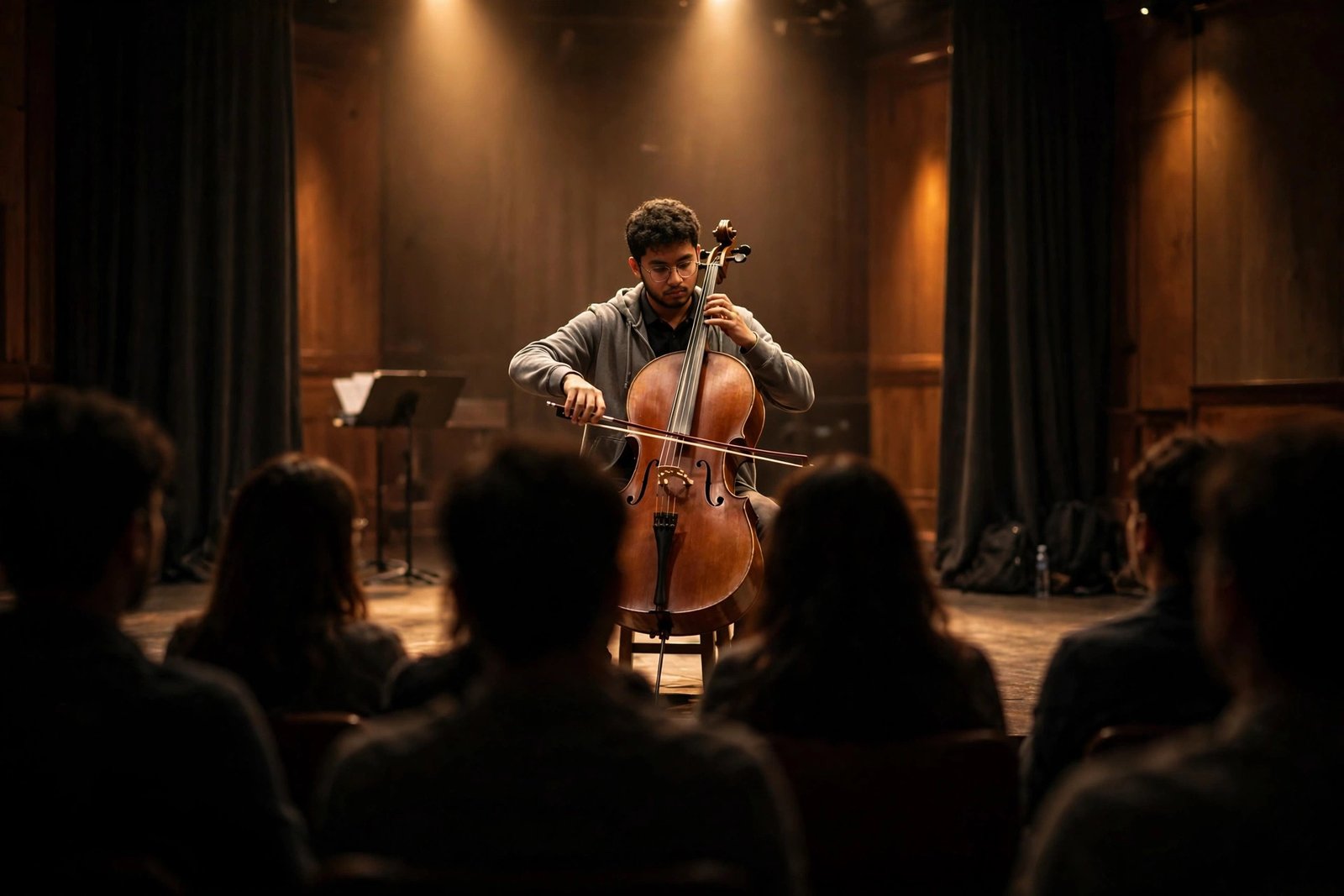
Programmes and Fields: Funding by Musical Path
Classical performance (instrumental and vocal). This is where audition scholarships are concentrated: conservatoires in London (Royal College of Music, Royal Academy of Music, Guildhall School, Trinity Laban), the USA (Curtis, Yale School of Music, Juilliard, New England Conservatory and university schools of music) and Germany’s Hochschulen all award fee support from the audition itself. Your strategy is a balanced list — one or two dream schools where full funding exists but places are counted in single figures per instrument, plus several strong schools where partial awards are more numerous — and an audition programme that shows range without exposing weaknesses. Singers should note that voice is the most age- and stage-sensitive discipline: check each school’s expectations for your voice type and repertoire languages.
Composition and conducting. Composers are usually judged on portfolio plus interview rather than a live performance audition — the RCM, for example, considers composers who audition by video interview for scholarships on the strength of portfolio and interview. Conducting places are few and often postgraduate-only, with funding tied to assistantships. In both fields, a professional-quality portfolio (scores, recordings of performances of your work, and for conductors, recent podium video) is your scholarship document.
Jazz and contemporary music. Berklee is the best-known destination, with merit scholarships decided through its audition and interview process for all full-time degree and diploma applicants, and songwriting/composition materials can also be submitted within the admissions application. Berklee Valencia’s graduate campus publishes USD 1.5 million in merit- and need-based scholarship support, which makes it a serious European option for contemporary and production-focused master’s students. University jazz programmes in the UK, Netherlands and Germany also award entrance scholarships — smaller, but real.
Music production, technology and business. These programmes sit inside universities more often than conservatoires, so the funding routes widen: general merit scholarships, country schemes such as Chevening and Fulbright, and university international awards all apply. If your goal is a master’s in production or music business, compare those general routes carefully before assuming you need a conservatoire. Our guide to media and communication scholarships covers adjacent funding for the creative industries.
Music research (musicology, ethnomusicology, performance science, music education). Research master’s and PhD students in music can access research-training funding that performers on coursework degrees cannot — Australia’s RTP (base stipend AUD 34,315 in 2026 and AUD 35,550 in 2027, plus fee offset) for projects with a research component, Canadian doctoral funding including the Canada Graduate Research Scholarship – Doctoral (CAD 40,000 per year for 36 months, replacing the discontinued Vanier, with up to 15% of awards open to international students enrolled at Canadian institutions), and UK doctoral loans and studentships in limited numbers. The RCM also runs specific research studentships — for instance, 1851 studentships on its MSc in Performance Science — though some are restricted to home-fee students, so read the fee-status rules before applying. Students headed for classroom teaching may also find the routes in our arts scholarships guide and education funding pages useful companions to this one.
How to Apply: Step by Step
- Choose your path honestly. Performance, composition, production and research are funded differently. Pick the path that matches your strongest evidence — audition, portfolio or academic writing — not the path that sounds most prestigious.
- Build a school list across funding tiers. Include full-tuition outliers (Curtis, Yale School of Music for graduates), audition-award conservatoires (RCM and its peers), Germany’s DAAD route, and at least two general-scheme options (Fulbright, Chevening, Commonwealth, MEXT or GKS, depending on your passport).
- Prepare the audition or portfolio first. Scholarship money follows the audition. Record practice auditions months ahead, work with a teacher on repertoire choice, and check each school’s exact recording specifications — file format, time limits, whether accompaniment is required, and whether prescreening exists.
- Hit the main audition round. For UK conservatoires the main round is typically in the autumn (RCM auditions run November–December, and ABRSM consideration requires auditioning in London in that main period). Late rounds exist at some schools but scholarship funds are usually thinner.
- Complete the academic file in parallel. Transcripts, references, English scores and — for general schemes — essays on leadership and career plans. Our test preparation guides help if you still need an English score.
- Apply for DAAD and government schemes on their own calendars. These deadlines do not align with conservatoire auditions; track them separately and start employer or referee requests early.
- Read the award letter like a contract. Amount, duration, renewal GPA or progress conditions, what happens if you change course, and whether the award can be combined with other funding.
- Prepare the visa money evidence. Even full-tuition scholars must show living funds in many countries. Keep bank documents consistent with your scholarship letters.
Required Documents
Expect to provide: passport; academic transcripts and certificates (with translations where needed); a CV focused on musical training, teachers, masterclasses, ensembles, competitions and performances; audition recordings or a live-audition confirmation, prepared exactly to each school’s specification; a composition portfolio with scores and recordings where relevant; two references, at least one from your principal-study teacher; a personal statement (for general schemes, a fuller set of essays); English-language scores where required; and financial documents for need-based aid or visa purposes — Curtis, for example, asks families of dependent graduate students for parental tax information as part of its need-based aid materials through the CSS Profile route it describes on its financial aid pages. Keep one master folder with identical, correctly named files so you are not re-recording or re-scanning under deadline pressure.
Deadlines and Application Timeline
| Route | Typical timing | Notes verified at write time |
|---|---|---|
| UK conservatoires (e.g. RCM) | Applications via UCAS Conservatoires in autumn; main auditions November–December | Scholarship consideration is automatic at audition; ABRSM international nominations come from main-round London auditions |
| US conservatoires & schools of music | Applications commonly due late autumn/early winter; prescreening recordings earlier | Curtis and Yale decide funding with admission — there is no separate full-tuition application at Curtis |
| DAAD Performing Arts / Music (Germany) | Annual DAAD call; funding usually starts 1 October of the following year | Check the DAAD database entry for your country’s deadline; €992/month; tuition not covered |
| Fulbright / Chevening / Commonwealth | Country calls, mostly autumn–winter for the following academic year | Deadlines are set per country; music applicants compete against all fields |
| Australia RTP (music research) | University rounds, often August–December | Only for research degrees; supervisor agreement usually needed first |
| Berklee | Rolling by term with audition/interview scheduling | Merit consideration is automatic for full-time degree/diploma applicants; Valencia graduate scholarships use the admissions portal |
How Music Funding Differs by Country
The same musician faces a completely different funding system in each destination. In the USA, funding lives inside the institution: a tiny number of full-tuition outliers (Curtis for all levels; Yale School of Music at graduate level), and elsewhere a negotiation of merit awards, assistantships and need-based aid decided with admission — which is why applying to only one American school is a financial gamble as well as an artistic one. In the UK, conservatoires award from the audition, amounts range from a fee contribution to full fees, and almost nobody should arrive expecting living costs to be covered by the conservatoire itself. In Germany, the DAAD performing arts scholarship (€992 per month) plus low public tuition at the Hochschulen produces the most predictable budget in Europe for postgraduate musicians. In Australia and Canada, serious money is concentrated in research degrees and national doctoral schemes rather than performance coursework. Choose the country whose system matches your level and your evidence, and the scholarship search becomes dramatically shorter.
Selection Criteria and How to Improve Your Chances
Audition panels reward three things: technical security, musical individuality, and teachability — evidence that you will use world-class teaching well. Choose repertoire you can perform under pressure over repertoire that merely looks impressive on paper; a polished, characterful performance of standard repertoire beats a shaky performance of the hardest piece in the book. Record your prescreening exactly as specified — panels do reject files for wrong formats and missing pieces. For composers, submit fewer, stronger works with good recordings rather than everything you have ever written. For general schemes, translate your musical life into their language: leading an ensemble, teaching younger students, organising community concerts and building a music programme at home are leadership and public-benefit evidence, not hobbies. Finally, apply widely but coherently: a focused list of six to eight schools and schemes, each with a properly prepared audition or portfolio, will outperform twenty rushed applications every time. You can compare institutions in the rankings section and read country funding detail via the study abroad hub.
Common Mistakes to Avoid
- Assuming “scholarship” means full funding. At many conservatoires it means a partial fee contribution. Always convert the offer into a full annual budget including living costs.
- Planning around Eiffel or AAUW as a musician. Eiffel’s field list excludes music, and AAUW’s recent cycle is STEM-focused. Do not spend your season on closed doors.
- Missing the main audition round. Scholarship budgets are allocated from the main round at most UK conservatoires; late auditions compete for what is left.
- Recording the audition casually. Poor audio, wrong repertoire, missing scales or spoken introductions where required — each is an unforced error panels cannot ignore.
- Forgetting instrument costs. Insurance, maintenance, bows, reeds, strings and travel with an instrument (including airline cabin rules for cellos and larger instruments) belong in your budget.
- Ignoring Germany. DAAD’s €992/month plus low public tuition is one of the most realistic near-full-funding combinations for postgraduate musicians.
- Believing outdated Vanier information. Vanier is discontinued; Canada’s doctoral route is now the CGRS-D at CAD 40,000 per year for 36 months.
Frequently Asked Questions
Can I get a full scholarship to study music abroad?
Yes, but the truly complete packages are rare and specific: Curtis gives every admitted student a full-tuition scholarship (published value USD 55,995 undergraduate and USD 69,527 graduate for 2026–27) with additional need-based help for living costs; Yale School of Music pairs full tuition with a living fellowship for graduate students; DAAD in Germany pays €992 per month in a low-tuition system. Most other awards are partial, so a realistic budget usually combines a conservatoire award with family funds, a general scheme or a smaller grant.
Do I need to apply separately for conservatoire scholarships?
Often not. At the Royal College of Music every auditionee for performance and composition courses is considered automatically, and Berklee considers all full-time degree and diploma applicants for merit scholarships through the audition and interview. But “automatic” cuts both ways: there is no later form to rescue a weak audition, so preparation is the application.
Are there music scholarships without an audition?
For performance degrees, effectively no — the audition (live or recorded) is the scholarship test. For music research, education and some production programmes, funding is decided on academic evidence and proposals instead, through routes such as Australia’s RTP for research degrees or general schemes like Fulbright and Chevening.
Does DAAD fund music students in Germany?
Yes. DAAD runs a dedicated study scholarship for postgraduate studies in the performing arts (including music), paying €992 per month plus insurance contributions, a one-off study allowance and a travel allowance on application, with possible rent and family supplements. DAAD does not cover tuition fees, and a place at a German arts institution is central to the scheme — check the current DAAD database entry for your country.
Can musicians apply for Chevening or Fulbright?
Generally yes — these schemes fund across fields for eligible countries, and musicians compete on academic record, leadership and career plan as well as artistry. Read your country call carefully: some country programmes prioritise particular fields in a given year. What you cannot do is assume every general scheme is open to music — Eiffel’s field list, for example, does not include it.
What about Destination Australia or Vanier that I saw on other sites?
Both are traps in older content. Destination Australia closed to new applicants when its funding ceased on 1 July 2024, and the Vanier Canada Graduate Scholarships have been discontinued and replaced at doctoral level by the Canada Graduate Research Scholarship – Doctoral (CAD 40,000 per year for 36 months). Treat any site still advertising them as open with caution.
How good do I need to be to win a conservatoire scholarship?
There is no published grade threshold — panels award on the audition in front of them. As a realistic benchmark, scholarship winners at top conservatoires are typically performing at a level well beyond standard diploma repertoire, with secure technique and a distinctive musical voice. The honest way to test yourself is a trial lesson or a teacher’s frank assessment before you pay application and travel costs.
Should singers and instrumentalists budget differently?
Yes. Singers often need language coaching and may mature later, which affects when a funded postgraduate place is realistic; instrumentalists carry instrument insurance, maintenance and travel costs, and pianists and organists depend on institutional practice facilities. Build these discipline-specific costs into the funding target you are trying to reach.
Sources and Verification
Key facts were checked in October 2026 against official sources: the Curtis Institute of Music financial aid page (full-tuition scholarships for all students since 1928; 2026–27 values USD 55,995 undergraduate and USD 69,527 graduate; need-based aid for living costs); the Yale School of Music study pages and Yale bulletin (full-tuition award plus fellowship for admitted students); the Royal College of Music scholarships page (automatic consideration at audition, awards from a fee contribution to full fees, ABRSM international awards covering full tuition plus £5,000 per year); the DAAD scholarship database entry for postgraduate performing arts (€992 per month, insurance, travel allowance on application, tuition not covered); Berklee’s official scholarship pages including Berklee Valencia scholarships and financial aid (USD 1.5 million in graduate merit- and need-based scholarships; automatic merit consideration through audition and interview); the Australian Government RTP guidance (base stipend AUD 34,315 for 2026 and AUD 35,550 for 2027); and Campus France/EURAXESS Eiffel field rules. If you are also weighing a broader creative degree, see our arts scholarships guide.
Disclaimer: Scholarship amounts, deadlines and eligibility rules change every cycle. Always confirm the details for your programme and your cycle on the official funder or university website before applying. StudyGraduate is an independent information portal, not an agency or a funder: we cannot promise or influence selection, admission or visa approval, and no legitimate scholarship requires you to pay an agent to be selected.
✅ Eligibility Criteria
- Check the official website for full eligibility criteria for your country
🎁 Benefits
- See the official website for the complete list of benefits
⚙️ Application Process
- 1Check your eligibility on the official site
- 2Prepare your documents and statements
- 3Submit the online application before the deadline
- 4Complete interviews or assessments if shortlisted
- 5Await the final selection announcement
📅 Important Dates
Deadlines vary by country and intake. Check the official website for country-specific dates.
📄 Required Documents
- Valid passport
- Academic transcripts & certificates
- Statement of purpose
- Letters of recommendation
- CV / resume
Commonly required — confirm the exact list on the official site.
❓ Frequently Asked Questions

Ready to Take the Next Step?
Explore more scholarships and study opportunities around the world.
Browse Scholarships →