KAIST International Scholarship 2027 in South Korea: Fully Funded Undergraduate & Graduate Guide
KAIST International Scholarship 2027 in South Korea: Fully Funded Undergraduate & Graduate Guide KAIST — the Korea Advanced Institute of Science and Technology — is South Korea’s flagship research university for science and technology, based in Daejeon, the country’s science city. For international students, its most important feature is not only its laboratories or its ... <a title="KAIST International Scholarship 2027 in South Korea: Fully Funded Undergraduate & Graduate Guide" class="read-more" href="https://studygraduate.com/scholarship/kaist-international-scholarship-2027-in-south-korea-fully-funded-undergraduate-graduate-guide/" aria-label="Read more about KAIST International Scholarship 2027 in South Korea: Fully Funded Undergraduate & Graduate Guide">Read more</a>
📖 Overview
KAIST International Scholarship 2027 in South Korea: Fully Funded Undergraduate & Graduate Guide
KAIST — the Korea Advanced Institute of Science and Technology — is South Korea’s flagship research university for science and technology, based in Daejeon, the country’s science city. For international students, its most important feature is not only its laboratories or its English-taught programs. It is the way funding is built into admission itself. The KAIST International Scholarship is awarded as part of the admission process to international students admitted to KAIST degree programs: there is no separate scholarship application to hunt down, no second portal, and no second deadline. You apply for admission, indicate your scholarship request within the admission application’s financial resources section, and the scholarship decision arrives with the admission decision.
The package, as KAIST presents it on its admissions scholarship pages, combines a full tuition waiver with a monthly living allowance and national health insurance support. The monthly allowance differs by level — the figures KAIST’s scholarship information is known for are KRW 350,000 per month for undergraduate and master’s students and KRW 400,000 per month for doctoral students, with graduate students in research laboratories often receiving additional support through their advisor’s projects. Because KAIST reviews and updates its published figures, this guide presents those amounts as the scholarship’s established structure and tells you plainly to confirm the current figures on KAIST’s official admissions pages for your intake — a habit that protects you with every scholarship, not only this one.
This guide covers the whole route in one place: who counts as an international applicant at KAIST, what the scholarship covers at undergraduate, master’s and PhD level and what it does not cover, the programs and colleges you can study in, the undergraduate Early, Regular and Late tracks and the graduate Spring and Fall tracks with the 2027 entry dates KAIST has published, the documents each level requires, how selection and scholarship renewal actually work, and the mistakes that cost applicants a funded place. You can see KAIST’s full profile in our directory at KAIST’s university profile, and compare this route with Korea’s government scholarship in our GKS Scholarship graduate guide.
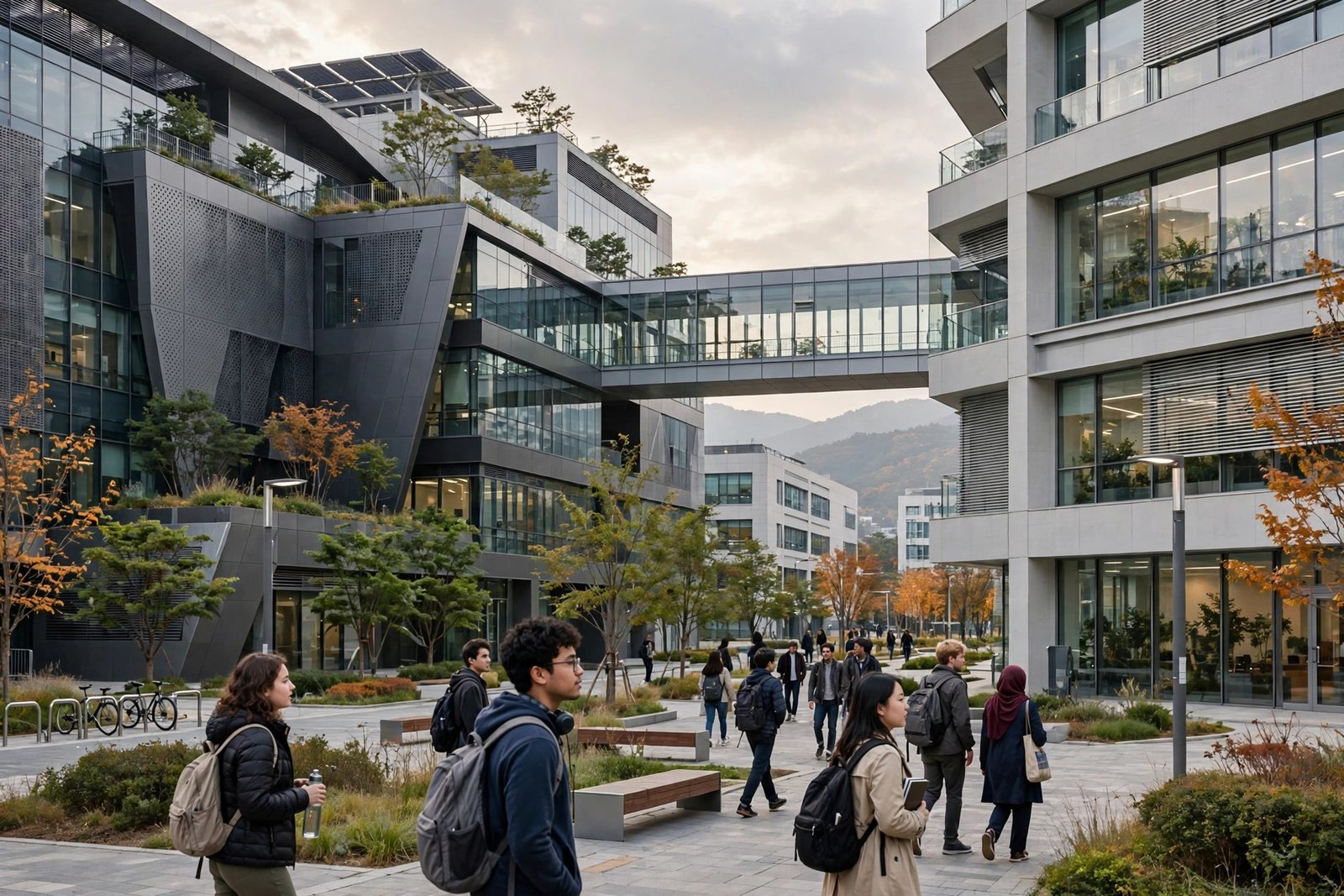
KAIST International Scholarship at a Glance
| Item | Details |
|---|---|
| University | KAIST (Korea Advanced Institute of Science and Technology), Daejeon, South Korea |
| Scholarship name | KAIST International Scholarship (undergraduate KAIST Scholarship; graduate KAIST Scholarship and related schemes) |
| Levels | Undergraduate (bachelor’s), master’s, integrated master’s–PhD, and PhD |
| Core benefit | Full tuition waiver for the standard duration of the degree |
| Monthly allowance | KRW 350,000/month undergraduate; KRW 350,000/month master’s; KRW 400,000/month PhD — as stated in KAIST scholarship information; confirm current figures for your intake on the official admissions site |
| Health coverage | National Health Insurance support included in the scholarship package |
| Separate scholarship form? | No — request the scholarship within the admission application (Statement of Financial Resources); admission and scholarship are decided together |
| Application fee | USD 80 / KRW 80,000 for admission, per KAIST’s published admission information (check the current guide for your track; fee-waiver routes exist for eligible applicants, including those from UN-listed least developed countries, under KAIST’s published conditions) |
| Language of instruction | English across KAIST programs; Korean proficiency (TOPIK) is not required for international admission |
| Renewal condition (undergraduate) | Maintain satisfactory academic standing — KAIST scholarship information specifies a minimum GPA of 2.7 out of 4.3 after the first year for undergraduate scholarship continuation |
Read the “no separate form” row twice, because it reverses the instinct most applicants bring from other scholarships. With KAIST, a brilliant scholarship essay sent to the wrong place achieves nothing; a complete, on-time admission application with the scholarship box properly indicated achieves everything. Your entire strategy is therefore an admissions strategy — strong academics, the right track, complete documents, and a financial resources statement that matches your situation.
Eligibility: Who Counts as an International Applicant
KAIST’s international admission is defined first by citizenship, and the rules are strict. For undergraduate international admission, applicants must hold foreign citizenship, and neither parent should be a Korean citizen. Applicants holding Korean citizenship — including dual citizenship — cannot apply through the international track. Applicants of Korean descent educated entirely outside Korea (elementary, middle and high school) may be eligible under KAIST’s published conditions; if that describes you, read the current admissions guide very carefully, because your document burden is different. Graduate international admission applies the same core principle: you apply as an international student on the basis of non-Korean citizenship, with a completed bachelor’s degree for master’s and integrated programs, and a master’s degree (or the integrated route) for doctoral entry.
On top of citizenship, you must meet the academic requirements of the level you are entering:
- Undergraduate: You must have graduated, or be about to graduate, from high school (or its equivalent) by the time of enrolment, with a strong record — KAIST is a science and technology university, and mathematics and science achievement carries particular weight. All admitted undergraduate students enrol as freshmen; KAIST does not operate a transfer-entry route in this track, and students enter without a declared major, choosing their department from the second year under KAIST’s undeclared-major system.
- Master’s and integrated master’s–PhD: You must hold, or be about to complete, a bachelor’s degree. Your background should support research in your target department; for many departments, identifying a prospective advisor whose laboratory matches your interests is an important part of a competitive application, even where formal pre-contact is not mandatory.
- PhD: You must hold, or be about to complete, a master’s degree, or enter through the integrated program. Research fit with a specific laboratory matters more at this level than at any other.
- English proficiency: KAIST programs are taught in English, and KAIST publishes minimum English test standards for international admission (TOEFL iBT, IELTS Academic, TOEIC or TEPS options, with scores valid within the published window), alongside waiver conditions — for example for applicants who completed their education in an English-medium context meeting KAIST’s criteria. Because thresholds and accepted tests are revised, take the exact numbers from the current admissions guide for your track rather than from any secondary summary, including this one.
One further eligibility point is financial rather than academic: even fully funded students must complete visa formalities, and KAIST’s guidance to admitted international students has included demonstrating a minimum bank balance for the student visa calculation after the scholarship value is counted. Treat this as an administrative step to prepare for with the admissions office’s current instructions, not as a hidden fee — and never let anyone charge you for “arranging” it.
Benefits and Coverage by Level
The scholarship’s spine is identical at every level — full tuition waiver, monthly allowance, health insurance support — while the allowance amount and duration follow the degree. The table below sets out the structure as KAIST presents it; amounts are the established figures from KAIST scholarship information and must be re-confirmed for your intake on the official admissions site, since universities revise stipend levels.
| Level | Tuition | Monthly allowance | Duration | Notes |
|---|---|---|---|---|
| Undergraduate | Full waiver | KRW 350,000 | Up to 8 semesters | Continuation requires satisfactory standing — minimum GPA 2.7/4.3 after the first year per KAIST scholarship information |
| Master’s | Full waiver | KRW 350,000 | Standard master’s duration (4 semesters) | Additional laboratory/research support may be provided through the advisor’s projects |
| Integrated MS–PhD | Full waiver | Per level as the program progresses | Standard integrated duration | Suited to bachelor’s graduates committed to doctoral research |
| PhD | Full waiver | KRW 400,000 | Standard doctoral duration | Research assistantship support from laboratories is common on top of the base allowance |
Three honest qualifications belong beside that table. First, the monthly allowance is a contribution to living costs in Daejeon — a comparatively affordable Korean city — covering dormitory-style living, food and local transport for a careful student; it is not a salary, and students who budget as if it were one run into trouble by mid-semester. Second, the scholarship does not include an international airfare component: travel to Korea, visa fees and your initial settlement costs are yours to plan for, unlike scholarship schemes that bundle flights. Third, graduate funding at KAIST is an ecosystem rather than a single cheque — beyond the base KAIST Scholarship, departments and laboratories support students through research projects, and KAIST also operates more selective named schemes at graduate level. What you are guaranteed by the standard scholarship is the table above; anything additional depends on your department and advisor, and should be confirmed in writing with the department rather than assumed from a website’s “up to” figures.

Programs and Fields of Study
KAIST organises its teaching through colleges that cover the core of modern science and technology. The College of Engineering includes Mechanical Engineering, Aerospace Engineering, Electrical Engineering, Computer Science, Civil and Environmental Engineering, Bio and Brain Engineering, Industrial Design, Industrial and Systems Engineering, Chemical and Biomolecular Engineering, Materials Science and Engineering, and Nuclear and Quantum Engineering. The College of Natural Sciences covers Physics, Mathematical Sciences and Chemistry. The College of Life Science and Bioengineering covers Biological Sciences and related brain and cognitive science fields. The College of Business covers Business and Technology Management, and KAIST’s liberal arts and convergence units add fields such as culture technology, digital humanities and science and technology policy at graduate level. Graduate applicants apply to a specific department or school; undergraduate applicants enter undeclared and choose their department after exploring in the first year — a system that rewards students who are strong across mathematics and science but not yet certain which branch they want.
Fit matters more than fashion when you choose. A graduate applicant whose bachelor’s project and any publications align with a KAIST laboratory’s current research will outcompete a nominally stronger applicant whose interests match nothing the department is doing. Before applying, read the department pages, follow the laboratory links, and read two or three recent papers from the group you hope to join; your statement of purpose should be able to name the problems that group works on and explain what you would contribute. Undergraduate applicants cannot name a laboratory in the same way, but they can show genuine, evidenced engagement with science and technology — olympiads, projects, coding, research experience, competitions — rather than generic enthusiasm. For a broader comparison of Korean study routes, see our study abroad guides and the full scholarships directory.
How to Apply: Step by Step, With No Separate Scholarship Form
- Choose your level and track. Undergraduate applicants choose an admission track (Early, Regular, or Late where offered for that entry year); graduate applicants choose the Spring or Fall intake cycle. Your track choice fixes your deadlines, so make it deliberately.
- Read the current admissions guide for your track. KAIST publishes a detailed admissions guide PDF for international undergraduate admission and equivalent graduate guidance. Download it from the official admissions site and treat it — not blogs, not agents — as your rulebook for documents, tests and dates.
- Create your account on KAIST’s online application system when your track’s window opens, and complete the application form carefully, exactly as your passport spells your name.
- Indicate the KAIST Scholarship in the Statement of Financial Resources. This is the scholarship “application.” Select the KAIST Scholarship option as the guide instructs; admitted international students are then granted the scholarship on the terms of their level.
- Upload and submit the required documents listed in the next section, in the formats and by the method (online upload, recommender-submitted, or original-by-post where required) that the guide specifies for each item.
- Pay the application fee — USD 80 / KRW 80,000 in KAIST’s published information — by the permitted methods, before the deadline; an unpaid application is an incomplete application. If you believe you qualify for the fee-waiver route KAIST publishes for eligible applicants, apply for the waiver inside its own request period, which falls before the main application window.
- Track your application status through the portal. Graduate departments may schedule interviews for shortlisted candidates; undergraduate review is document-based for most applicants.
- Receive the admission and scholarship decision together, then complete enrolment, the Certificate of Admission process and your D-2 student visa application using KAIST’s issued documents, following the admissions office’s instructions for admitted students.
Required Documents
Document lists differ by level; the core sets below reflect KAIST’s published admission requirements, and the current guide for your track is the final authority.
Undergraduate applicants
- Online application form, including essays answering KAIST’s published prompts.
- High school transcripts and, where already issued, graduation certificate; school profile where requested.
- One recommendation letter, submitted through KAIST’s system by the recommender (a teacher — typically mathematics or science — counsellor or school principal, per the guide).
- English proficiency test results meeting KAIST’s published standards, unless you qualify for and claim a waiver on the guide’s terms; standardised test scores (such as SAT, ACT, AP or national examination results) where you submit them to strengthen the file — KAIST’s guide explains how optional scores are treated.
- Passport copy (or national ID where the guide permits) for you, and documents evidencing your parents’ citizenship where required to prove international-track eligibility.
- Statement of Financial Resources with the KAIST Scholarship option selected.
- Optional honours and awards documentation.
Graduate applicants
- Online application form, including your statement of purpose / study and research plan.
- Bachelor’s (and, for PhD entry, master’s) degree certificates and full transcripts.
- Two recommendation letters, submitted through the system by your recommenders.
- English proficiency results meeting KAIST’s published standards, or a waiver claim on the guide’s terms.
- Passport copy and citizenship-evidencing documents as required for international applicants.
- Statement of Financial Resources with the KAIST Scholarship option selected; department-specific items (such as a research proposal aligned to a laboratory) where your department requires them.
Prepare certified, legible copies and English translations where documents are issued in another language, and start early on anything that must come from a third party — transcripts, translations and recommendation letters are the three items most often responsible for a rushed final week.
Deadlines and Timeline: Tracks for 2027 Entry
KAIST runs distinct calendars for undergraduate and graduate admission, and KAIST’s official graduate timeline page publishes the pattern clearly: international graduate admission for Spring entry runs mid-August to early September, and for Fall entry early January to early February, with the specific 2027 dates published as Spring 2027 entry, 18 August – 1 September 2026, and Fall 2027 entry, 7 January – 5 February 2027 (marked TBA on the official page, so confirm before relying on them). Undergraduate admission runs in tracks across the preceding autumn and winter; KAIST’s 2027 undergraduate admissions guide structures the year into Early, Regular and (for some entry points) Late tracks, with recent-cycle reference dates including an Early deadline in October 2026 and a Regular deadline in January 2027 for the following spring entry. Because track dates are republished in each year’s guide, the table below combines KAIST’s published patterns with clear instructions on what to verify.
| Route | Published window / 2027 reference | Classes begin | Verify at |
|---|---|---|---|
| Undergraduate — Early track | Autumn window; recent-cycle reference deadline 22 October 2026 for 2027 entry — confirm in the 2027 admissions guide | Spring semester (late February / early March) | KAIST international undergraduate admission pages and the year’s admissions guide PDF |
| Undergraduate — Regular track | Winter window; recent-cycle reference deadline 14 January 2027 for 2027 entry — confirm in the guide | Spring semester | Same as above |
| Undergraduate — Late track | Offered for some entry points/years for later (fall) entry; dates only as published in that year’s guide | Fall semester where offered | Same as above — do not assume a Late track exists for your entry year |
| Graduate — Spring 2027 entry | 18 August – 1 September 2026 (KAIST International Graduate Admission, per KAIST’s official yearly timeline) | Spring 2027 (March) | KAIST international graduate yearly timelines page |
| Graduate — Fall 2027 entry | 7 January – 5 February 2027, marked TBA by KAIST — confirm when finalised | Fall 2027 (September) | Same as above |
| GKS at KAIST (separate route) | University Track announced around February; Embassy Track varies by your country’s Korean embassy | After the GKS Korean-language year where applicable | KAIST timeline page and the official GKS channels for your country |
Two planning rules follow. First, your real deadline is the document deadline, not the form deadline: recommenders submit through KAIST’s system inside the same window, and originals or verified copies required by the guide must arrive on the guide’s terms. Build your personal schedule backwards from the closing date with recommenders briefed a month early. Second, never carry a date from a previous year’s article — including the reference dates in this table, which are labelled as recent-cycle or TBA precisely because KAIST republishes them — into your plan without re-checking the current guide. Our planning tools can hold the milestones once you have confirmed them.
Selection Criteria and How to Improve Your Chances
KAIST selects international students the way a research university should: primarily on academic evidence, preparation for an English-medium science and technology curriculum, and — at graduate level — research potential and fit. There is no separate scholarship jury applying different criteria; the same file that wins admission wins the funding, which is why the strongest improvement you can make is to the file itself.
For undergraduates, that means demonstrable strength in mathematics and science, an academic record that is strong in context (KAIST reads school profiles, not only raw percentages), honest and specific essays that show how you engage with problems — building, coding, experimenting, competing, teaching others — and a recommendation from someone who has actually watched you work. KAIST’s own framing of the students it seeks emphasises a love of challenges, creativity and a caring spirit; evidence beats adjectives for all three. For graduates, add three things: a research narrative that connects your past work to a named KAIST direction; letters from referees who can speak to research ability, not only coursework; and early, professional contact with prospective advisors where your department’s culture expects it — a short, specific email that shows you have read the lab’s work is worth more than a generic plea sent to thirty professors.
Finally, protect the scholarship after you win it. Undergraduate continuation depends on maintaining satisfactory standing, with KAIST scholarship information specifying a minimum GPA of 2.7 out of 4.3 after the first year; graduate continuation similarly depends on satisfactory progress and department/advisor arrangements. Students who treat the first semester as a holiday discover that a fully funded place is renewable funding, not unconditional funding.
Common Mistakes
- Looking for a separate KAIST scholarship application. There is none — the request sits inside the admission application’s Statement of Financial Resources. Missing that step is the most expensive checkbox error in Korean admissions.
- Applying through the wrong track or citizenship category. Korean citizens, including dual citizens, cannot use the international track; parents’ citizenship matters for undergraduate eligibility. Check before you pay the fee.
- Assuming a Late undergraduate track or a fall undergraduate entry exists every year. Tracks are published per entry year in the admissions guide.
- Treating English tests as optional decoration. Meet KAIST’s published minimums or claim a waiver strictly on the guide’s terms; “my school taught in English” is a waiver argument only if the guide says so and you document it.
- Generic graduate statements of purpose. No named department problems, no laboratory fit, no research line from your past work — no offer.
- Recommender failures. Letters must be submitted through KAIST’s system inside the window; a brilliant letter that never arrives counts for nothing.
- Believing “up to” stipend marketing. Third-party pages blend the base scholarship with selective departmental fellowships and research assistant pay. Budget on the base package in this guide’s table, confirmed on KAIST’s official pages.
- Confusing KAIST funding with GKS. They are different routes with different calendars and obligations — GKS at KAIST runs on its own university/embassy track timetable and includes a Korean-language year requirement for its scholars, per KAIST’s timeline notes.
Frequently Asked Questions
Is the KAIST International Scholarship fully funded?
It covers the core costs of study: a full tuition waiver for the standard duration, a monthly living allowance (KRW 350,000 for undergraduate and master’s students; KRW 400,000 for PhD students, as stated in KAIST scholarship information — confirm current figures for your intake), and national health insurance support. It does not include international airfare, so plan travel and visa costs separately.
Do I need a separate application for the scholarship?
No. You request the KAIST Scholarship within the admission application, in the Statement of Financial Resources section, and the scholarship is decided together with admission. Admitted international students receive the scholarship on the terms of their level.
How much is the monthly stipend, exactly?
KAIST scholarship information gives KRW 350,000 per month for undergraduate students, KRW 350,000 per month for master’s students and KRW 400,000 per month for PhD students. Graduate students may receive additional support through their research laboratory or department. Because amounts are revised over time, confirm the figures for your intake on KAIST’s official admissions scholarship pages before you budget.
Do I need Korean language skills or TOPIK to apply?
No. KAIST teaches its programs in English and does not require TOPIK for international admission. You will need to meet KAIST’s English proficiency standards with an accepted test, or qualify for a waiver under the admissions guide’s terms.
What GPA do I need to keep the undergraduate scholarship?
KAIST scholarship information specifies maintaining a minimum GPA of 2.7 out of 4.3 after the first year for undergraduate scholarship continuation. Treat satisfactory standing as a condition of the award at every level.
When should I apply for 2027 entry?
Graduate Spring 2027 entry applications ran 18 August – 1 September 2026, and Fall 2027 entry is published as 7 January – 5 February 2027 (marked TBA) on KAIST’s official timeline. Undergraduate 2027 entry runs through the Early and Regular tracks of the 2027 admissions guide, with recent-cycle reference deadlines in October 2026 and January 2027. Always confirm your track’s dates in the current official guide.
Can I choose my major later as an undergraduate?
Yes. KAIST operates an undeclared-major system for undergraduates: you enter without declaring a department and choose from the second year, after exploring subjects in your first year. All international undergraduate admits enrol as freshmen.
How is KAIST’s scholarship different from the GKS scholarship?
The KAIST Scholarship is KAIST’s own funding, decided with KAIST admission, with no separate form and no Korean-language year. GKS is the Korean government’s scholarship, run through embassy and university tracks on its own timetable, and KAIST notes that GKS scholars take a one-year Korean language course and must reach TOPIK level 3 or above. Many students consider both routes; read our GKS guide linked in the introduction and KAIST’s timeline page before choosing where to focus.
Sources and Verification
This guide draws on KAIST’s official admissions information and timelines, checked at the time of writing. KAIST revises figures, test standards and track dates by intake; the current admissions guide for your level and track is the final authority.
- KAIST International Undergraduate Admission — admission.kaist.ac.kr/intl-undergraduate: tracks, eligibility, documents, fees and the 2027 admissions guide.
- KAIST International Graduate Admission — Yearly Timelines: Spring and Fall application patterns, the 2027 entry dates (Spring 2027: 18 Aug – 1 Sep 2026; Fall 2027: 7 Jan – 5 Feb 2027, TBA), and GKS track timing notes.
- KAIST International Graduate Admission — admission.kaist.ac.kr/intl-graduate: graduate eligibility, scholarship information and department application guidance.
- KAIST Graduate Scholarship information — KAIST Scholarship page: graduate scholarship structure, tuition waiver, monthly allowances and health insurance support.
Disclaimer: Scholarship details change yearly, so always confirm deadlines, amounts and eligibility on the official website before applying. StudyGraduate is an information portal, not an agency and not a representative of KAIST, and we cannot promise selection, admission or visa approval to any applicant.
✅ Eligibility Criteria
- Check the official website for full eligibility criteria for your country
🎁 Benefits
- See the official website for the complete list of benefits
⚙️ Application Process
- 1Check your eligibility on the official site
- 2Prepare your documents and statements
- 3Submit the online application before the deadline
- 4Complete interviews or assessments if shortlisted
- 5Await the final selection announcement
📅 Important Dates
Deadlines vary by country and intake. Check the official website for country-specific dates.
📄 Required Documents
- Valid passport
- Academic transcripts & certificates
- Statement of purpose
- Letters of recommendation
- CV / resume
Commonly required — confirm the exact list on the official site.
❓ Frequently Asked Questions

Ready to Take the Next Step?
Explore more scholarships and study opportunities around the world.
Browse Scholarships →