Jardine Scholarship 2027 at Oxford & Cambridge: Undergraduate Guide
Jardine Scholarship 2027 at Oxford & Cambridge: Undergraduate Guide The Jardine Scholarship is one of the most generous — and most geographically specific — undergraduate scholarships in the world. Established in 1982 by the Jardine Matheson Group to mark its 150th anniversary, and administered by the Jardine Foundation from Hong Kong, it offers full scholarships ... <a title="Jardine Scholarship 2027 at Oxford & Cambridge: Undergraduate Guide" class="read-more" href="https://studygraduate.com/scholarship/jardine-scholarship-2027-at-oxford-cambridge-undergraduate-guide/" aria-label="Read more about Jardine Scholarship 2027 at Oxford & Cambridge: Undergraduate Guide">Read more</a>
📖 Overview
Jardine Scholarship 2027 at Oxford & Cambridge: Undergraduate Guide
The Jardine Scholarship is one of the most generous — and most geographically specific — undergraduate scholarships in the world. Established in 1982 by the Jardine Matheson Group to mark its 150th anniversary, and administered by the Jardine Foundation from Hong Kong, it offers full scholarships for undergraduate study at the Universities of Oxford and Cambridge to outstanding students from the Asian territories where Jardine Matheson has significant business operations. Its goal, stated plainly by the Foundation, is to develop future leaders who will give back to the communities in which the Group operates. More than 470 Scholarships had been awarded by recent Foundation reporting — and, in its current overview, the Foundation reports over US$60 million in scholarships awarded and more than 600 scholarships in total across its schemes — to students who combined academic excellence with leadership, fellowship and community commitment.
That specificity cuts both ways, and this guide will be honest about it from the first page. If you are not resident in one of the eligible territories, with a family connection to that territory of the length the Foundation requires, the Jardine Scholarship is not open to you — however brilliant your grades are. If you are from Hong Kong, mainland China, Singapore, Malaysia, Indonesia, Vietnam, the Philippines, Thailand, Taiwan, Cambodia or Myanmar, and you have the academic standard to win a place at Oxford or Cambridge at one of the Foundation’s eight preferred colleges, Jardine can cover your university tuition fees, your college fees, your board, lodging and living expenses, and your economy airfare to and from the United Kingdom — a complete financial package for a three- or four-year first degree at two of the world’s most demanding universities.
This guide explains the 2027 undergraduate scheme in full: the exact eligibility list as the Foundation publishes it, including the seven-year residence and parental residence rules and the rule that you must normally be within seven years of completing secondary education; the eight preferred colleges — Exeter, Oriel, The Queen’s and Trinity at Oxford, and Downing, Magdalene, Peterhouse and Trinity at Cambridge; what the Scholarship pays and on what conditions; how selection weighs leadership, non-curricular achievement and community involvement alongside academics; and how the two parallel applications work — your UCAS application to Oxford or Cambridge by the mid-October Oxbridge deadline, and your separate Jardine Foundation application, which typically opens in mid-August and closes in late October, with interviews in November and a final interview in Hong Kong in January. You can explore the universities in the StudyGraduate universities directory, check their standing in the rankings directory, and compare other UK awards in the scholarships directory as you plan. For the graduate comparison at Oxford, see also our Rhodes Scholarship guide.
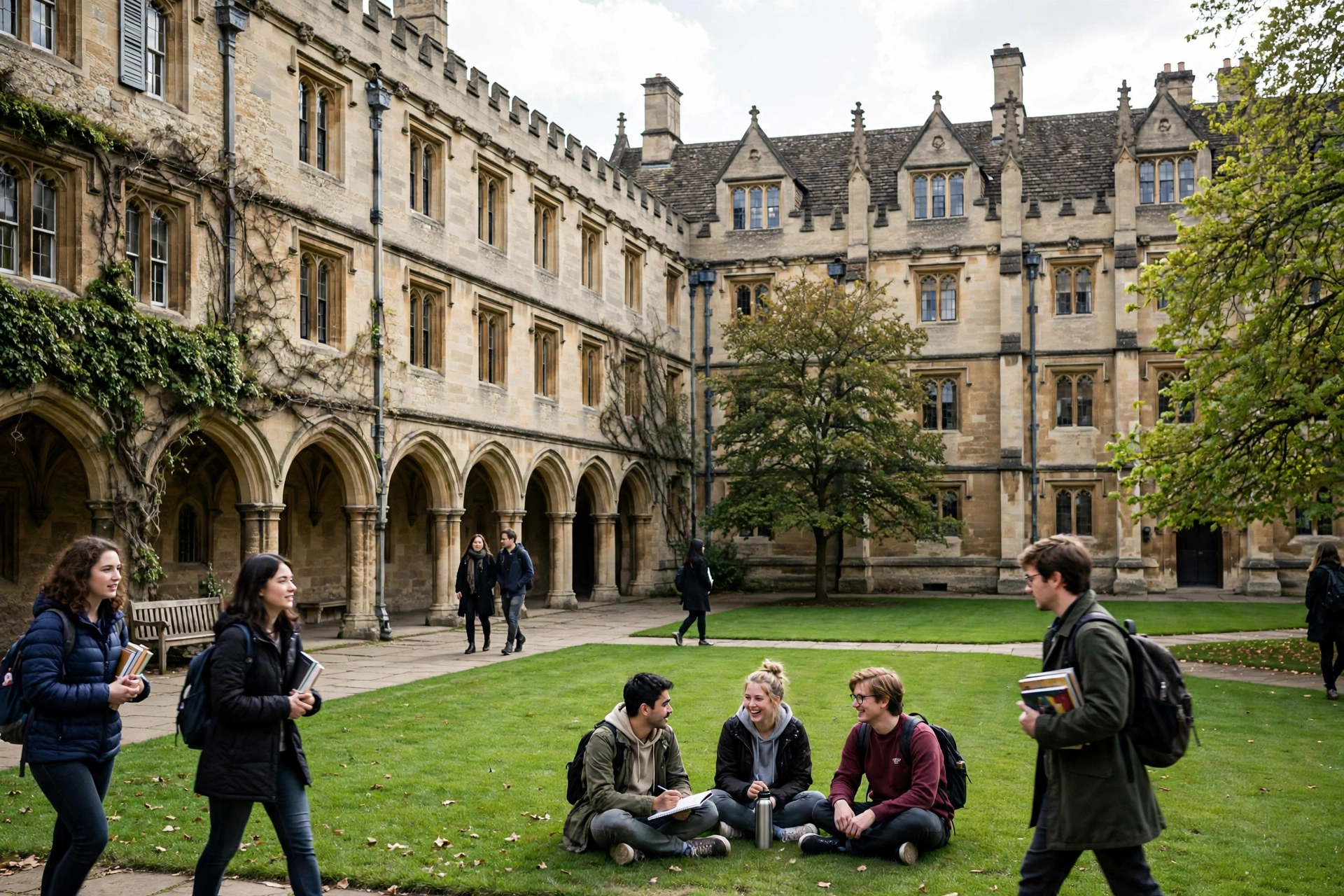
Jardine Scholarship at a Glance
| Item | Details |
|---|---|
| Scholarship name | Jardine Scholarship / Jardine Foundation Scholarship Awards — Oxford & Cambridge Undergraduate Scheme |
| Founded | 1982, by the Jardine Matheson Group to commemorate its 150th anniversary |
| Administered by | The Jardine Foundation, Jardine House, Hong Kong (Secretaries of the Jardine Foundation) |
| Level | Primarily undergraduate first degrees (three or four years, or such longer period as the Trustees on the Scholarship Committee’s recommendation may decide). A limited number of postgraduate scholarships are also considered — see below. |
| Universities | University of Oxford and University of Cambridge only, with very strong preference for the eight preferred colleges below |
| Preferred colleges — Oxford | Exeter College, Oriel College, The Queen’s College, Trinity College |
| Preferred colleges — Cambridge | Downing College, Magdalene College, Peterhouse, Trinity College |
| Eligible territories | Applicants must be resident in a country or territory where the Jardine Matheson Group has significant business interests: Cambodia, mainland China, Hong Kong, Indonesia, Malaysia, Myanmar, the Philippines, Singapore, Taiwan, Thailand and Vietnam — in the Foundation’s published wording |
| Residence depth | Generally, applications will not be accepted from candidates whose parents have not resided in the relevant country or territory for at least seven years prior to the proposed date of entry, in the published undergraduate criteria; the postgraduate scheme wording requires applicants to have been a national of or resident of a listed territory for at least seven years |
| Timing since school | Applicants must normally be within seven years of having completed secondary school education at the date of entry to a preferred college |
| Value | Generally sufficient to cover: university tuition fees (paid directly to the University), college fees excluding board and lodging (paid directly to the College), an annual stipend for board, lodging and incidental expenses, and a standard economy airfare to the UK at the start and back home at the end. Postgraduate scheme wording also lists the UK Immigration Health Surcharge. |
| Selection basis | Academic achievement, plus personal qualities and exceptional leadership and fellowship, achievements in non-curricular activities including sports, community involvement, and likelihood of becoming an outstanding citizen committed to public duties / community involvement |
| Applications | Two parallel applications: UCAS to Oxford or Cambridge by the Oxbridge deadline (15 October in recent cycles), selecting a preferred Jardine college; plus the separate Jardine Foundation application form, typically opening mid-August and closing in late October |
| Interviews | First interviews typically mid-November; final selection interview in Hong Kong in early January, which shortlisted candidates must attend |
| Condition of award | Conditional on being selected for and taking up a place at one of the preferred colleges; awards are not confirmed until the candidate has been accepted by a preferred college |
| Official sources | Jardine Foundation (jardine-foundation.org) and Jardine Matheson scholarship pages; Oxford and Cambridge college pages |
Two points in that table deserve emphasis before you read further. First, the Jardine Scholarship and admission to Oxford or Cambridge are separate processes run by separate bodies. Trinity College Oxford states the position clearly: after applications are submitted, the admissions process for Oxford is conducted entirely independently of the Jardine Scholarship process, applicants must satisfy the same exacting standard for entry as all other applicants, and it is quite possible to be offered a place at Oxford but not a Jardine Scholarship, because the Foundation applies additional criteria. The reverse is also true in effect: a Jardine award cannot create an Oxford or Cambridge place that the university has not offered. Second, the award is conditional on a preferred college. If you are admitted to Oxford or Cambridge at a non-preferred college, the Foundation’s published position is that scholarships are tenable at the preferred colleges, with the award confirmed only when you have been accepted by one of them. Choose your college application accordingly.
Who Can Apply: Eligibility in Detail
Residence in an eligible territory — with depth
The Foundation’s published undergraduate criteria require applicants to be resident in any of the countries or territories in which the Jardine Matheson Group has significant business interests, which include Cambodia, mainland China, Hong Kong, Indonesia, Malaysia, Myanmar, the Philippines, Singapore, Taiwan, Thailand and Vietnam. Note the wording carefully: the test is framed around residence in those territories in relation to the Group’s operations, not simply holding any Asian passport, and not studying abroad elsewhere. Generally, applications will not be accepted from candidates whose parents have not resided in such a relevant country or territory for at least seven years prior to the proposed date of entry to university. A student who has recently moved to Hong Kong or Singapore for the final year of school, with parents resident elsewhere, should therefore expect the eligibility test to be difficult, and should clarify their position with the Foundation before applying.
For Singapore applicants, published guidance adds that male applicants must have completed or been exempted from National Service. That detail illustrates a wider point: country-specific conditions sit inside the general criteria, and the Foundation’s current application materials for your territory are the authoritative source.
Academic standard for entry to a preferred college
You must have reached an academic standard to qualify for entry to one of the preferred colleges — in practice, the standard Oxford and Cambridge require for your chosen course, which is among the highest in the world: typically top grades in your school system (for example A-level, IB, or your national equivalent at the level the course page specifies), success in any admissions tests for your course, and strong performance at interview if you are shortlisted by the university. Jardine does not lower the academic bar; it adds criteria on top of it. Check the exact entry requirements, subject requirements and admissions test for your course on the Oxford or Cambridge website, and plan your subject choices at school so you meet them — a brilliant student missing a required subject cannot be admitted, and therefore cannot hold the Scholarship.
Within seven years of secondary school, in satisfactory health, and other conditions
Published criteria state that applicants must normally be within seven years of having completed secondary school education at the date of entry to a preferred college, and must be in a satisfactory state of health. Applications for a study programme leading to a second first degree, or for a programme currently being pursued, will not be considered, and applicants who have already been awarded other fully-covered scholarships to study overseas at the time of application will also not be considered. Older summaries of the scheme also describe scholars as single during the award — if any personal-status condition appears in the current application materials, take it from those materials rather than from third-party summaries. The honest approach to every condition in this paragraph is the same: read the current Foundation application form and regulations, which govern your cycle, and ask the Secretaries of the Foundation if your circumstances are unusual.
Postgraduate Jardine Scholarships — a separate, limited route
This guide’s title and focus are undergraduate, as the Foundation’s flagship scheme is. For completeness: the Foundation also considers a limited number of applications for postgraduate study. On the Foundation’s current scholarship schemes page, postgraduate scholarships are for periods of up to four years, for full-time courses only, and are awarded only if the applicant has already been accepted by one of the Foundation’s partner colleges. Postgraduate applicants apply through one of the admissions offices at the eight partner colleges (for the standalone scheme), or through the jointly funded Jardine Cambridge Graduate Scholarship Scheme with the Cambridge Trust, or the Jardine Oxford Graduate Scholarship Scheme with the University of Oxford, as the page describes. Postgraduate eligibility requires applicants to have been a national of or resident of Cambodia, the Chinese mainland, Hong Kong SAR, Indonesia, Malaysia, Myanmar, the Philippines, Singapore, Taiwan, Thailand or Vietnam for at least seven years, to be within the early stages of their career, and to be in satisfactory health; selection takes into account academic achievement and potential, leadership ability and potential, commitment to community contribution, and — for the postgraduate scheme — financial need. If you are a graduate, do not use the undergraduate deadlines in this guide; follow the postgraduate instructions on jardine-foundation.org and through the colleges.
Benefits and Coverage: What Jardine Pays
The Foundation’s published description is that each Scholarship awarded will generally be sufficient to cover fees, tuition, the cost of necessary books and equipment, board and lodging — preferably on a living-in basis where that is available at the university — and reasonable living expenses and travel expenses to and from the university at the beginning and at the end of the course. Broken into components, the Scholarship includes:
- University tuition fees, payable directly to the University
- College fees, excluding board and lodging, payable directly to the College (in the postgraduate scheme wording, college fees payable directly to the College, and the UK Immigration Health Surcharge is also listed)
- An annual stipend, determined by the Trustees, to cover board and lodging and all other incidental expenses — undergraduate summaries describe it as payable in four instalments, and the postgraduate wording describes three instalments a year with a larger first instalment to cover initial costs; the instalment pattern for your scheme and cycle is set in your award terms
- A standard economy class airfare from your place of residence to the United Kingdom at the beginning of the Scholarship, and for the return journey home on completion — undergraduate summaries describe it as payable directly to the airline, and postgraduate wording as reimbursed at cost to the Scholar
The Foundation also states that in cases of financial hardship, the Trustees may, in their absolute discretion, make arrangements by way of supplemental awards, loans or other means as they think fit to assist Jardine Scholars in meeting essential expenses. That discretion is a safety net, not an entitlement to plan around. Budget on the published package, live within the stipend — college accommodation and catering, which the “living-in” preference encourages, help considerably — and approach the Foundation early and honestly if a genuine essential cost arises that the package cannot meet.
Conditions matter as much as amounts. For first degree courses, scholarships are for periods of three or four years, or such longer period as the Trustees, on the recommendation of the Scholarship Committee, may decide — matching the normal length of Oxford and Cambridge bachelor’s degrees, including four-year integrated master’s courses in sciences and engineering where applicable. Scholars are required to comply with the Foundation’s Regulations Governing Scholarships, and undergraduate guidance has long stated that scholars must not accept another scholarship alongside Jardine during the scholarship period — consistent with the eligibility bar on holding another fully-covered overseas scholarship at application. Read your award letter and the Regulations as the binding terms.

Courses and Colleges: Choosing Where to Apply
Jardine Scholarships are awarded to candidates in any academic subject, tenable at the preferred colleges. Oxford and Cambridge between them offer undergraduate courses across the arts, humanities, social sciences, sciences, engineering, medicine-related subjects and law — under their own course names and structures, which do not always match school subjects or other universities’ degrees. At Oxford you apply for a named course (for example PPE, Law, Engineering Science, Medicine, English, Mathematics); at Cambridge you apply through its Tripos system, where some subjects are read within broader frameworks such as Natural Sciences or Human, Social and Political Sciences. Research the actual course content, teaching pattern — the tutorial system at Oxford and supervisions at Cambridge, built around very small-group teaching with experts — assessment, and any subject or test requirements, on the university websites. Trinity College Oxford notes its recent Jardine Scholars have read subjects including Engineering, Material Sciences, Law and History & Politics, which gives a sense of the breadth in practice.
College choice deserves real thought, because for Jardine it is not cosmetic. You must apply through UCAS selecting one of the preferred colleges — Exeter, Oriel, The Queen’s or Trinity at Oxford; Downing, Magdalene, Peterhouse or Trinity at Cambridge — or, if the university’s open-application route is used, understand that the award’s preferred-college condition may not be met. Within the eight, colleges differ in size, location within the city, accommodation, subject strengths and atmosphere. Visit college websites, read their subject pages, check that your course is offered and well supported at that college, and, if open days or virtual events are accessible to you, use them. Do not choose a college only because its name is famous; choose one where you can write specifically about studying your subject, and where you would be happy living for three or four years. Note also that you apply to either Oxford or Cambridge as an undergraduate, not both in the same UCAS cycle — a UCAS rule, not a Jardine rule, that forces an early, well-researched decision.
Use the StudyGraduate study abroad directory for how UCAS, Oxbridge admissions tests and interviews work in general, and the tools directory to track the overlapping deadlines — UCAS, admissions tests, Jardine form, interviews — without missing one.
How to Apply: Step by Step
- Check eligibility ruthlessly, a year or more ahead. Residence in an eligible territory, parental residence of at least seven years in that territory, within seven years of completing secondary school, satisfactory health, no second first degree, and no other fully-covered overseas scholarship already awarded. If you fail a condition, do not apply and hope — clarify with the Foundation if the position is genuinely ambiguous, and otherwise direct your effort to scholarships open to you.
- Choose Oxford or Cambridge, a course, and a preferred college. Research course content and entry requirements, required school subjects and admissions tests, and the eight preferred colleges. Register for any admissions test for your course by its own deadline, which can fall before the UCAS deadline.
- Submit your UCAS application by the Oxbridge deadline — 15 October in recent cycles. Trinity College Oxford confirms the route: eligible applicants who wish to be considered for a Jardine Scholarship apply to Oxford in the normal way through UCAS by 15 October, selecting Trinity or one of the other preferred Jardine colleges, and in addition complete the separate Jardine Foundation application form. Cambridge applicants follow the same parallel logic with the Cambridge UCAS deadline and their preferred college.
- Complete the separate Jardine Foundation application. Applications for the undergraduate Awards typically open in mid-August. The application has in recent cycles included a personal statement (in published summaries, not more than 700 words, covering your aspirations, plans after graduation and personal particulars), a recent / passport-sized photograph, a copy of your completed UCAS application form, certified copies of your academic transcripts / examination results as specified, and details of referees who can speak to your academic ability and personal qualities — follow the exact list and format in the current form on the Jardine Foundation scholarship schemes page and the Foundation’s application materials, and submit to the Secretaries of the Jardine Foundation as directed, by the closing date, typically in late October. Singapore listings for the current cycle have shown a late-October closing date (23 October 2026 in one listing) — treat any specific date as cycle- and territory-specific until you confirm it in the official form.
- Take your university admissions steps in parallel. Sit the admissions test if your course requires one, and, if the university shortlists you, attend Oxford or Cambridge interviews in December. The university process is independent: prepare for subject interviews on their own terms, with deep reading around your course.
- Attend Jardine interviews if shortlisted. Published process summaries describe a first interview in the middle of November, in some cases a second screening interview, and a final personal interview with the Scholarship Committee in Hong Kong in early January, which candidates must attend in person — applicants who cannot attend the final interview in Hong Kong will not be considered, in published guidance, and applicants not invited to interview by the relevant date should consider their application unsuccessful. Some territory routes describe an initial automated / video interview stage before in-person rounds. Prepare to discuss your academics, your leadership and service, your community, and why you will give back — with evidence, not claims.
- Wait for both decisions to align. University offers are made in January; Jardine awards are confirmed only when you have been accepted by a preferred college. Decisions have in published summaries been communicated in February / March, after university places are known. If you receive a university offer at a preferred college but no Jardine award, you will need another funding plan to take up the place — build that contingency honestly with your family and school from the start.
- If awarded, accept formally, meet your offer conditions, and complete visa steps. Achieve the grades your university offer requires, comply with the Regulations Governing Scholarships, arrange your UK Student visa and Immigration Health Surcharge as your award terms direct, and take up your place in October.
Required Documents
- Completed Jardine Foundation application form for the current Awards cycle, submitted as directed to the Secretaries of the Foundation
- Personal statement — in recent-cycle summaries, not more than 700 words, covering aspirations, plans after graduation and personal particulars
- Recent passport-sized photograph, as specified in the form
- Copy of your completed UCAS application form
- Certified copies of school transcripts and public examination results / predicted grades documentation as the form requires
- Referee details and references — typically two referees able to vouch for academic ability and personal qualities; follow the current form’s instructions on number and submission
- Evidence supporting eligibility: residence in an eligible territory and, where the form asks, your parents’ residence history
- Any territory-specific documents the current form lists (for example, for Singapore male applicants, National Service completion or exemption documentation)
Keep certified copies consistent across the UCAS and Jardine applications: names, dates and results must match exactly. Discrepancies between what a university is told and what the Foundation is told create avoidable doubt in a process that has no spare time to resolve it.
Deadlines and Timeline
| Stage | Typical timing | Notes |
|---|---|---|
| Jardine undergraduate applications open | Mid-August | Stated in Foundation / scheme summaries: applications open in mid-August each year. Download the current form as soon as it appears. |
| Admissions test registration | September – early October, by test | Course-dependent; registration deadlines precede the test dates and can precede UCAS submission. Check your course page. |
| UCAS application to Oxford / Cambridge | 15 October | The Oxbridge UCAS deadline in recent cycles, confirmed on Oxford college Jardine pages. Select a preferred Jardine college. |
| Jardine Foundation application closes | Late October | Typically late October; one Singapore listing showed 23 October 2026. Confirm the exact closing date and submission address / portal in the current official form for your territory. |
| Jardine first interviews | Middle of November | Shortlisted candidates only; some routes include a prior video interview. University admissions tests also fall in this period. |
| Oxford / Cambridge interviews and decisions | Interviews in December; offers in January | Run entirely by the universities, independently of Jardine selection. |
| Jardine final interview | Early January, in Hong Kong | Personal interview with the Scholarship Committee; attendance is required to remain in consideration, per published guidance. |
| Awards confirmed | After university acceptance at a preferred college — decisions communicated in February / March in published summaries | Awards are not confirmed until the candidate has been accepted by a preferred college. |
| Take up place | October — start of the academic year | For the 2027 Awards, entry in October 2027, subject to meeting offer conditions. |
A note on the 2027 cycle specifically: at the time this guide was written, the Foundation’s general cycle pattern — mid-August opening, October UCAS alignment — was the published basis for planning, and territory listings were beginning to show October 2026 closing dates. The Foundation publishes the application form and exact closing date for each Awards cycle; that form, not any guide including this one, governs your application. Build your plan backwards from a late-October Jardine closing date and the 15 October UCas deadline, and you will be ready whichever exact October date the form confirms.
Selection Criteria and How to Improve Your Chances
The Foundation states that in making awards, the Scholarship Committee will take into account not only academic achievement, but also: personal qualities and character, in particular exceptional qualities of leadership and fellowship; achievements in non-curricular activities, including sports; community involvement and activities; and other attributes which indicate that the applicant is likely to become an outstanding citizen with a high commitment to the performance of public duties and / or community involvement. The postgraduate wording compresses the same idea into academic achievement and potential, demonstrated leadership ability and potential, and commitment to community contribution.
Practically, that means your application must prove three things at once. First, Oxbridge-level academics: predicted and achieved grades at the top of your system, the right subjects, strong admissions test preparation, and a personal statement for UCAS that shows genuine, evidenced intellectual passion for your course — super-curricular reading, projects, competitions and reflection, not a list of unrelated prizes. Second, leadership and fellowship with a record: roles where you led people, built something, served a team or community over time, and can describe outcomes and what others gained — fellowship matters as much as headline leadership, because Oxford and Cambridge colleges are small residential communities and Jardine is selecting future members of one. Third, community commitment that points homeward: the Foundation exists to develop leaders who give back to the societies where Jardine Matheson operates. Be specific about the community you come from, the problems you care about there, what you have already done, and how an Oxford or Cambridge education — and the Jardine Scholars network, a global network of current and past scholars who share knowledge and engage socially and professionally — will equip you to contribute after graduation. Vague “I want to help my country” language convinces no one; a track record plus a credible plan does.
In your Jardine personal statement, do not repeat your UCAS statement. UCAS is about the course; Jardine is about the person, the leadership, the service and the future contribution, within the word limit the form sets. Use your strongest two or three examples in depth. Choose referees who between them can verify both halves — academic excellence and character / leadership — and brief them on the Jardine criteria. For interviews, practise talking about your subject at Oxbridge depth for the university, and about your leadership, your community and current affairs affecting your home territory for Jardine. Committees in Hong Kong in January are selecting future citizens and leaders, not only future undergraduates; maturity, humility and clarity about service are noticed.
Finally, protect the basics: apply to a preferred college, submit both applications complete and on time, keep your grades at offer level through your final examinations, and stay eligible — a second fully-covered overseas scholarship accepted in parallel, or a move that breaks the residence basis, can end a Jardine award before it begins.
Common Mistakes to Avoid
- Applying from outside the eligible territories. Residence in Cambodia, mainland China, Hong Kong, Indonesia, Malaysia, Myanmar, the Philippines, Singapore, Taiwan, Thailand or Vietnam — with the parental seven-year residence rule — is a gate. Check it first.
- Choosing a non-preferred college, or an open UCAS application. The award is conditional on acceptance at Exeter, Oriel, Queen’s or Trinity (Oxford) or Downing, Magdalene, Peterhouse or Trinity (Cambridge). A place elsewhere does not confirm a Jardine Scholarship.
- Submitting only one of the two applications. UCAS by 15 October and the separate Jardine form by its late-October closing date are both required. Either alone achieves nothing.
- Assuming Jardine influences university admission. Oxford states admissions are conducted entirely independently, to the same standard as for all applicants. Prepare for the university process on its own merits.
- Writing only about grades. Leadership, fellowship, non-curricular achievement including sport, and community involvement are published selection criteria. An application silent on them is incomplete in substance, whatever the form allows.
- Missing the Hong Kong final interview. Published guidance says candidates who cannot attend the final interview in Hong Kong will not be considered. Plan travel and permissions early if you are shortlisted.
- Holding another fully-covered overseas scholarship. Applicants already awarded one at application will not be considered in published criteria, and scholars are not to accept another scholarship during the award. Choose your route cleanly.
Frequently Asked Questions
Who is eligible for the Jardine Scholarship?
Applicants resident in territories where the Jardine Matheson Group has significant business interests — Cambodia, mainland China, Hong Kong, Indonesia, Malaysia, Myanmar, the Philippines, Singapore, Taiwan, Thailand and Vietnam — who meet the academic standard for entry to a preferred Oxford or Cambridge college, are normally within seven years of completing secondary school, and are in satisfactory health. Generally, candidates whose parents have not resided in the relevant territory for at least seven years before entry will not be accepted. Singapore male applicants must have completed or been exempted from National Service, per published guidance.
At which colleges is the Jardine Scholarship tenable?
With very strong preference — and as the condition for confirmation of an award — at four Oxford colleges: Exeter, Oriel, The Queen’s and Trinity; and four Cambridge colleges: Downing, Magdalene, Peterhouse and Trinity. This college list was verified for this guide against the Foundation’s current schemes page partners, Oxford college pages and Cambridge listings.
What does the Jardine Scholarship cover?
Generally enough to cover university tuition fees (paid directly to the University), college fees excluding board and lodging (paid directly to the College), an annual stipend for board, lodging and incidental expenses, and a standard economy airfare from your place of residence to the UK at the start and home at the end of the course. Necessary books and equipment and reasonable living expenses are within the Foundation’s general description of the package. Exact stipend amounts are determined by the Trustees and set in your award terms.
When do I apply for the Jardine Scholarship 2027?
Plan on the established pattern: Jardine applications open in mid-August 2026, your UCAS application to Oxford or Cambridge must be submitted by 15 October 2026 selecting a preferred college, and the Jardine form closes in late October 2026 — confirm the exact closing date in the official form for your territory when it is published. First Jardine interviews follow in mid-November, university interviews in December, and the final Jardine interview in Hong Kong in early January 2027.
Can I apply to both Oxford and Cambridge for Jardine?
No — not as an undergraduate in the same cycle. UCAS rules prevent applying to both Oxford and Cambridge in the same undergraduate application cycle. Choose one university, one course and one preferred Jardine college, and research that choice thoroughly.
Does the Jardine Scholarship cover postgraduate study as well?
Yes, on a limited and separate basis. Postgraduate scholarships of up to four years for full-time courses are considered for applicants already accepted by a partner college, applied for through the partner colleges or through the jointly funded Jardine Cambridge Graduate Scholarship Scheme or Jardine Oxford Graduate Scholarship Scheme, as described on jardine-foundation.org. Eligibility requires at least seven years as a national of or resident in a listed territory, early career stage and satisfactory health, and selection also takes financial need into account. Do not use the undergraduate deadlines for a postgraduate application.
Can I hold another scholarship together with Jardine?
Published undergraduate criteria state that applicants who have already been awarded other fully-covered scholarships to study overseas at the time of application will not be considered, and scholars are not to accept another scholarship during the scholarship period under the scheme’s long-standing guidance and Regulations. If you hold any award or offer of funding, disclose it and clarify your position with the Foundation before proceeding.
Does Jardine guarantee a place at Oxford or Cambridge?
No. University admission is decided independently by Oxford or Cambridge to the same standard applied to all applicants, and a Jardine award is confirmed only after you have been accepted by a preferred college. It is possible to receive a university offer without a Jardine award, and a Jardine application cannot substitute for meeting the university’s entry requirements, admissions tests and interview standard.
Sources and Verification
This guide was prepared from official sources, checked in October 2026:
- Jardine Foundation — official website (jardine-foundation.org): establishment in 1982 by Jardine Matheson, mission to develop future leaders by improving access to higher education, total value and number of scholarships across its schemes, and the Jardine Scholars network.
- Jardine Foundation — Scholarship schemes page: postgraduate scheme structure, partner-college application routes, eligibility (national of or resident of Cambodia, the Chinese mainland, Hong Kong SAR, Indonesia, Malaysia, Myanmar, the Philippines, Singapore, Taiwan, Thailand or Vietnam for at least seven years; early career stage; satisfactory health), selection basis (academic achievement and potential, leadership, community contribution, financial need for postgraduate), and value (fees, tuition, reasonable living and travel; university fees and college fees paid directly; annual stipend; Immigration Health Surcharge; economy airfare), plus the condition that awards are confirmed only on acceptance by a partner college.
- Trinity College, University of Oxford — Jardine Scholarships page: Trinity as one of four Oxford Jardine colleges, eligible territories list, the requirement to apply through UCAS by 15 October selecting a preferred college plus the separate Jardine form, and the independence of Oxford admissions from Jardine selection.
- Jardine Foundation undergraduate Awards criteria and process summaries published by the British Council (Hong Kong) and partner listings: preferred colleges at both universities, undergraduate eligibility including the seven-year parental residence rule and seven-years-since-secondary-school rule, second-degree and other-scholarship exclusions, benefits components, mid-August opening, November first interviews and early-January final interview in Hong Kong.
Disclaimer: Scholarship details, stipend amounts, college partnerships and deadlines change yearly. Always confirm deadlines, amounts, eligibility and document requirements on the official Jardine Foundation website and in the current application form before applying. StudyGraduate is an information portal, not an agency, and does not promise selection, admission or visa approval.
✅ Eligibility Criteria
- Check the official website for full eligibility criteria for your country
🎁 Benefits
- See the official website for the complete list of benefits
⚙️ Application Process
- 1Check your eligibility on the official site
- 2Prepare your documents and statements
- 3Submit the online application before the deadline
- 4Complete interviews or assessments if shortlisted
- 5Await the final selection announcement
📅 Important Dates
Deadlines vary by country and intake. Check the official website for country-specific dates.
📄 Required Documents
- Valid passport
- Academic transcripts & certificates
- Statement of purpose
- Letters of recommendation
- CV / resume
Commonly required — confirm the exact list on the official site.
❓ Frequently Asked Questions

Ready to Take the Next Step?
Explore more scholarships and study opportunities around the world.
Browse Scholarships →