Humboldt University of Berlin Scholarships for International Students 2026
Humboldt University of Berlin Scholarships for International Students 2026 Humboldt-Universität zu Berlin — HU Berlin — is one of Germany’s oldest and most prestigious universities, and like every public university in Berlin it charges no general tuition fees. For an international student, that single fact reshapes the entire scholarship question: you are not hunting for ... <a title="Humboldt University of Berlin Scholarships for International Students 2026" class="read-more" href="https://studygraduate.com/scholarship/humboldt-university-of-berlin-scholarships-for-international-students-2026/" aria-label="Read more about Humboldt University of Berlin Scholarships for International Students 2026">Read more</a>
📖 Overview
Humboldt University of Berlin Scholarships for International Students 2026
Humboldt-Universität zu Berlin — HU Berlin — is one of Germany’s oldest and most prestigious universities, and like every public university in Berlin it charges no general tuition fees. For an international student, that single fact reshapes the entire scholarship question: you are not hunting for tuition money, you are hunting for living-cost support in an expensive capital city, and the realistic instruments are monthly grants measured in hundreds of euros, DAAD programmes measured more generously but awarded far more selectively, and completion grants designed to carry you through the final phase of your degree. This guide covers the funding routes that genuinely attach to HU Berlin in 2026 and 2027 — above all the Deutschlandstipendium, for which HU publishes unusually complete information including the next application window, plus DAAD and STIBET graduation support, doctoral funding routes, and the short-term programmes students often confuse with scholarships.
Start with the full Humboldt University of Berlin profile on StudyGraduate for programmes and admissions, then compare HU’s offer with the national picture in our guide to scholarships in Germany. You can also browse the wider StudyGraduate scholarships directory to see which German schemes are open to your country and degree level right now.
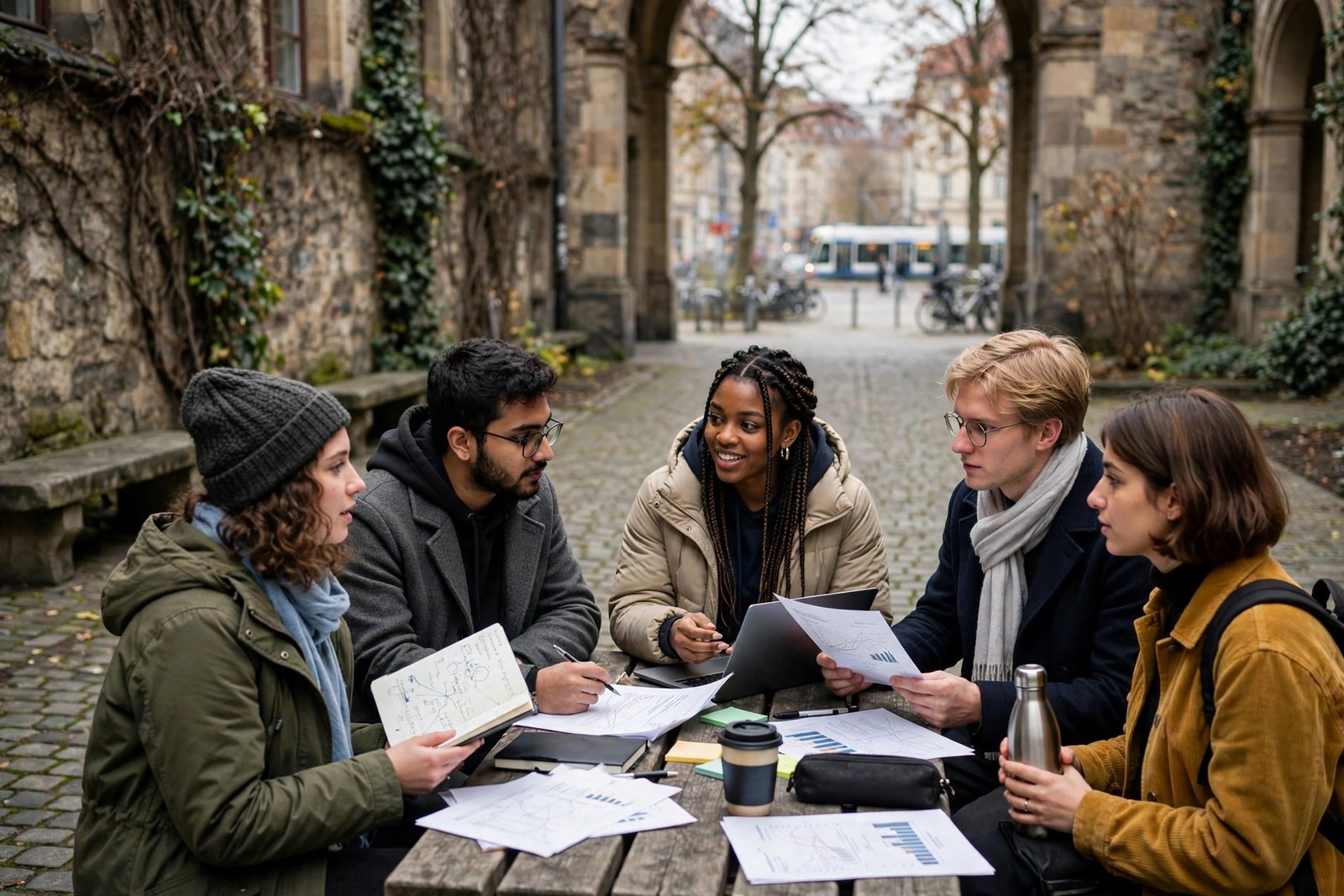
Humboldt Scholarships at a Glance
| Funding route | Amount (as officially published) | Who it is for | Key timing |
|---|---|---|---|
| Deutschlandstipendium at HU Berlin | €300 per month for at least two semesters (one year, extendable); half federal government, half private sponsors | Bachelor’s and Master’s students of all nationalities enrolled at HU in their main subject, within the standard period of study | 2027/28 round: apply 9 November – 6 December 2026; funding from 1 April 2027; around 90 scholarships expected |
| Deutschlandstipendium Research Class / Ostia Project | €300 per month within the Deutschlandstipendium framework, plus research-class participation and 5 ECTS per semester in the themed class model | Bachelor’s and Master’s students in participating disciplines | 2027/28 round: apply 9 November – 20 December 2026 |
| DAAD STIBET graduation / completion grants (via HU’s international services) | No single published HU figure; STIBET completion grants are partial, short-term awards set per call | International students in the final phase of a degree who face financial difficulty through no fault of their own | Calls via HU international pages; check current announcements |
| DAAD scholarships (database programmes, including EPOS on listed courses) | EPOS: €992 per month Master’s; €1,300 per month doctoral, rising to €1,400 from February 2026 in current calls | Postgraduates from eligible countries; EPOS requires at least two years of relevant work experience | Course-specific deadlines; apply to the course |
| Doctoral funding (positions, structured programmes, foundations) | Set by the position, programme or foundation; no single HU-wide doctoral stipend figure | Doctoral candidates across HU’s faculties and graduate schools | Rolling and call-based |
Tuition Context: No Tuition in Berlin, Real Costs Everywhere Else
Berlin’s public universities charge no general tuition for standard consecutive Bachelor’s and Master’s programmes, and HU Berlin is no exception. What you pay instead is a semester contribution each term — covering student services and, historically, a public transport ticket component — which you should confirm on HU’s official enrolment pages for the current semester because its composition changes over time. Doctoral students at HU likewise study without tuition in the standard model, though their funding question (position versus scholarship versus self-funding) is a career decision, not an administrative one.
The binding financial constraint for non-EU students is therefore not the university invoice but the residence permit: Germany requires proof of €11,904 for one year (2026 figure), most commonly via a blocked account. A Deutschlandstipendium of €300 per month — €3,600 over a year — is a meaningful contribution to a Berlin budget, typically covering a student-residence room or a large share of food, insurance and transport, but it is roughly a third of the official annual proof figure and cannot replace it. Build your plan as the university itself implicitly advises: secure the full proof of funds first, then treat every scholarship in this guide as money that stretches your budget, shortens your part-time working hours and buys you study time.
Berlin living costs need a clear-eyed paragraph. Rents have risen steeply; shared-flat rooms and student residences are contested; and HU’s location in Mitte and Adlershof means both premium central prices and cheaper outer-district options within commuting range. Most international students at HU combine family support or savings, the blocked account, permitted part-time work and — where awarded — a scholarship. The Deutschlandstipendium’s design deliberately supports that mix: it is income-independent, it can be held alongside BAföG where a student is eligible for it, and HU explicitly notes compatibility with Erasmus+ in its requirements guidance.
The Deutschlandstipendium at HU Berlin in Detail
The Deutschlandstipendium is HU Berlin’s flagship scholarship for enrolled students, and HU runs it at real scale. The programme supports students of all nationalities with €300 per month for at least two semesters. Half of each scholarship comes from the federal government and half from private sponsors — companies, foundations and individuals — which is why the total number of awards depends on sponsor commitments each year. For the 2026/27 funding year (1 April 2026 to 31 March 2027), HU reported that 90.5 scholarships were awarded, including 37 non-subject-specific scholarships open to all disciplines; fractional figures arise because some awards are shared or part-year, a normal feature of sponsor-funded rounds.
The forward-looking facts are the ones to plan around. For the 2027/28 funding year, HU’s official Deutschlandstipendium site states that the application period will run from 9 November to 6 December 2026, with funding beginning on 1 April 2027, and that the university currently expects to award approximately 90 scholarships, including 57 subject-independent scholarships open to students from all degree programmes. The separate application period for the Research Class and the Ostia Project runs from 9 November to 20 December 2026. The online portal activates only at the start of the application period, and HU is explicit that once the portal closes automatically, late applications cannot be considered. Those dates — published on the university’s own scholarship site at the time of writing — make HU one of the easiest German universities to plan a Deutschlandstipendium application around, provided you start in October, not on 5 December.
Eligibility, per HU’s official requirements page, is broader than many students assume. You must be enrolled with your main subject at HU when the scholarship starts (the summer semester following application), be within the standard period of study (exceptions only for special reasons such as a stay abroad or raising a child), and be studying in a Bachelor’s or Master’s programme. Students of all nationalities and all degree programmes can apply; first-year students and school leavers can apply; a second or further degree can be funded if you are within its standard period. Assessment combines academic performance with social or political commitment, awards and prizes, and special social, family or personal circumstances — HU states plainly that it particularly encourages applications from students who have overcome personal hurdles alongside their academic achievements. In plain terms: a strong transcript opens the door, but the file that wins usually also documents mentoring, volunteering, community work or a non-linear educational biography, evidenced rather than asserted.
The Research Class and Ostia Route
Within the Deutschlandstipendium, HU offers themed research classes — most visibly the “Sustainability and Global Justice” research class based at IRI THESys, supported by the Humboldt University Foundation since 2013 — in which up to around 15 scholarship holders from different disciplines work on an interdisciplinary research theme, learn scientific working methods from active researchers and earn additional credit (five ECTS per semester for successful participation in the themed-class model). For the right student this is worth more than the stipend: it is supervised research experience, a network and a reference letter in the making. Its application window runs slightly longer than the general round (to 20 December 2026 for the 2027/28 cycle), and eligibility is tied to the institutes and faculties involved, so read the class-specific call rather than assuming the general rules transfer unchanged.
DAAD and STIBET Graduation Support
Alongside the Deutschlandstipendium, HU’s international students encounter DAAD-funded support through the STIBET framework — the same DAAD Scholarship and Support Programme family used across German universities to fund supervision and targeted grants for international students. At campus level, the most relevant STIBET instrument for degree students is the graduation or completion grant: short-term, partial funding for international students in the final phase of their studies who have run into financial difficulty through no fault of their own and who are on track to finish successfully within a short period. Two honesty points matter here. First, HU does not publish one permanent STIBET amount or a standing annual deadline on a single stable page in the way it does for the Deutschlandstipendium, so this guide gives no figure: amounts, windows and eligibility details are set in each call announced through HU’s international services, and any third-party site quoting a fixed HU STIBET sum and date without linking the current call should not be trusted. Second, a completion grant is by design a bridge, not a budget: it exists to stop a final-semester crisis from destroying a nearly finished degree, and students who plan from the start to “rely on the graduation grant later” are planning to be in financial difficulty, which is the opposite of a plan.
Beyond campus-administered support, HU applicants should work DAAD’s own channels directly. DAAD’s scholarship database carries study and research programmes by country of origin, level and subject — including research grants for doctoral candidates and postdocs — and the EPOS programme funds development-related postgraduate courses on a published course list. EPOS pays €992 per month for Master’s scholars and €1,300 per month for doctoral scholars (rising to €1,400 from February 2026 in current calls), plus insurance, travel allowance and possible rent and family allowances, and it normally requires at least two years of relevant professional experience after a first degree obtained within the last six years. EPOS is attached to listed courses, not to universities as a whole, so the check that matters is whether your specific HU programme appears on the EPOS list for your intake — if it does not, your DAAD strategy is the database programmes and campus schemes, pursued in parallel rather than instead of admission.
Doctoral Funding at HU Berlin
Doctoral candidates at HU are funded through a patchwork that this guide will describe structurally, because inventing a tidy single scheme would be a disservice. The main routes are: employment as a research associate on a professor’s project or a third-party-funded position, which is the most common and most financially complete model in the sciences and increasingly elsewhere; scholarships from structured doctoral programmes and graduate schools attached to HU and its Berlin partners; DAAD research grants for international doctoral candidates; and the German research foundations and Begabtenförderungswerke, which fund small numbers of outstanding candidates, often with nomination or strong supervisor support. The practical sequence is therefore supervisor-first: identify a research group or structured programme, discuss funding explicitly before you relocate, and treat any offer that leaves funding “to be sorted out after arrival” with great caution — Berlin rents do not wait for sorting out. HU’s central pages for doctoral studies and its graduate institutions are the authoritative starting points, and figures belong in individual calls and contracts, not in general guides.
Humboldt International Campus and KOSMOS: A Necessary Clarification
Search results for “Humboldt scholarships” frequently surface the Humboldt International Campus and its KOSMOS summer and winter school activities. These are short-term academic programmes — summer and winter universities, language and subject courses — aimed largely at international visiting students. They are study opportunities, not degree scholarships: participation is normally fee-based, and they do not fund a HU Bachelor’s, Master’s or doctoral degree. They can still be useful — a summer school is a legitimate way to test Berlin, meet HU academics and strengthen a later degree application — but budget for them as paid short courses unless a specific call states otherwise, and do not let any intermediary present them to you as a funded route into a HU degree.

Eligibility Summary
For the Deutschlandstipendium — the scheme most readers will apply for — eligibility reduces to five tests: enrolment at HU in your main subject when funding starts; Bachelor’s or Master’s level; within the standard period of study; any nationality; and a file that combines academic achievement with commitment and circumstances. For STIBET completion support, the tests are international-student status, final-phase standing, a credible near-term completion plan and documented financial difficulty that arose through no fault of your own. For DAAD database and EPOS programmes, eligibility is defined per programme — origin country, subject, prior degree timing and, for EPOS, professional experience — and overrides anything general said here. In all cases, a scholarship application never substitutes for admission: secure the HU place first.
How to Apply: Step by Step
Step 1 — Win the place and enrol (or be firmly on track to). Deutschlandstipendium funding starts in the summer semester; you must be enrolled in your main subject at HU at that point. Everything else is sequenced around enrolment.
Step 2 — Diarise the November window now. For the 2027/28 round, the general application period is 9 November to 6 December 2026 (Research Class/Ostia: to 20 December 2026). The portal opens at the start of the period; there is no early submission and no late submission.
Step 3 — Assemble the evidence file in October. Transcript or predicted/entrance record as your stage requires, CV, and documented commitment: certificates from organisations, named roles, dates. Add a concise account of any special personal or family circumstances the criteria invite — factual, specific, and only what you are comfortable evidencing.
Step 4 — Choose your track deliberately. If you fit a research class call (for example Sustainability and Global Justice via IRI THESys and partner institutes), the themed route adds research experience and ECTS to the same €300; if you do not fit a class, the general subject-independent scholarships — 57 expected in 2027/28 — are your pool.
Step 5 — Submit inside the portal, early in the window. HU warns that after the automatic portal closure, applications cannot be considered. Submitting in the first fortnight leaves time to fix technical problems with the Deutschlandstipendium team’s help while they are reachable during the application period.
Step 6 — In parallel, run the DAAD track. Check the DAAD database for your origin country and level each autumn, and check the EPOS course list if you are a postgraduate with two or more years of professional experience. These deadlines sit outside HU’s calendar.
Step 7 — Keep the visa finances independent. Maintain the blocked account (€11,904 for 2026) or equivalent proof regardless of a pending scholarship decision, and plan part-time work within your residence-permit limits as the flexible layer of the budget.
Required Documents
| Document | Needed for | Notes |
|---|---|---|
| Proof of enrolment at HU (main subject) | Deutschlandstipendium | Must cover the funding start (summer semester) |
| Transcript of records / academic record | Deutschlandstipendium; DAAD | First-year applicants use their entrance qualification record as the call specifies |
| CV | All routes | Education, work, commitment — with dates |
| Evidence of social/political commitment, awards | Deutschlandstipendium | Certificates and confirmations from organisations; unverifiable claims carry no weight |
| Statement of special circumstances (where applicable) | Deutschlandstipendium | Personal hurdles, family or social circumstances the criteria recognise |
| Completion plan and evidence of financial difficulty | STIBET graduation grants | Set by each call via HU international services; no standing published figure |
| Employer references, degree certificates | DAAD EPOS | At least two years of relevant professional experience must be documented |
Deadlines and Timeline
| When | What happens | Source status |
|---|---|---|
| 1 April 2026 – 31 March 2027 | Deutschlandstipendium funding year 2026/27 (90.5 scholarships awarded) | Official HU Deutschlandstipendium site |
| October 2026 | Prepare documents; HU announces the 2027/28 application phase | Official HU site (announcement pattern) |
| 9 November – 6 December 2026 | Deutschlandstipendium application period for 2027/28 | Official HU Deutschlandstipendium site |
| 9 November – 20 December 2026 | Research Class / Ostia Project application period for 2027/28 | Official HU Deutschlandstipendium site |
| 1 April 2027 | 2027/28 funding begins (approx. 90 scholarships expected, incl. 57 subject-independent) | Official HU Deutschlandstipendium site |
| Course-specific | DAAD database and EPOS deadlines | DAAD / course pages |
Tips to Strengthen Your Application
Write the second half of the criteria. HU’s own wording pairs academic performance with commitment, awards and personal circumstances, and explicitly encourages students who overcame hurdles. Applicants who submit grades alone compete with one hand tied; applicants who document a year of mentoring, a community role or a first-generation path with evidence use the full marking scheme.
Apply for the research class if you genuinely fit it. A smaller, themed pool with a research payoff can be a better bet than the general pool for students in the participating institutes — but only with a real thematic fit; committees spot generic sustainability essays quickly.
Stay inside the standard period. Funding outside it is exceptional. Plan modules so a semester abroad, a job or a thesis delay does not silently push you outside the Regelstudienzeit before the April funding start.
Use the application-period support. HU staffs the Deutschlandstipendium inbox during the window. Ask factual questions there in November rather than guessing in a forum in December.
Reapply. With around 90 awards a year and a changing sponsor pool, a well-documented reapplication after a stronger semester is a normal path to success, not an admission of failure.
Common Mistakes
The costliest mistake is calendar failure: discovering the Deutschlandstipendium in January, when the window closed on 6 December and funding starts in April. The second is treating €300 per month as full funding and under-preparing the €11,904 blocked account. The third is submitting commitment claims without certificates — HU’s criteria reward evidence, and selection is competitive enough that unverifiable text is dead weight. The fourth is confusing Humboldt International Campus short courses with degree scholarships and paying course fees under a misapprehension. The fifth is assuming STIBET completion money can be planned as income: it is a final-phase safety net announced per call, with no standing published HU amount. The sixth, for doctoral applicants, is relocating to Berlin on a vague funding promise instead of a signed position, programme place or grant letter.
Frequently Asked Questions
How much is the Deutschlandstipendium at HU Berlin?
€300 per month for at least two semesters, funded half by the federal government and half by private sponsors. For 2026/27, HU awarded 90.5 scholarships; for 2027/28 it expects around 90, including 57 open to all disciplines.
When do I apply for the 2027/28 Deutschlandstipendium at HU?
The official HU scholarship site gives 9 November to 6 December 2026 for the general round, and 9 November to 20 December 2026 for the Research Class and Ostia Project. Funding begins on 1 April 2027. The portal is only active during the application period.
Can international students get the Deutschlandstipendium?
Yes. HU’s requirements state that students of all nationalities can apply, provided they are enrolled at HU in their main subject, in a Bachelor’s or Master’s programme, and within the standard period of study when funding starts.
Does HU Berlin charge tuition?
No general tuition is charged at Berlin’s public universities for standard consecutive programmes; students pay a semester contribution instead. Confirm the current contribution on HU’s official pages, and budget separately for living costs and the €11,904 (2026) blocked-account proof for the visa.
What is a STIBET graduation grant and how much is it at HU?
It is DAAD-funded, short-term completion support for international students in the final phase of their degree facing financial difficulty. HU does not publish one standing amount or deadline for it; details are set in each call announced through HU’s international services, which is why this guide gives no figure.
Can I hold the Deutschlandstipendium together with other support?
HU’s requirements note it can be combined with BAföG (for those eligible) and with Erasmus+, and it is income-independent. Multiple-scholarship combinations are possible only under certain conditions, so declare other funding as the application asks.
Are Humboldt International Campus or KOSMOS programmes scholarships?
No. They are short-term summer/winter and course programmes, normally fee-based, and they do not fund a HU degree. Treat them as paid study experiences unless a specific call explicitly offers funding.
How are doctoral candidates funded at HU?
Mainly through research-associate positions, structured doctoral programmes and graduate schools, DAAD research grants, and foundations. There is no single HU-wide doctoral stipend figure; funding is defined in each position, programme or grant call.
Sources & Verification
This article is based on official sources checked at the time of writing: the Humboldt-Universität zu Berlin Deutschlandstipendium site at deutschlandstipendium.hu-berlin.de (€300 per month; 2026/27 funding year 1 April 2026–31 March 2027 with 90.5 awards; 2027/28 applications 9 November–6 December 2026, Research Class/Ostia to 20 December 2026, funding from 1 April 2027, around 90 scholarships expected including 57 subject-independent) and its requirements page at deutschlandstipendium.hu-berlin.de/en/receive-funding/voraussetzungen (all nationalities, main-subject enrolment, standard period, BAföG and Erasmus+ compatibility); HU news on the 2026/27 round; and the German Academic Exchange Service at daad.de for DAAD and EPOS rates (€992 Master’s; €1,300 doctoral, rising to €1,400 from February 2026 in current calls) and the STIBET framework. Where HU publishes no standing figure (STIBET graduation grants; doctoral funding), this article says so and gives none. The €11,904 blocked-account figure is the 2026 requirement used across this StudyGraduate Germany series.
Disclaimer: Scholarship details, deadlines and amounts change yearly. Always confirm deadlines, amounts and eligibility on the official university and DAAD websites before applying. StudyGraduate is an information portal, not an agency, and cannot guarantee admission, scholarship selection or visa approval.
✅ Eligibility Criteria
- Check the official website for full eligibility criteria for your country
🎁 Benefits
- See the official website for the complete list of benefits
⚙️ Application Process
- 1Check your eligibility on the official site
- 2Prepare your documents and statements
- 3Submit the online application before the deadline
- 4Complete interviews or assessments if shortlisted
- 5Await the final selection announcement
📅 Important Dates
Deadlines vary by country and intake. Check the official website for country-specific dates.
📄 Required Documents
- Valid passport
- Academic transcripts & certificates
- Statement of purpose
- Letters of recommendation
- CV / resume
Commonly required — confirm the exact list on the official site.
❓ Frequently Asked Questions

Ready to Take the Next Step?
Explore more scholarships and study opportunities around the world.
Browse Scholarships →