Government of Ireland International Education Scholarships (GOI-IES) 2027: Master’s & PhD Guide
Government of Ireland International Education Scholarships (GOI-IES) 2027: Master’s & PhD Guide The Government of Ireland International Education Scholarships — universally shortened to GOI-IES — are Ireland’s flagship national scholarships for international postgraduate students. The programme is funded by the Government of Ireland in partnership with Irish higher education institutions and managed by the Higher ... <a title="Government of Ireland International Education Scholarships (GOI-IES) 2027: Master’s & PhD Guide" class="read-more" href="https://studygraduate.com/scholarship/government-of-ireland-international-education-scholarships-goi-ies-2027-masters-phd-guide/" aria-label="Read more about Government of Ireland International Education Scholarships (GOI-IES) 2027: Master’s & PhD Guide">Read more</a>
📖 Overview
Government of Ireland International Education Scholarships (GOI-IES) 2027: Master’s & PhD Guide
The Government of Ireland International Education Scholarships — universally shortened to GOI-IES — are Ireland’s flagship national scholarships for international postgraduate students. The programme is funded by the Government of Ireland in partnership with Irish higher education institutions and managed by the Higher Education Authority (HEA). The HEA’s official programme page states the offer with unusual clarity: 60 scholarships are awarded each year, each consisting of a stipend of €10,000 for one year of full-time study plus a full fee waiver for that year, provided by the scholar’s host institution. The scholarships support study at NFQ levels 9 and 10 — that is, master’s degrees, postgraduate diplomas and PhD programmes — at eligible Irish higher education institutions.
Sixty awards for the entire world is a small number, and this guide will not pretend otherwise. GOI-IES is one of the most competitive national scholarships in Europe relative to its visibility: it attracts high-calibre applicants from every continent, it requires you to already hold an offer from an Irish institution before you can even apply, and its assessment rewards a combination of outstanding academics, communication skill, extracurricular distinction and a persuasive rationale for Ireland specifically. But for the right candidate — a non-EU/EEA student with a strong record, an offer in hand from an eligible Irish institution, and a story about why Ireland, why this programme and why now — it converts one year of postgraduate study in Ireland from a major financial undertaking into a funded year, with the tuition waiver alone worth many times the stipend on higher-fee programmes. If you are comparing Ireland against other destinations, start with our study abroad guides and the full scholarships directory, then come back here for the detail.
One clarification before anything else, because confusion between two similarly named programmes wastes applicants’ time every year. GOI-IES is the HEA-managed international education scholarship described in this guide: 60 awards, €10,000 stipend, full fee waiver, one year, for students domiciled outside the EU/EEA, Switzerland and the UK. It is not the Government of Ireland Postgraduate Scholarship administered by Research Ireland, which is a multi-year research award with a different value, different eligibility and a supervisor-led application. Blog posts and videos conflate the two constantly. If a source tells you the “Government of Ireland Scholarship” pays a much larger annual amount over several years, it is describing the other programme. Managing organisation is the tell: HEA means GOI-IES.

GOI-IES at a Glance
| Item | Details (per the HEA official programme page) |
|---|---|
| Programme | Government of Ireland International Education Scholarship (GOI-IES) |
| Funded by | Government of Ireland, in partnership with Irish higher education institutions |
| Managed by | Higher Education Authority (HEA) |
| Number of awards | 60 scholarships each year |
| Value | €10,000 stipend for one year, plus a full fee waiver for the scholarship year provided by the host institution |
| Duration | One year only — a taught master’s year, a postgraduate diploma year, or one year (typically the first year) of a PhD |
| Levels | NFQ Level 9 (master’s, postgraduate diploma) and NFQ Level 10 (PhD), full-time study |
| Eligibility core | Domiciliary of origin outside the EU/EEA, Switzerland and the United Kingdom; conditional or final offer from an eligible Irish institution required before applying; previous GOI-IES holders ineligible; Russian and Belarusian nationals ineligible per the current call |
| Application | Online via the HEA GOI-IES application portal; one application per candidate; two references uploaded through the portal |
| Deadline | 2026 cycle: 5pm Irish time, 12 March 2026, with outcomes in early June 2026. The 2027 deadline had not been published at the time of writing — expect a similar March position and confirm on hea.ie |
Every fact in that table comes from the HEA’s own page for the programme — and that page, together with the annual call document it publishes, is the controlling source for everything in this guide. Where cycle-specific details may change for 2027 (the institution list, the exact deadline, portal opening dates), this guide says so rather than presenting last cycle’s arrangements as certainties.
Eligibility: Who Can Apply for GOI-IES?
The HEA sets the eligibility spine, and it has four load-bearing elements. First, domicile: applicants must have a domiciliary of origin outside the EU/EEA, Switzerland and the United Kingdom. Note the concept carefully — it is domiciliary of origin, your country of permanent legal residence and origin, not simply the passport you happen to hold or the country you are temporarily studying in. Students from Bangladesh, India, Pakistan, Nepal, Nigeria, Indonesia and most other non-European countries meet this element straightforwardly; students who have become domiciled within the EU/EEA, Switzerland or the UK do not, even if they were born elsewhere. The current call also states that Russian and Belarusian nationals are not eligible to apply. Second, an offer: candidates must first apply for admission to a master’s, postgraduate diploma or PhD programme at an eligible Irish higher education institution, following that institution’s own admission procedures, and must hold a conditional or final offer at the time of applying for GOI-IES — proof of admission must be submitted within the application form itself. No offer, no application: this sequencing is absolute, and it dictates your whole timetable, because Irish admission decisions take time. Third, level and mode: the programme must be at NFQ Level 9 or 10 and full-time. Fourth, novelty: prospective candidates who have previously held a GOI-IES scholarship are not eligible to apply again.
Around that spine sit institution-level rules you must also respect. The HEA advises candidates to enquire directly with their chosen institution about whether their specific course is eligible for GOI-IES, and the annual call document lists eligible institutions with institutional contact details. Individual institutions may add their own criteria on top of the national ones for their internal handling — for example, an institution might restrict which of its programmes it supports, prioritise unconditional offers, or apply its own academic thresholds when shortlisting. Trinity College Dublin’s published GOI-IES guidance, for instance, has in recent cycles specified eligible programme types and applicant profiles for its own candidates. The lesson is to work two channels in parallel: the HEA call document for national rules, and your institution’s international office for local ones. Applicants who read only one of the two are the ones caught out.
Academic expectations deserve a direct word. GOI-IES is aimed, in the HEA’s words, at high-calibre students, and the assessment criteria below begin with a record of outstanding academic achievement. There is no single published grade cut-off that this guide can quote you — assessment is holistic and institutional shortlisting matters — but realistically, successful candidates present degree results at the top of their cohort’s range, strong references and a coherent record. If your grades are merely good, apply anyway if you meet eligibility and your wider profile is exceptional — but do so with clear eyes about the competition, and with parallel applications elsewhere, including institution-level awards such as global excellence scholarships that Irish universities run separately.
Benefits: What the Scholarship Actually Pays
The award has two components, funded by two different parties, and understanding the split explains several practical details. The €10,000 stipend comes from the Government of Ireland side of the programme and is paid to support your living costs for one year of full-time study. The full fee waiver — covering your tuition fee (and, per programme documentation, the associated charges the institution waives) for the scholarship year — is provided by your host institution itself, which is required to give the waiver as its partnership contribution. The combined value therefore varies enormously by programme: on a master’s with non-EU fees of €20,000–€30,000, the total package is worth €30,000–€40,000 in that year; on a lower-fee programme the waiver is worth less, though the stipend is identical. When you compare GOI-IES with other scholarships, compare totals on your actual programme’s fees, not headline stipends.
| Component | Who provides it | What it covers |
|---|---|---|
| Stipend | Government of Ireland, via the programme | €10,000 towards living costs for one year of full-time study |
| Fee waiver | Your host higher education institution | Full tuition fee waiver for the year of the scholarship |
| Duration limit | — | One year only; no renewal and no stipend for additional years |
The one-year limit is the benefit’s sharpest edge, and PhD applicants must stare at it directly. For a one-year taught master’s or a one-year postgraduate diploma, the fit is perfect: the funded year is the whole programme. For a PhD lasting three to four years, GOI-IES funds one year — typically the first — and you must have a credible, honest plan for funding the remaining years, whether through institutional research funding, a supervisor’s project, family resources or other awards. Institutions assessing your application will think about exactly this, and a PhD application that behaves as if GOI-IES solves four years of funding undermines itself. Similarly, budget honestly around the stipend: €10,000 is a contribution to a year of living in Ireland, and in Dublin especially, rent alone can consume most of it. Scholars typically combine the stipend with part-time work within their student immigration permissions and with savings. Use our budgeting and cost-of-living tools to model Dublin, Cork, Galway or Limerick costs before you commit to an institution.
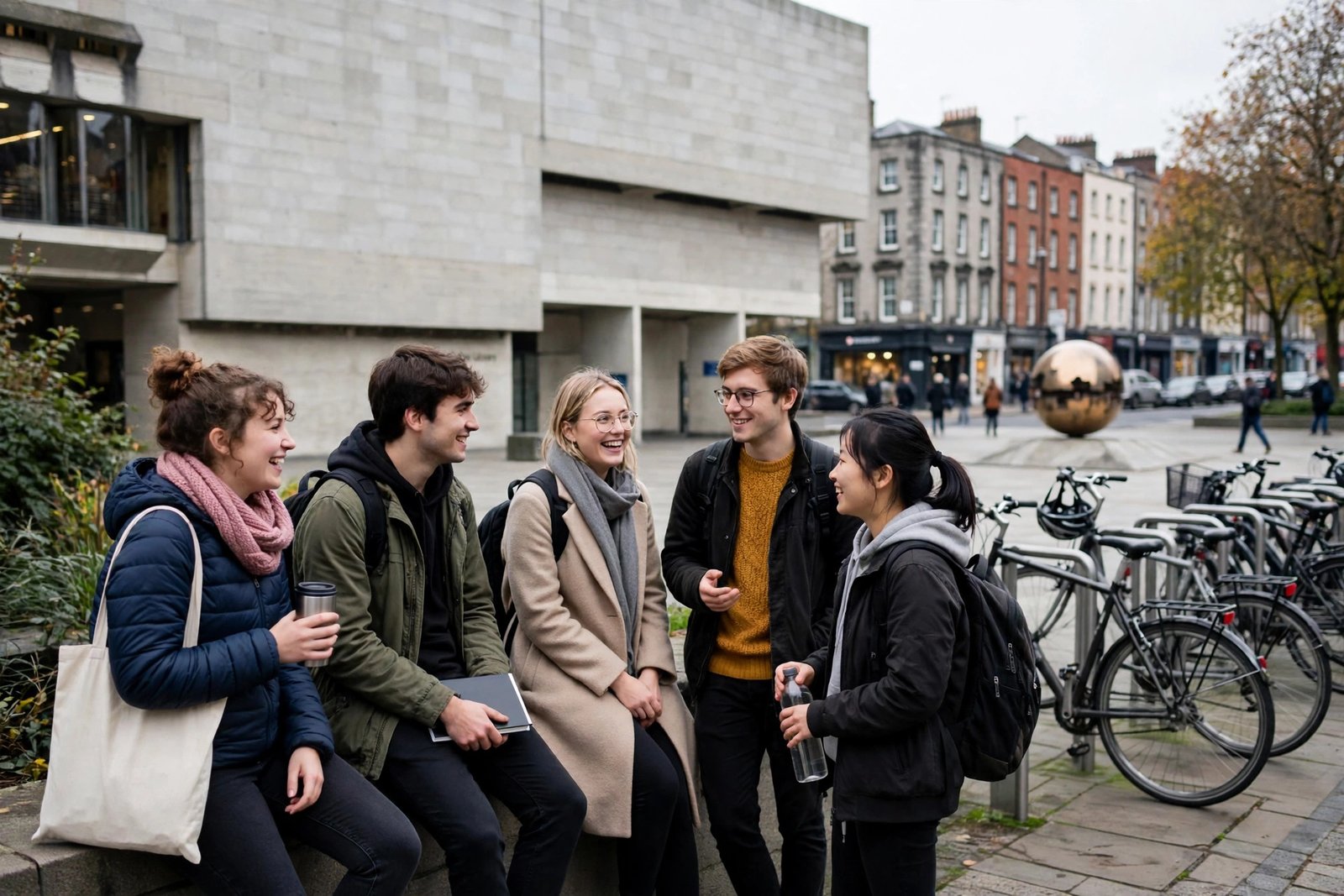
Programmes and Institutions
Any full-time programme at NFQ Level 9 (master’s or postgraduate diploma) or NFQ Level 10 (PhD) at an eligible Irish higher education institution can in principle host a GOI-IES scholar — the eligible-institution list is published as an appendix to the annual call document and has covered Ireland’s universities and technological universities and other recognised institutions. Because institutions confirm course-level eligibility individually, the correct sequence is: choose your programme on academic merit; confirm with the institution that the programme is GOI-IES-eligible in this cycle; secure your offer; then apply. Ireland’s postgraduate strengths — pharmaceuticals and life sciences, ICT and data, business and finance, engineering, public health, law, humanities and social sciences — map well onto international demand, and our universities directory and rankings pages can help you shortlist institutions before you approach them. There is no subject quota published nationally; alignment with your institution’s strategic objectives plays a role at shortlisting, which is one more reason your rationale should speak to the institution as well as to the HEA.
How to Apply, Step by Step
Step 1 — Choose programmes and check eligibility early (autumn before the call). Read the most recent GOI-IES call document and FAQs on the HEA programme page, note the eligible institutions, and contact your target institution’s international office about course eligibility. Step 2 — Apply for admission and secure an offer. Submit your programme application to the Irish institution well ahead of the scholarship deadline; you must hold a conditional or final offer when you apply for GOI-IES, and offer processing slows dramatically in peak season. Step 3 — Read the new cycle’s call documentation in full when it opens. The call document governs: eligibility, the portal, the form’s sections, reference requirements and the deadline. Do not reuse last year’s summary — including this guide — as a substitute. Step 4 — Complete the online application via the HEA portal. Submit exactly one application (a maximum of one per candidate per cycle), upload your proof of admission in the relevant section, and complete every field; applications cannot be altered once submitted. Step 5 — Arrange your two references. All applications require two references uploaded by you via the portal — so obtain them in uploadable form, from referees who know your work, well before the deadline; the HEA recommends submitting well ahead of the deadline to avoid technical problems from heavy server traffic, advice worth taking literally. Step 6 — Submit before 5pm Irish time on the deadline day. The 2026 deadline was 5pm (Irish time) on 12 March 2026; applications cannot be submitted after the deadline passes. Convert that time to your own time zone twice. Step 7 — Await institutional shortlisting and panel assessment. Applications are shared with the relevant institutions, which check eligibility and shortlist against their strategic objectives; shortlisted applications go to an independent panel of assessors. Outcomes for the 2026 cycle were scheduled for early June 2026. Step 8 — If successful, complete visa and enrolment. Separately from the scholarship, secure your Irish student immigration permission and meet any remaining offer conditions. A scholarship is not a visa, and neither StudyGraduate nor any scholarship letter can promise one.
Required Documents
Expect to assemble: your completed GOI-IES online application form; proof of your conditional or final offer from the eligible Irish institution, uploaded in the section the form specifies; two references, uploaded via the portal; your academic certificates and transcripts evidencing your record of achievement; identification and domicile evidence supporting your eligibility as a candidate domiciled outside the EU/EEA, Switzerland and the UK; and a curriculum vitae supporting the extracurricular and experience claims your application makes. The sample application form the HEA publishes (expressly on an indicative basis) is the best preparation tool available: download it when the call opens, draft every long answer against it offline, and only then touch the live portal. Keep referees briefed on what the scholarship rewards — academic excellence, communication, broader engagement and Ireland rationale — so their letters address the actual criteria instead of offering generic praise.
Deadlines and Timeline
| Stage | Timing |
|---|---|
| Programme applications to Irish institutions | Autumn–winter before the call; offers must be in hand at GOI-IES application time |
| GOI-IES call opens / portal available | Set by the HEA each cycle (the 2026 window ran to a March deadline; the portal for that cycle was accessed from the HEA page) |
| Application deadline (last published cycle) | 5pm Irish time, 12 March 2026 |
| Institutional eligibility checks and shortlisting | After the deadline, before panel assessment |
| Call outcome (last published cycle) | Early June 2026 |
| Study begins | Autumn of the award year (September/October intakes) |
For the 2027 cycle in this article’s title, the honest statement is this: the HEA had not published the 2027 deadline at the time of writing, and the working expectation — based on the verified 2026 cycle — is an application deadline in March 2027 with outcomes around early June 2027. Treat that as a planning assumption, not a date: diarise a weekly check of the HEA page from January 2027, and build your admission applications for autumn 2026 so that an offer is in hand whenever the portal opens. Contact for programme queries published by the HEA is goi-ies@hea.ie; institution-specific questions go to the institution using the call document’s contact appendix. Official background on Ireland as a study destination is also available via Trinity College Dublin’s GOI-IES page, which restates the national criteria — 60 awards, €10,000 stipend, full fee waiver — from an institutional perspective.
Selection Criteria and How to Improve Your Chances
The HEA publishes what assessors expect applicants to demonstrate, and this guide simply hands it to you: a record of outstanding academic achievement; excellent communication skills; participation in extracurricular activities — the HEA’s examples include humanitarian work, politics, arts and sport; and a strong rationale for pursuing study in Ireland that shows how a GOI-IES award aligns with your longer-term goals. After institutional eligibility checks and shortlisting against institutional strategic objectives, an independent panel assesses the shortlist. Work backwards from those four criteria when you draft. Academic achievement: present results with context — rank, awards, distinctions — rather than bare grades a panel cannot calibrate. Communication: the written application itself is the evidence; precise, structured, specific prose is your audition. Extracurricular participation: choose depth over inventory — two years of sustained humanitarian work outweighs a list of twelve memberships — and quantify outcomes. Ireland rationale: answer why Ireland rather than any Anglophone country, why this institution and programme, and how the year fits a credible longer-term plan in your field and home region. Generic praise of Ireland’s beauty or a wish to “experience a new culture” will not survive a panel that reads hundreds of applications.
Timing tactics matter as much as prose. Candidates who hold an unconditional (final) offer are simply easier to shortlist than those juggling conditions, so clear language or document conditions early where you can. Submit days before the deadline — the HEA itself warns about heavy server traffic on deadline day. And apply in a year when your record is ready: a rushed application with a mediocre transcript and thin extracurricular evidence spends your one application for that cycle; sometimes the strongest move is a deliberate gap year spent building exactly the record the criteria describe, while applying to less competitive institutional awards in parallel.
Common Mistakes
The fatal mistake is applying for GOI-IES without holding an offer — the proof of admission is part of the application itself. Second, confusing GOI-IES with the Research Ireland postgraduate scholarship and preparing for the wrong value, duration and process. Third, missing that eligibility turns on domiciliary of origin outside the EU/EEA, Switzerland and the UK — students domiciled inside those areas are ineligible regardless of birthplace. Fourth, PhD applicants treating one funded year as full PhD funding, with no plan for later years. Fifth, submitting more than one application — the maximum is one per candidate per cycle — or attempting to alter an application after submission, which the portal does not allow. Sixth, leaving references to the final week, or uploading generic letters that ignore the published criteria. Seventh, submitting at the last hour against a 5pm Irish-time deadline from a distant time zone. Eighth, ignoring institution-level eligibility: assuming every course at an eligible institution qualifies without asking the institution, as the HEA advises. Ninth, previous GOI-IES holders applying again — expressly ineligible.
Frequently Asked Questions
How many GOI-IES scholarships are awarded, and what are they worth?
Sixty scholarships are awarded each year. Each consists of a €10,000 stipend for one year of full-time study at NFQ Level 9 or 10, plus a full fee waiver for that year provided by the host institution — so the total value depends on your programme’s tuition fee.
Can I apply before I have an offer from an Irish university?
No. You must hold a conditional or final offer from an eligible Irish higher education institution at the time of applying, and proof of admission must be submitted within the application. Apply for admission first, and early.
Does the scholarship cover a full PhD?
No — it covers one year only, typically the first year of a PhD. Taught master’s and postgraduate diploma students whose programme lasts one year are fully covered for that year; PhD students need a separate, credible funding plan for the remaining years.
Who is eligible by nationality and domicile?
Applicants must have a domiciliary of origin outside the EU/EEA, Switzerland and the United Kingdom. Under the current call, Russian and Belarusian nationals are not eligible, and previous GOI-IES holders cannot apply again. Individual institutions may add their own criteria — check with yours.
When is the 2027 deadline?
It had not been published by the HEA at the time of writing. The verified 2026 deadline was 5pm Irish time on 12 March 2026, with outcomes in early June 2026, so plan for a similar March deadline in 2027 and confirm on the HEA’s GOI-IES page as soon as the new call appears.
How do I apply, and how many applications can I make?
Through the HEA’s online GOI-IES application portal, linked from its programme page. A maximum of one application per candidate may be submitted in a cycle, two references must be uploaded via the portal, and no alterations are possible after submission — so draft offline using the HEA’s sample form first.
What are assessors looking for?
Per the HEA: outstanding academic achievement, excellent communication skills, extracurricular participation (for example humanitarian work, politics, arts or sport), and a strong rationale for studying in Ireland aligned with your longer-term goals. Institutions first check eligibility and shortlist against their strategic objectives; an independent panel then assesses the shortlist.
Is GOI-IES the same as the Government of Ireland Postgraduate Scholarship?
No. GOI-IES is managed by the HEA and funds one year for international students domiciled outside the EU/EEA, Switzerland and the UK. The similarly named postgraduate scholarship is managed by Research Ireland, runs for multiple years with a different value, and follows a different, supervisor-centred process. Check the managing body before following any guide.
Sources and Verification
This guide is built on the Higher Education Authority’s official programme page, “Government of Ireland International Education Scholarships” (hea.ie), which verifies: 60 scholarships per year; the €10,000 one-year stipend; the host institution’s full fee waiver; NFQ Levels 9 and 10; domiciliary-of-origin eligibility outside the EU/EEA, Switzerland and the UK; the conditional or final offer requirement and proof of admission; the ineligibility of previous holders and of Russian and Belarusian nationals under the current call; the online portal, one-application limit and two-reference requirement; the assessment criteria and institutional shortlisting plus independent panel process; and the 2026 key dates (deadline 5pm Irish time, 12 March 2026; outcome early June 2026). Trinity College Dublin’s official GOI-IES page was used as institutional corroboration of the same national criteria.
Disclaimer: Scholarship details change yearly — always confirm deadlines, amounts, eligible institutions and course eligibility on the official HEA website before applying. StudyGraduate is an information portal, not an agency, and no article can promise selection, admission or visa approval.
✅ Eligibility Criteria
- Check the official website for full eligibility criteria for your country
🎁 Benefits
- See the official website for the complete list of benefits
⚙️ Application Process
- 1Check your eligibility on the official site
- 2Prepare your documents and statements
- 3Submit the online application before the deadline
- 4Complete interviews or assessments if shortlisted
- 5Await the final selection announcement
📅 Important Dates
Deadlines vary by country and intake. Check the official website for country-specific dates.
📄 Required Documents
- Valid passport
- Academic transcripts & certificates
- Statement of purpose
- Letters of recommendation
- CV / resume
Commonly required — confirm the exact list on the official site.
❓ Frequently Asked Questions

Ready to Take the Next Step?
Explore more scholarships and study opportunities around the world.
Browse Scholarships →