Fully Funded Scholarships in South Korea for International Students 2026: GKS Guide
Fully Funded Scholarships in South Korea for International Students: GKS Guide If you are looking for a genuinely fully funded scholarship in South Korea for 2026 — tuition paid, a monthly allowance in your bank account, your flight covered and a year of Korean language training included before your degree even starts — there is ... <a title="Fully Funded Scholarships in South Korea for International Students 2026: GKS Guide" class="read-more" href="https://studygraduate.com/scholarship/fully-funded-scholarships-in-south-korea-for-international-students-2026-gks-guide/" aria-label="Read more about Fully Funded Scholarships in South Korea for International Students 2026: GKS Guide">Read more</a>
📖 Overview
Fully Funded Scholarships in South Korea for International Students: GKS Guide
If you are looking for a genuinely fully funded scholarship in South Korea for 2026 — tuition paid, a monthly allowance in your bank account, your flight covered and a year of Korean language training included before your degree even starts — there is one program that does all of that in a single award: the Global Korea Scholarship, known everywhere as GKS. Run by the National Institute for International Education (NIIED) on behalf of the Korean Ministry of Education, GKS invites students from invited countries around the world to complete associate, bachelor’s, master’s and doctoral degrees at more than 80 participating Korean universities, and it pays the full structure of costs that makes studying abroad possible for students who could not otherwise afford it.
This is the dedicated GKS guide in StudyGraduate’s South Korea coverage. It goes deeper than an overview can: the exact benefits architecture published in the official guidelines, the difference between degree programs and the exchange program, the Embassy Track and University Track decision in full, the eligibility rules line by line — citizenship, age, the 80 percent academic threshold and its CGPA equivalents — the documents and legalisation process, the three selection rounds and their months, the TOPIK bonus system, and the mistakes that quietly eliminate otherwise strong candidates. If you read one page before applying for GKS in 2026 or preparing for the 2027 cycles, make it this one — then verify every figure against the current guideline PDF on the official portal, because GKS amounts and quotas are republished every cycle and the newest document always wins.
Plan your wider research alongside this guide. The StudyGraduate scholarships directory lists the alternatives if GKS does not fit your level or timing, the study abroad hub compares Korea with Japan and other Asian destinations that run similar government schemes, and the rankings pages will help you judge the Korean universities on the GKS lists. Inside this article, though, the focus stays narrow and practical: GKS, only GKS, and exactly how to win it.

GKS at a Glance: The 2026 Award in One Table
| Item | GKS Undergraduate (GKS-U) | GKS Graduate (GKS-G) |
|---|---|---|
| Degrees covered | Associate (2–3 years) and Bachelor’s (4–6 years), each plus 1 year of Korean language training | Master’s (2 years) and Doctoral (3 years), each plus 1 year of language training where required; short research programs also exist |
| Published selection scale | Approximately 280 scholars including associate degree students (official portal summary); 286 in the 2027 undergraduate guidelines (Embassy 156 + University 130) | About 1,600 scholars in the official portal summary; up to 2,000 in the full graduate breakdown including specialization streams |
| Tuition | NIIED pays up to ₩5 million per semester to the university; the host university covers any excess and waives the admission fee | |
| Korean language program | 1 year, fees funded (₩5.2 million per year in the 2027 undergraduate guidelines); waived for TOPIK level 5–6 holders | |
| Monthly allowance (all-inclusive) | ₩1,130,000/month in the language year and ₩1,200,000/month in the degree period (2027 GKS-U annual totals: ₩13,560,000 and ₩14,400,000) | Higher graduate rates — the 2026 GKS-G guidelines applied ₩16,560,000 per year (₩1,380,000/month) for degree study and a higher annual rate for research scholars; confirm the current GKS-G PDF |
| Airfare | Round-trip economy airfare at actual cost between your home country and Korea (published exceptions apply — see Benefits) | |
| Application tracks | Embassy Track or University Track — one only; applying through both disqualifies you | |
| Announcement months | September | February |
One phrase in that table needs unpacking before anything else: “all-inclusive.” In recent guidelines, NIIED restructured the GKS allowance so that a single monthly payment bundles together living expenses, accommodation, health insurance, the Korean proficiency grant, TOPIK examination fees, the settlement allowance and the degree completion grant. Older guides on the internet still list those items as separate payments on top of a smaller stipend — that structure is out of date. Budget on the basis that the monthly figure in the current guidelines is the money you receive, and rent, insurance and daily costs all come out of it.
What GKS Covers — Benefit by Benefit
Tuition and admission fees
NIIED pays tuition directly to your university, up to ₩5 million per semester. Where a program’s tuition exceeds that cap, the host university covers the difference, and the university also waives the admission fee. The scholar’s tuition bill is therefore zero for the funded period — but note the boundary: the funded period is the standard degree duration plus the language year. Extending your degree beyond the standard period, repeating failed semesters or switching programs (which GKS does not permit after final selection in any case) falls outside the award.
The Korean language year
Unless you already hold TOPIK level 5 or 6, your award begins with up to one year of full-time Korean language training at a language institute designated through your university. The program fee is paid under the scholarship (₩5.2 million per year in the published undergraduate guidelines), and you receive the language-program rate of the monthly allowance throughout. Scholars are expected to reach TOPIK level 3 to progress smoothly into degree study; if you reach level 5 or 6 within the first six months, you are exempted from the remaining six months and start your degree the following semester. Scholars who enter with TOPIK 5 or 6 skip the year entirely and receive the Korean Proficiency Grant automatically.
Monthly allowance, settlement and completion support
The monthly allowance is paid as an annualised total divided across the year: for undergraduates, ₩13,560,000 per year during language training and ₩14,400,000 per year during the degree, per the 2027 guidelines published on the official Study in Korea scholarships page and its linked guideline documents. Graduate degree scholars receive the higher graduate rate (₩16,560,000 per year applied in the 2026 graduate guidelines), and graduate research-program scholars a higher rate still. Because recent guidelines fold settlement, insurance, proficiency grants and completion support into this all-inclusive payment, you should plan your arrival budget — deposit for housing if you leave dormitories, winter clothing, initial supplies — from within it and from a personal reserve, not from an expected separate grant. GKS amounts are reviewed between cycles and the guidelines state plainly that the scholarship amount may be subject to change; your award letter and the current guidelines are the authority, in that order.
Airfare — and its exceptions
GKS provides an economy-class flight ticket at actual cost for entry to Korea and for return after completion. The published exceptions matter: entry airfare is not provided to newly selected scholars who are already residing in Korea at the time of the final announcement; travel from a country other than your country of citizenship is not supported; domestic travel inside your home country and international travel insurance for the journey are not covered. A scholar who withdraws within the first three months after enrolment must return the full scholarship amount received — a clause worth knowing before you treat selection as a free option.
Degree Programs, Specializations and the Exchange Program
GKS degree programs divide into a General Program spanning humanities, social sciences, natural sciences, arts and physical education across the participating universities, and Specialization streams. At undergraduate level, the University-Industry Cooperation (UIC) specialization places students in science and engineering departments with customised curricula and industry field experience, and is open to applicants from all countries. At graduate level, the R&D specialization targets science and engineering departments connected to industrial fields for master’s and doctoral applicants, and the Global Network specialization offers master’s programs in humanities and social-science fields related to global cooperation, taught mainly in English and run without the Korean language training year — an important exception for applicants whose priority is an English-taught, professionally oriented master’s. The R-GKS stream, present in both tracks, channels applicants toward regional (Type B) universities and exists to distribute scholars beyond the capital region.
Separately from degrees, the GKS Exchange Students Program funds one semester (four months) in Korea for students enrolled at overseas universities that hold exchange agreements with participating Korean universities. Its published benefits are a monthly allowance of ₩630,000 and round-trip airfare; eligibility requires enrolment in a degree exchange program (not a language-only course), an academic record of 80 percent or above, no previous Korean government scholarship, no Korean dual citizenship, and not currently studying in Korea. Roughly 500 exchange scholars are selected, and the route in is nomination through your home university — there is no independent application. Exchange is a taster, not a funding strategy for a degree; treat it as such.
Embassy Track vs University Track: Choosing Correctly
| Question | Embassy Track | University Track |
|---|---|---|
| Where do you apply? | Online through Study in Korea, under your Korean embassy’s recommendation | Directly to one GKS-designated university |
| How many universities? | Up to three (at least one must be Type B) | Exactly one university and one department |
| Graduate quota structure (published) | 800 places (General 776 + Overseas Koreans 24) | General 717 (incl. R-GKS 480, Research 5, International Organization 72) + Specialization 483 (R&D 403 + Global Network 80) |
| Undergraduate quota structure (2027 guidelines) | 156 places (General 88, R-GKS 61, Overseas Koreans & Adoptees 7) | 130 places (UIC 100 + Associate Degree 30) |
| Selection rounds | 1st: embassy screening → 2nd: NIIED → 3rd: your listed universities | 1st: university screening → 2nd: NIIED confirmation |
| Best for | Applicants who want up to three university chances and country-quota competition | Applicants with one clear department, laboratory or specialization target |
| Fatal error | Applying through both tracks in the same cycle — NIIED cross-checks and excludes dual applicants | |
The strategic reading of those numbers is this. The Embassy Track’s graduate quota is the largest single pool, but your file competes first inside your own country’s allocation — Bangladesh’s published undergraduate embassy allocation, for example, is just three places across the General and R-GKS streams in the 2027 guidelines, with similar small numbers for Nepal (two), Pakistan (three), India (four, including R-GKS) and Nigeria (four). Small country quotas make the embassy pool intensely competitive per place. The University Track spreads competition across institutions and streams instead, and the R-GKS and R&D streams are chronically less crowded than the famous Seoul names. A strong applicant with a precise research fit at a regional university often has a better expected outcome on the University Track than an equally strong applicant gambling everything on three metropolitan universities through an embassy. Neither track is “easier” in absolute terms; they reward different profiles, and choosing deliberately is the first scored decision of your application — even though nobody awards it marks.
Eligibility in Full
Nationality. You must hold citizenship of a country invited to the GKS program for that cycle, and both of your parents must also hold non-Korean citizenship. Applicants who hold Korean citizenship, including dual nationals, are ineligible. A defined exception structure exists for overseas Koreans and adoptees within the Embassy Track.
Age. Undergraduate applicants must be under 25 years of age, and graduate applicants under 40, measured against the reference date printed in the cycle’s guidelines (for the 2027 undergraduate cycle, applicants are born after 1 March 2002 under the published guidance). Professors applying through the graduate research provisions and certain specialization streams should check their stream’s own age wording.
Education. Bachelor’s and associate applicants must have graduated from high school, or be expected to graduate by the deadline the guidelines set (31 December of the application year in the 2027 undergraduate guidelines). Master’s applicants need a bachelor’s degree; doctoral applicants need a master’s degree — in each case held, or expected by the enrolment deadline the guidelines publish, typically the August before a September start.
Academic threshold. Your cumulative record from your last educational program must meet one of the published measures: 80 percent or higher on a 100-point scale; a ranking within the top 20 percent of your class; or a CGPA of at least 2.64 on a 4.0 scale, 2.80 on a 4.3 scale, 2.91 on a 4.5 scale or 3.23 on a 5.0 scale. NIIED applies its own conversion table to foreign transcripts, so do not self-convert optimistically — if your record sits near a boundary, obtain your institution’s official percentage or rank statement to support the file.
Restrictions. You cannot already hold the degree you are applying for; graduates of Korean schools and universities face level-specific restrictions (notably for undergraduate applications); former GKS degree scholars are restricted from reapplying at the same level; and evening, short-term, online and distance-learning programs are outside GKS altogether. Academic programs must be among the universities and departments listed in the cycle’s University Information file — a department not on that list is not an eligible choice, however excellent it is.
Health. Applicants complete a self medical assessment with the application, and finalists undergo an official medical examination. A condition that would prevent sustained study in Korea can end a candidacy at that stage, which is a further reason to answer the self-assessment accurately rather than optimistically.
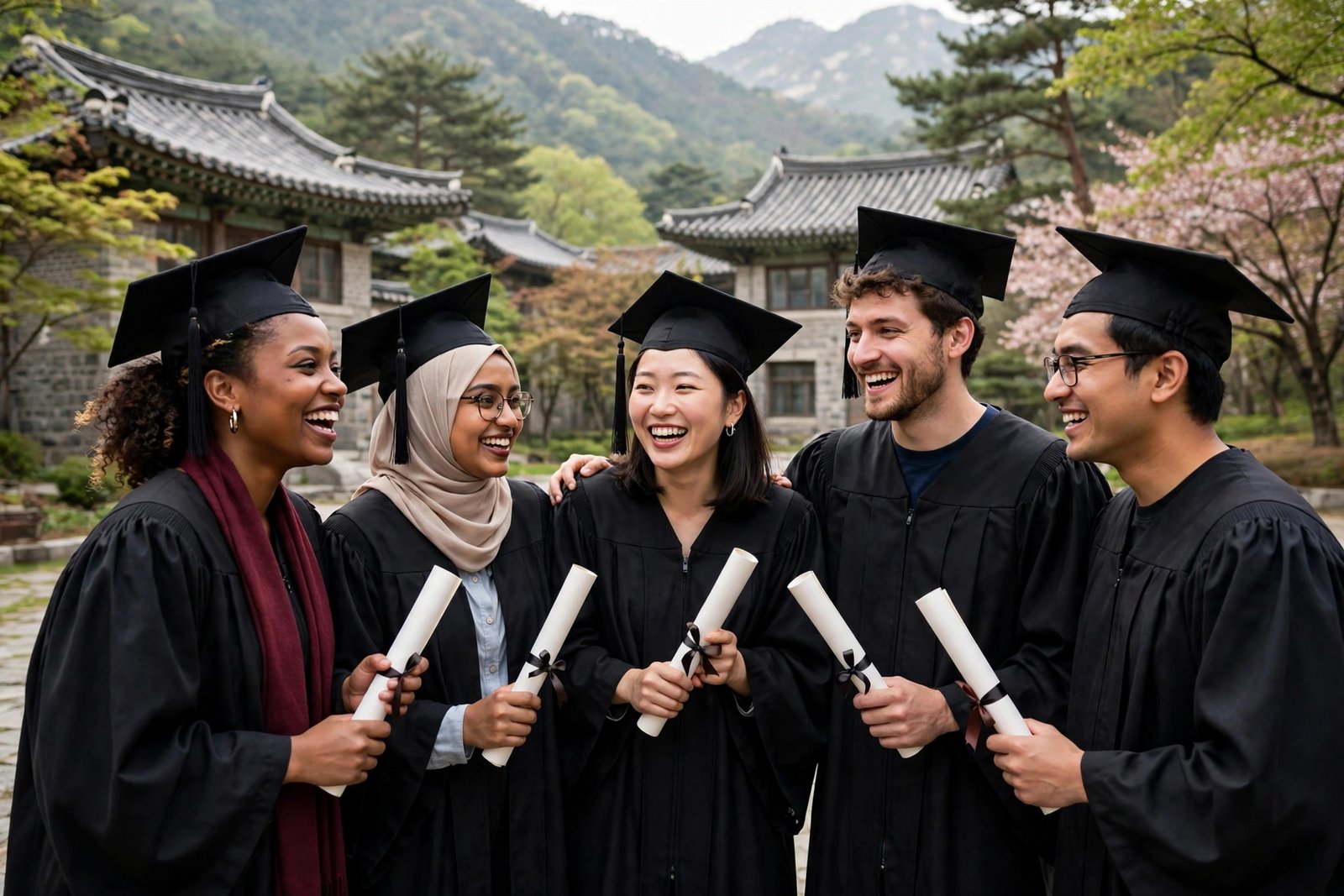
How to Apply: The Complete Sequence
- Read the current guidelines end to end. Download the GKS-U or GKS-G Application Guidelines and the University Information file from the GKS Notice board on Study in Korea. Every date, quota and form in this article is subordinate to those documents.
- Choose your track and universities. Embassy Track: up to three universities, at least one Type B. University Track: one university, one department. Check each department in the University Information file for its own language and eligibility notes.
- Start document legalisation immediately. Graduation certificates and transcripts generally require apostille or consular legalisation, and citizenship proofs for you and your parents must be assembled in the prescribed form. In many countries this step alone consumes a month.
- Write the personal statement. Cover your motivation, your academic preparation, relevant experience and awards, and your character and goals — in specific, evidenced paragraphs, not general praise of Korea.
- Write the study plan. For undergraduates: your language preparation plan, your degree study plan by year, and your post-graduation plan. For graduates: a research-grounded plan naming your field, research questions, methods and the department resources you will use.
- Obtain the recommendation. One recommendation letter in the GKS format, sealed as the guidelines require, from a teacher, professor or supervisor who knows your academic work.
- Complete the remaining forms. Application form, applicant agreement, pledge, self medical assessment and consent for records verification — signed and dated exactly as instructed.
- Attach score evidence. TOPIK certificates earn bonus evaluation points (and level 5–6 changes your language-year status); English scores support your file where relevant; include up to the permitted number of award certificates.
- Submit through your single track. Embassy Track applications are submitted online through the Study in Korea portal within the embassy window; University Track files go to the university by its own deadline. Retain proof of submission.
- Pass the rounds and complete final steps. Survive the screening rounds, complete the official medical examination when requested, receive final selection, apply for the D-2 student visa, and travel on the instructed dates for the language program or semester start.
Documents Checklist
Application form; personal statement; study plan or research proposal; one sealed recommendation letter; applicant agreement and pledge; self medical assessment; personal data consent form; proof of citizenship for the applicant and both parents (birth certificates, family registration extracts, passports or national documents as your country’s list specifies), legalised as required; graduation certificate or expected-graduation certificate; full official transcripts, legalised as required; optional TOPIK and English certificates; optional award certificates within the stated limit; and a passport copy where requested. Every name spelling and date must agree across the entire file — NIIED and embassy reviewers return or reject files for discrepancies that applicants consider trivial.
Deadlines and Selection Timeline
| Stage | GKS Undergraduate | GKS Graduate |
|---|---|---|
| Guidelines & announcement | September | February |
| Applications | Embassy Track from September; University Track September–November by university | February–March by embassy / university window |
| Screening rounds | October–December (embassy/university → NIIED → university) | April–June (embassy/university → NIIED → university) |
| Final results | December–January (7 January in the published 2027 undergraduate schedule) | Late June |
| Arrival in Korea | Late February | Late August |
| Program start | Korean language program, then degree from the following March cycle structure | Korean language program, then degree the following year — or degree directly for TOPIK 5–6 and Global Network scholars |
Exact closing dates inside those windows are set by each embassy and each university, and they differ — sometimes by weeks — between countries and institutions. The guideline months above come from the official selection schedules published on the Study in Korea portal; the binding date for your file is the one on your embassy’s notice or your university’s GKS page. Build your preparation backwards from the earliest plausible date, keep your documents in a tracker — the StudyGraduate tools section includes planning aids for exactly this — and never let legalisation be the last task on the list.
How Selection Is Scored, and How to Improve Your Chances
GKS evaluation combines your academic record, document review of the personal statement and study plan, the recommendation, and bonus points — TOPIK certification carries explicit additional weight in the graduate guidelines (with bonus points scaling by level), and English proficiency evidence and awards contribute within the published rubric. Universities in the final round assess departmental fit, which is why a generic study plan fails late even when it survived early. The highest-yield preparations, in order: secure any TOPIK certificate before applying (even level 1 or 2 is scored evidence of commitment, and level 3 or above carries stronger bonus value); write a study plan that a professor in your named department would recognise as belonging to their field; choose at least one Type B university you have genuinely researched for the Embassy Track; present your grades with official percentage or rank documentation where conversion is ambiguous; and submit a file with zero defects — every form signed, every legalisation attached, every name consistent. Selection at this scale is partly an audit, and immaculate files survive audits.
Life on GKS: An Honest Word About the Money
The all-inclusive monthly allowance is designed to cover a student life, not a professional one. In Seoul, the largest single cost is housing: university dormitories are the economical default during the language year, while private one-room rentals require deposits that can consume several months of allowance if you are unprepared. Scholars outside the capital — one practical benefit of Type B universities — find the same allowance stretches considerably further. Food, transport on a student budget, and the national health insurance contribution all come from the same payment. None of this makes GKS inadequate; generations of scholars complete degrees on it. It does mean the scholars who thrive financially are the ones who budget the annual total as a whole — including the settlement and completion components folded into it — rather than spending the first month’s payment as though it were a salary. For a sense of how Korean costs compare with other destinations, work through the budgeting material in the StudyGraduate guides before you depart.
Common Mistakes
Applying through both tracks and being excluded entirely. Forgetting the mandatory Type B choice on the Embassy Track. Choosing a department that is not in the cycle’s University Information file. Missing the legalisation requirement, or submitting documents whose name spellings differ. Writing a study plan about Korea in general instead of a department in particular. Ignoring TOPIK until after selection, when the bonus points and the language-year exemption are already decided. Budgeting from outdated blog figures that list separate settlement and insurance payments the current guidelines have folded into the allowance. Withdrawing early without reading the repayment clause. And, most basically, missing your own embassy’s or university’s specific closing date because you followed the month printed in a general guide — including this one. The guidelines and your track’s notice board are the only dates that count.
Frequently Asked Questions
Is GKS really 100 percent fully funded?
For the funded period, the core costs are covered: tuition (NIIED up to ₩5 million per semester with the university covering the excess and waiving admission fees), the Korean language program, a monthly all-inclusive living allowance, and round-trip economy airfare. Personal items the guidelines exclude — domestic travel at home, journey travel insurance, dependants’ costs — remain yours, so “fully funded” should still be read alongside the current guidelines’ benefits page.
What TOPIK level do I need to apply for GKS?
None is compulsory for application on the standard degree tracks. But TOPIK certification earns bonus points in selection, level 3 is the expected standard before progressing into degree study after the language year, and level 5 or 6 exempts you from the language program entirely and triggers the Korean Proficiency Grant automatically. Any certificate you can earn before the deadline improves your file.
Can I choose only Seoul universities on the Embassy Track?
No. Embassy Track applicants choose up to three universities and at least one must be a Type B (regional) university. An application naming only Type A metropolitan universities breaches the published rule and is excluded. Research your Type B choice properly — strong regional departments are also where the R-GKS stream concentrates its places.
What GPA do I need for GKS?
Your record must reach 80 percent or higher, or the top 20 percent of your class, or a CGPA of at least 2.64/4.0 (2.80/4.3, 2.91/4.5, 3.23/5.0) from your most recent program, as converted under NIIED’s table. If your transcript does not state a percentage or rank, obtain an official statement from your institution that does — boundary cases are decided on documents, not on your own conversion.
How much is the GKS monthly allowance in 2026?
It is paid as an all-inclusive annual total. The published 2027 undergraduate figures are ₩13,560,000 for the language year and ₩14,400,000 for degree years (₩1,130,000 and ₩1,200,000 per month). The 2026 graduate guidelines applied ₩16,560,000 per year for degree study (₩1,380,000 per month), with a higher rate for research scholars. Figures are revised between cycles — your cycle’s guideline PDF is the binding source, and this guide deliberately flags the year attached to each figure so you can check it.
Can I apply for GKS again if I am not selected?
Yes. Unsuccessful applicants may apply in a later cycle, provided they still meet the age, education and restriction rules for that cycle. Many successful scholars are second-attempt applicants whose second file fixed the first file’s defects — usually a stronger study plan, a TOPIK certificate or a better-judged university list.
Does GKS allow me to bring my spouse or children?
GKS funds the scholar only. There is no dependant allowance in the published benefits, and family costs, housing upgrades and dependant visas are entirely your own responsibility. Scholars with families should budget independently and confirm dormitory and visa rules for dependants with their university before accepting, because the allowance assumes a single student’s costs.
What happens if I fail the Korean language program?
Progression into the degree depends on completing the language program and reaching the required TOPIK standard; the guidelines set expectations around reaching level 3, and scholars who reach level 5 or 6 early exit the program ahead of schedule. Persistent failure to meet the language requirement can end the scholarship under the guideline rules, which is why treating the language year as a serious full-time course — not a holiday before the degree — is essential.
Sources & Verification
This guide was compiled from official sources checked at the time of writing: the Korean Government’s Study in Korea portal, Scholarships — GKS (Global Korea Scholarship) Program, for program structure, quotas, durations, benefits, Type A/Type B universities, eligibility and selection schedules for both degree levels; the National Institute for International Education (NIIED) GKS Application Guidelines published through Study in Korea, including the 2027 Global Korea Scholarship Application Guidelines for Undergraduate Degrees for tuition caps, language-program fees, annual allowance totals, country quotas and track rules; and the same portal’s GKS Exchange Students Program section for the exchange allowance and eligibility. Graduate allowance figures are identified in the text with the guideline year that published them, because NIIED revises amounts between cycles.
Disclaimer: Scholarship details, amounts, quotas and deadlines change yearly — always confirm deadlines and amounts on the official website before applying. StudyGraduate is an information portal, not an agency or a university, and we never promise selection, admission or visa approval to any applicant.
✅ Eligibility Criteria
- Check the official website for full eligibility criteria for your country
🎁 Benefits
- See the official website for the complete list of benefits
⚙️ Application Process
- 1Check your eligibility on the official site
- 2Prepare your documents and statements
- 3Submit the online application before the deadline
- 4Complete interviews or assessments if shortlisted
- 5Await the final selection announcement
📅 Important Dates
Deadlines vary by country and intake. Check the official website for country-specific dates.
📄 Required Documents
- Valid passport
- Academic transcripts & certificates
- Statement of purpose
- Letters of recommendation
- CV / resume
Commonly required — confirm the exact list on the official site.
❓ Frequently Asked Questions

Ready to Take the Next Step?
Explore more scholarships and study opportunities around the world.
Browse Scholarships →