
MS in Computational Biology Abroad: Eligibility, Fees, Top Universities and Careers
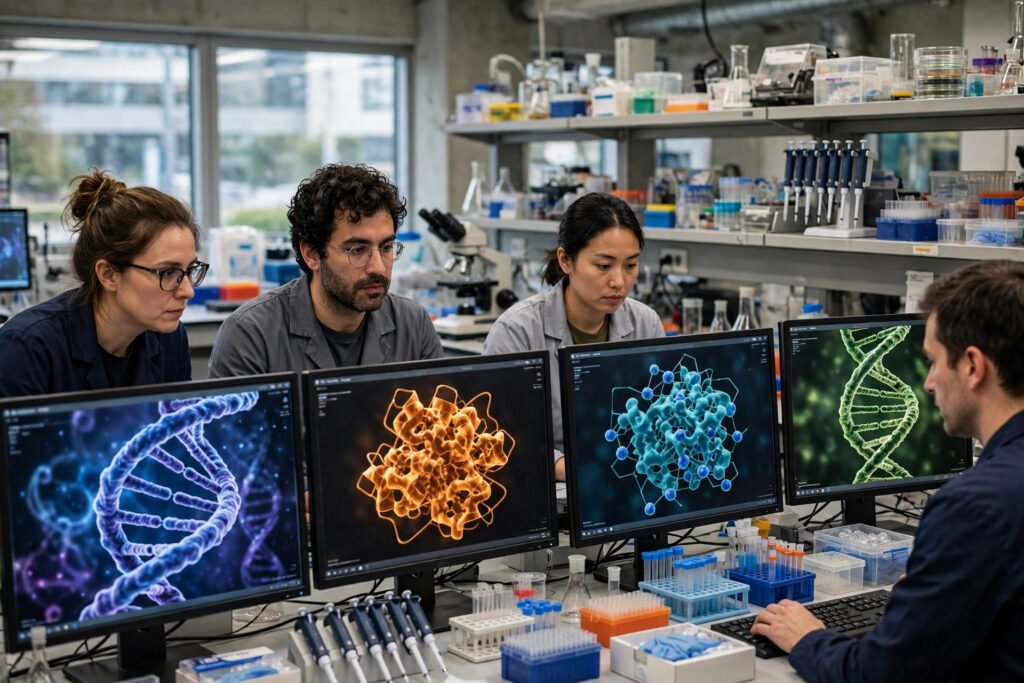
Computational biology is the discipline that turns biological data into understanding. Modern biology produces data at a scale no human can read directly: whole genomes, single-cell profiles, protein structures, medical images, population health records and ecological time series. An MS in Computational Biology Abroad trains you to analyse that data with programming, statistics, machine learning and mathematical modelling — and, crucially, to understand the biology well enough to ask the right questions and to recognise a biologically meaningless answer when a model produces one.
The field overlaps heavily with bioinformatics, and the two titles are often used interchangeably. As a rough guide, bioinformatics emphasises tools, databases and pipelines for biological data, while computational biology emphasises models, algorithms and theory for biological systems. In practice, most master’s programmes cover both, and employers hire across both titles. Do not reject a strong bioinformatics programme because your target title is computational biology, or vice versa. Compare the curriculum, the programming and statistics training, and the thesis or capstone, not the label alone.
This degree suits two kinds of graduate, and good programmes are designed for both. Biology graduates who can code, or who are willing to learn, gain the computational skills that modern life-science research and industry now require. Computer science, mathematics and statistics graduates gain the biology — molecular biology, genetics, cell biology and systems biology — that lets them work credibly on biological problems. The degree’s value lies precisely in that bridge: neither pure biology nor pure computing alone is enough for the jobs it leads to.
At a Glance
| Item | Typical position |
|---|---|
| Degree level | Master’s (MSc or MS), taught or research, depending on the university |
| Typical duration | 1 year full-time in the UK; 2 years in much of continental Europe; 1.5 to 2 years in the USA and Australia |
| Entry background | Usually a bachelor’s degree in biology, computer science, mathematics, statistics, physics, engineering or a related quantitative or life-science subject |
| Core subjects | Programming (Python, R), statistics and machine learning, genomics, sequence analysis, structural biology, systems biology |
| Signature assessment | A thesis, capstone or research project, often with a real dataset or industry or laboratory partner |
| Best suited to | Graduates who enjoy both biology and computing, and who want research, biotech, pharma or health-data careers |
| Less suited to | Applicants who want only wet-laboratory work, or only general software engineering with no biology |
What You Actually Study
Most programmes begin by levelling the cohort. Biology graduates take intensive programming and statistics; computing graduates take molecular biology, genetics and cell biology. The University of Bern’s MSc in Bioinformatics and Computational Biology, for example, begins with an introduction to programming and Linux for biology graduates and an introduction to biology and laboratory work for computing and mathematics graduates, before both groups follow common courses in statistical and computational tools and big-data analysis. Boston University’s MS in Bioinformatics requires molecular biology, computational biology covering genomes, networks and evolution, biological database systems, physical chemistry for systems biology, a graduate seminar and an internship, with electives filling the remaining credits. St. John’s University’s MS in Computational Biology and Biostatistics requires biochemistry, molecular biology, bioinformatics, cell biology, probability, statistical modelling, computing, linear algebra and computational biology, plus electives and a comprehensive examination.
After the foundations, the core covers sequence analysis and genomics (alignment, variant calling, genome assembly, transcriptomics), statistical genetics and biostatistics, machine learning for biological data, structural bioinformatics and protein modelling, systems biology and network analysis, and data management for large biological datasets. You will learn Python and R, the Linux command line, version control, workflow tools and common bioinformatics software, and you will practise reproducible analysis — code, data and documentation that another researcher can actually rerun. That last skill is increasingly what separates a employable graduate from a graduate who can only run a pipeline once.
Electives let you specialise. Common directions include computational genomics and precision medicine, drug discovery and computational chemistry, single-cell and spatial omics, microbiome analysis, evolutionary and population genomics, biomedical imaging, health informatics, and agricultural or environmental genomics. Choose electives by the sector you want: pharma and biotech value genomics, drug discovery and statistics; hospitals and health-data employers value health informatics, biostatistics and data governance; academic research values modelling, algorithms and a strong thesis. A short, honest rule: pick the specialism whose datasets you enjoy cleaning, because in real jobs most of the work is data wrangling, quality control and interpretation, not glamorous model building.
Ethics and governance run through good programmes: genomic data is sensitive, consent and privacy matter, and algorithms trained on unrepresentative data can produce biased medical conclusions. Courses in research ethics, data protection and scientific integrity are not administrative extras; they are part of professional competence in this field, and employers in health and pharma will probe them in interviews.
Who This Degree Is For — and Who Should Think Twice
This degree fits biology graduates with quantitative aptitude, computing and mathematics graduates with an interest in biology and health, and professionals in life sciences, medicine or data roles who want a formal computational credential. It also fits graduates aiming at a PhD in computational biology, bioinformatics, genomics, systems biology or biostatistics, for whom a research master’s with a strong thesis is an ideal preparation.
Think twice if you dislike programming or statistics, because both are unavoidable, and if you want a purely laboratory-based career, a wet-lab master’s or a laboratory technician route may fit better. Think twice too if you want general software engineering: a computer science master’s will serve that goal more directly, and you can add biology later through domain experience. Computational biology is a bridge degree, and bridge degrees reward people who genuinely enjoy both sides of the bridge.
A practical test: take a public genomic dataset, follow a beginner tutorial in Python or R, and spend a weekend cleaning and visualising it. If the frustrations of messy data feel interesting rather than merely annoying, and if you find yourself asking what the biology means rather than only whether the code runs, this degree is a strong match.
Eligibility and Entry Requirements
Requirements vary by university, and the official programme page is always the final authority. The patterns below reflect published programme requirements and general international-applicant rules.
In the United Kingdom, a one-year MSc typically requires a good bachelor’s degree (usually a 2:1 or equivalent) in a relevant life-science, computing, mathematics or physical-science subject. Programmes commonly expect some prior programming, statistics or mathematics, but many provide bridging material for biology graduates. English requirements for international students are commonly IELTS 6.5 overall with no component below 6.0, though thresholds vary by university.
In the United States, an MS in computational biology or bioinformatics typically requires a bachelor’s degree in a related field, transcripts, a statement of purpose, letters of recommendation and English proficiency for international students. Boston University’s MS in Bioinformatics, for instance, admits students with a bachelor’s degree in a field related to bioinformatics, noting that entrants typically have strength in either the computational area or in biochemistry and molecular biology, but not both — the programme is designed to build the missing side. GRE requirements vary and have been waived or made optional at many universities in recent years. Research-based programmes may require or prefer prior research experience.
In continental Europe, a two-year MSc (120 ECTS) normally requires a bachelor’s degree in a relevant field, with the programme providing bridging courses for the cohort’s weaker side, as at Bern. English requirements are commonly IELTS 6.5 or TOEFL equivalent. In Switzerland, Germany and the Netherlands, check whether the programme is taught entirely in English and whether a thesis, internship or both are required, because structures differ. In Australia, master’s entry typically requires a bachelor’s degree in a relevant discipline, with English requirements commonly IELTS 6.5 overall, and related degrees in bioinformatics, biotechnology or data science may be the closest option at some universities. In Canada, a master’s in a related field normally requires a four-year bachelor’s degree, and research programmes may require a supervisor’s agreement before admission.
Across all countries, a strong application shows both sides of the bridge: biology or computing coursework, programming experience (even self-taught, evidenced by a GitHub portfolio or a small project), statistics or mathematics, and a clear statement of purpose naming a biological problem you want to work on computationally. A portfolio matters more in this field than in many others. A short, well-documented analysis of a public dataset, with code and a plain-language summary of findings and limitations, will impress an admissions tutor more than a generic statement of enthusiasm.
Tuition Fees and Living Costs
Fees vary widely and change every year; the ranges below are broad planning guides, not quotes, and the current fee must be confirmed on each university’s official page. International tuition for a one-year UK master’s in this area commonly falls in the range of about £26,000 to £38,000, with laboratory-based programmes sometimes at the higher end. In continental Europe, public universities in Germany often charge no tuition for a consecutive master’s, only a semester contribution, while the Netherlands charges non-EU/EEA students a published institutional fee commonly about €17,000 to €22,000 per year, and Switzerland charges fees that vary by institution. In the USA, international graduate tuition varies enormously, commonly from about US$25,000 to US$65,000 per year. In Australia, international master’s tuition commonly falls in the range of about AUD 40,000 to AUD 55,000 per year.
Visa financial evidence is separate from real living costs. For a UK Student visa, applicants must show £1,529 per month for study in London and £1,171 per month outside London. For Germany, the blocked account requirement is €11,904. For Australia, the student visa living-cost evidence requirement is AUD 29,710. For Canada, proof of funds outside Quebec rose from CAD 22,895 to CAD 23,448. Use the tuition fee calculator, the cost-of-living calculator and the study abroad budget planner to model your shortlist for the specific city.
| Destination | Indicative international tuition (per year) | Visa financial evidence to note |
|---|---|---|
| United Kingdom (1-year MSc) | About £26,000–£38,000 | £1,529/month London; £1,171/month outside London |
| Germany (public university) | Often no tuition for a consecutive master’s; semester contribution applies | Blocked account €11,904 |
| Netherlands (2-year MSc) | About €17,000–€22,000 | Check the university’s published financial requirement |
| USA (MS) | About US$25,000–US$65,000, varies greatly | Check the I-20 financial certification for your university |
| Australia | About AUD 40,000–AUD 55,000 | AUD 29,710 living-cost evidence for a student visa |
| Canada | About CAD 25,000–CAD 50,000 | CAD 23,448 proof of funds (outside Quebec) |
Top Universities and Countries for This Programme
Shortlist by curriculum, computing infrastructure, data access and thesis opportunities, not by title alone. In the USA, Boston University’s MS in Bioinformatics offers a pre-professional, industry-oriented programme with a bioinformatics internship and a curriculum spanning molecular biology, computational biology, databases and systems biology. The University of Delaware’s MS in Bioinformatics and Computational Biology combines a science core, an ethics core, electives and a thesis. St. John’s University’s MS in Computational Biology and Biostatistics combines biology, probability, statistical modelling and computing with a comprehensive examination. Virginia Commonwealth University’s MS in Bioinformatics offers thesis and non-thesis (industry-oriented) options with core courses in bioinformatics, molecular biology and computation. These programmes suit students who want a US degree with a clear industry or research route.
In Europe, the University of Bern’s MSc in Bioinformatics and Computational Biology offers a four-semester, 120-ECTS programme with bridging courses, in-depth statistical and machine-learning training, big-data analysis across genomics, personalised medicine, proteomics and metabolomics, a semester project and a six-month research thesis. It suits students who want depth, a research thesis and a European setting. Other strong European options include bioinformatics and computational biology programmes in the UK, Germany and the Netherlands, where strengths in genomics, systems biology and health data vary by institution — compare module lists and research groups, not country reputations alone.
Explore the universities directory and the Courses and Programs directory, and use the university comparison tool to weigh fees, duration and curriculum. For adjacent depth, see the MSc Computer Science profile for computing foundations and the Master of Public Health profile for the health context in which much computational biology is applied. Use the career path explorer to map computational biology roles against your background.
Careers and Salaries
Graduates work as bioinformaticians, computational biologists, genomic data scientists, biostatisticians, research scientists, data scientists in biotech and pharma, health-data analysts, and research software engineers. Employers include pharmaceutical and biotechnology companies, genomics and diagnostics firms, hospitals and health systems, government research institutes, universities and agricultural and environmental genomics organisations. Some graduates proceed to a PhD, which remains the usual route into independent academic research and senior research-scientist roles.
There is no BLS occupation titled “computational biologist”, so no field-specific salary should be quoted as if one existed. The nearest official occupations, labelled here as PROXIES, give an honest benchmark. In the USA, data scientists earned a median annual wage of $120,230 in May 2025 (BLS Occupational Outlook Handbook, May 2025), with employment projected to grow 35 percent from 2025 to 2035 and about 24,800 openings per year on average over the decade. Medical scientists, except epidemiologists, earned a median of $103,410 in May 2025 (BLS, May 2025), with employment projected to grow 13 percent over 2025–35. Microbiologists earned a median of $87,990 in May 2025 (BLS, May 2025), projected to grow 6 percent over the same period. The broader life, physical and social science group earned a median of $82,530 in May 2025 (BLS, May 2025). These are US national medians for related occupations, not computational-biologist salaries, and actual pay varies by sector, city and experience: industry roles in biotech hubs often pay more than academic roles, and senior roles requiring a PhD pay more than entry-level analyst roles.
| Nearest official occupation (PROXY) | US median, May 2025 (BLS) | Projected growth, 2025–35 (BLS) |
|---|---|---|
| Data scientists | $120,230 | 35% |
| Medical scientists, except epidemiologists | $103,410 | 13% |
| Microbiologists | $87,990 | 6% |
| Life, physical and social science occupations (group) | $82,530 | Not stated as a single figure here |
Employability depends on a portfolio of reproducible work. Employers want to see code on GitHub, analyses of real datasets, a thesis or capstone with a clear question and honest limitations, and the ability to explain a result to a biologist who does not code and to a programmer who does not know the biology. Internships matter greatly: Boston University’s programme, for example, includes a bioinformatics internship, and industry-oriented tracks elsewhere include externships for the same reason. Take one if your programme offers it, even if it extends your degree, because a first industry or laboratory placement often determines the first job.
Post-study work rights vary by destination and change frequently. In the UK, the Graduate Route currently allows eligible graduates to stay and work, with an announced shortening to 18 months for most graduates from 1 January 2027 — an announced change, not the current rule. In the USA, eligible graduates may use Optional Practical Training (OPT), with a STEM extension for qualifying degrees, which is relevant for many computational biology programmes. In Canada, eligible graduates may apply for a Post-Graduation Work Permit (PGWP). In Australia, the Temporary Graduate visa (subclass 485) applies to eligible graduates. Confirm duration and eligibility on official government pages at application time.

Scholarships for This Field
Funding follows the usual science routes: university merit scholarships, government scholarships such as Chevening and Commonwealth awards for eligible UK applicants, the NL Scholarship and university awards in the Netherlands, DAAD awards in Germany, and graduate assistantships and research funding in the USA. Because computational biology spans life science and computing, apply for both science and data-science scholarships, and check departmental and research-group funding pages, which often list assistantships tied to specific projects.
Use the scholarship finder and the scholarships directory, and apply early. A strong application emphasises programming and statistics preparation, a portfolio project, and a specific biological problem you intend to work on.
How to Choose Between Programmes
Compare programmes on six questions. First, how much programming and statistics will you actually do, and in which languages? Second, does the programme provide bridging for your weaker side, or does it assume you already have both? Third, is there a thesis, a capstone, an internship or an externship, and with whom? Fourth, what computing resources, datasets and research groups will you access? Fifth, what do graduates do — industry, health, government or PhD — and in which sectors? Sixth, what are the total cost, duration and post-study options? A programme with a strong thesis, real datasets and an internship is worth more than a programme with a fashionable title and only lecture-based assessment.
Also consider whether you want a research or a professional programme. A research master’s with a thesis suits PhD aspirants; a professional or industry-oriented master’s with a capstone and internship suits graduates heading straight into biotech, pharma or health-data roles. Both are legitimate; the mistake is choosing one while aiming at the other’s destination.
Application Timeline for 2026/2027 Entry
Start 12 to 15 months ahead. Build or refresh programming skills early — a short Python or R course and a portfolio project will strengthen both admission and the first term. Check prerequisite biology or computing coursework and fill gaps. Prepare English tests early. Draft a statement of purpose naming a biological problem and a computational approach. Request references from people who know your quantitative or laboratory work. Apply for scholarships in parallel. Use the application deadline finder and the document checklist to stay organised.
Skills Employers Test at Interview
Computational biology interviews are practical. An interviewer may give you a messy dataset — a gene-expression table with missing values, inconsistent sample labels and a batch effect — and ask what you would do first. A strong answer starts with quality control and provenance: where did the data come from, how were samples collected and sequenced, what do the metadata actually say, and which samples should be excluded and why, with the decision documented rather than silently made. Only then does it move to analysis: normalisation, dimensionality reduction, differential analysis or modelling, with appropriate multiple-testing correction and a check that the result is robust to reasonable alternative choices. Candidates who jump to a fashionable machine-learning model before checking data quality reveal inexperience, however fluent their coding sounds.
Communication is tested just as directly. You may be asked to explain a result to a biologist who does not code, or to defend a modelling choice to a statistician who does not know the biology. Practise both: a short, plain-language summary that states the biological question, the method, the finding and its limitations, and a technical appendix with code, parameters and version numbers that lets another analyst reproduce the work. Keep a public portfolio of two or three such projects, each with a README explaining the question, the data source, the steps and what you would do differently. In a field where tools change every year, that portfolio — reproducible, honest about limitations, biologically literate — is more durable evidence than any list of software names on a CV.
Frequently Asked Questions
Is computational biology the same as bioinformatics?
They overlap heavily. Bioinformatics emphasises tools, databases and pipelines; computational biology emphasises models, algorithms and theory. Most master’s programmes cover both, and employers hire across both titles, so compare curricula rather than labels.
Can a biology graduate with little coding experience succeed?
Yes, if the programme provides bridging programming and statistics and you commit to learning them. Many programmes are explicitly designed for biology graduates to add computing, and for computing graduates to add biology. Expect an intensive first term either way.
Can a computer science graduate with little biology succeed?
Yes, on the same condition in reverse: the programme should provide molecular biology, genetics and systems biology foundations, and you should be willing to learn them properly, not merely to treat biological data as abstract numbers.
Do I need a PhD to work in computational biology?
No for many industry, health-data and analyst roles, where a master’s with a strong portfolio and internship is sufficient. A PhD is usually needed for independent academic research and senior research-scientist roles, so choose a research master’s with a thesis if that is your goal.
What salary can I expect?
No official salary exists for “computational biologist” as a standalone occupation. The nearest BLS proxies in this guide are data scientists at $120,230, medical scientists at $103,410 and microbiologists at $87,990 (US medians, May 2025). Actual pay depends on sector, city, experience and qualifications, and these figures are benchmarks, not promises.
Is this degree useful outside pharma and biotech?
Yes. Graduates work in hospitals and health systems, government research, agriculture, environmental genomics, diagnostics and general data science, where the combination of statistics, programming and domain understanding transfers well.
Which programming languages matter most?
Python and R dominate in this field, with Linux command-line skills, version control and workflow tools close behind. Learn Python and R well, rather than collecting superficial familiarity with many languages.
What if my university offers bioinformatics but not computational biology?
Take it if the curriculum matches your goals — genomics, statistics, machine learning, a thesis or capstone, and preferably an internship. Employers in this sector care about skills and portfolio evidence far more than the exact degree title.
Sources & Verification
Sources consulted: Boston University MS in Bioinformatics programme pages; University of Bern MSc in Bioinformatics and Computational Biology programme pages; St. John’s University MS in Computational Biology and Biostatistics programme pages; University of Delaware MS in Bioinformatics and Computational Biology programme pages; Virginia Commonwealth University MS in Bioinformatics programme pages; US Bureau of Labor Statistics, Occupational Outlook Handbook — Data Scientists, Medical Scientists, Microbiologists, and Life, Physical, and Social Science Occupations (May 2025 medians and 2025–35 projections); UK, German, Australian and Canadian government visa financial-requirement guidance as summarised in the programme brief (UK £1,529/£1,171; Germany €11,904; Australia AUD 29,710; Canada CAD 23,448). Tuition ranges in this article are broad planning ranges, not official quotes for any single university.
Figures change yearly — confirm fees and requirements on the official university page. StudyGraduate is an information portal, not an agency — never promise admission, jobs, salaries or visa/PR outcomes. This article does not promise admission, employment, salary or visa outcomes.