Top 15 Fully Funded Scholarships in the Middle East 2026/2027
Top 15 Fully Funded Scholarships in the Middle East 2026/2027 The Middle East has quietly become one of the most generous study destinations in the world. Governments and universities in Saudi Arabia, the United Arab Emirates, Qatar, Oman, Kuwait, Türkiye, Egypt, Lebanon and Israel are investing heavily in research universities, and many of them fund ... <a title="Top 15 Fully Funded Scholarships in the Middle East 2026/2027" class="read-more" href="https://studygraduate.com/scholarship/top-15-fully-funded-scholarships-in-the-middle-east-2026-2027/" aria-label="Read more about Top 15 Fully Funded Scholarships in the Middle East 2026/2027">Read more</a>
📖 Overview
Top 15 Fully Funded Scholarships in the Middle East 2026/2027
The Middle East has quietly become one of the most generous study destinations in the world. Governments and universities in Saudi Arabia, the United Arab Emirates, Qatar, Oman, Kuwait, Türkiye, Egypt, Lebanon and Israel are investing heavily in research universities, and many of them fund international graduate students completely — full tuition, a monthly stipend, housing, health insurance and flights — because they want talent, not tuition income. For a student from Bangladesh, India, Pakistan, Nepal, Nigeria or Indonesia, that changes the calculation entirely: instead of proving you can pay, you compete on grades, research fit and preparation.
This guide ranks the 15 strongest fully funded and near-fully funded opportunities in the region for the 2026/2027 cycle. A word of honesty first, because it matters: in the Middle East, “fully funded” does not always mean the same thing. At King Abdullah University of Science and Technology (KAUST), every admitted graduate student is funded automatically. At Hamad Bin Khalifa University (HBKU) in Qatar, a PhD place can be funded at 100% while a master’s place in the same university may receive only a 60% or 75% tuition waiver. At Khalifa University in the UAE, the top tier is genuinely full, while lower tiers are partial. We tell you which is which for every entry, so you never apply expecting money that was never promised. Always confirm the current cycle’s terms on the official site before you apply — amounts and deadlines change, and this article was verified in October 2026.
If you are comparing regions, browse the wider scholarship directory on StudyGraduate, check where these universities sit in the global rankings, and read our companion ranking of the top 25 fully funded scholarships in the world for international students 2027 before you finalise a shortlist.
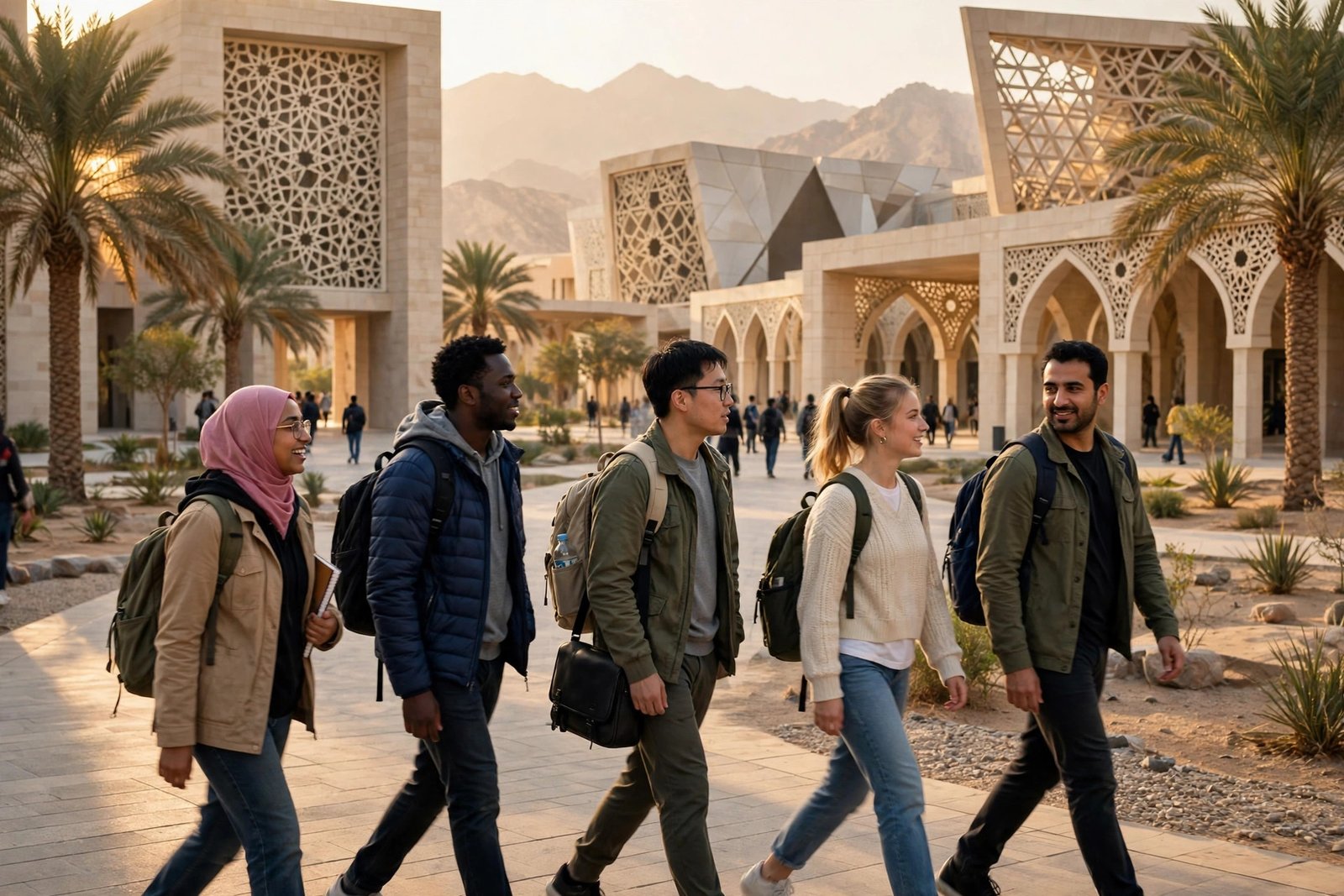
At a Glance: The 15 Scholarships Compared
| # | Scholarship | Country | Level | Headline coverage |
|---|---|---|---|---|
| 1 | KAUST Fellowship | Saudi Arabia | Master’s, PhD | Full tuition + $20,000/yr (MS) or $25,000–$30,000/yr (PhD) + housing + health cover |
| 2 | Khalifa University Graduate Scholarships | UAE | Master’s, PhD | Tiered: top tiers full tuition + stipend + accommodation + insurance |
| 3 | MBZUAI Scholarship | UAE | Master’s, PhD (AI) | Full tuition + monthly stipend + accommodation for admitted scholars |
| 4 | Hamad Bin Khalifa University funding | Qatar | Master’s, PhD | PhD tuition waiver 100%; master’s 60–75%; stipend QAR 7,000–9,000/mo for selected recipients |
| 5 | Qatar University International Scholarship | Qatar | Undergraduate, graduate | Tuition + housing + stipend + annual flight for competitive awards |
| 6 | Doha Institute Scholarships | Qatar | Master’s, PhD | Tamim (merit) and Sanabel (need) awards covering tuition and housing |
| 7 | Study in Saudi / Saudi university scholarships | Saudi Arabia | All levels | Tuition + stipend + housing at participating public universities |
| 8 | UAEU Graduate Scholarships | UAE | Master’s, PhD | Tuition waivers and graduate assistantships with stipend |
| 9 | Türkiye Burslari | Türkiye | All levels | Tuition + 6,500 / 9,500 / 13,000 TL per month by level (current published rates) + housing + flight + language year |
| 10 | Weizmann Institute fellowships | Israel | Master’s, PhD, postdoc | Full tuition + monthly fellowship for research students |
| 11 | American University of Beirut graduate funding | Lebanon | Master’s, PhD | Assistantships and fellowships covering tuition for selected students |
| 12 | American University in Cairo fellowships | Egypt | Master’s | Full and partial fellowships with tuition and stipend for top awards |
| 13 | Sultan Qaboos University scholarships | Oman | Postgraduate | Limited government and university awards; verify current call |
| 14 | Kuwait scholarships for non-Kuwaitis | Kuwait | Undergraduate, postgraduate | Limited places via Ministry channels; verify current call |
| 15 | KAUST Global Fellowship | Saudi Arabia | Postdoctoral | $75,000/yr stipend + up to $40,000 research budget + housing and schooling support |
The Ranked List
1. KAUST Fellowship — Saudi Arabia
KAUST is the benchmark for funded graduate study anywhere in the world, not just the Middle East. According to KAUST’s own Fees and Funding page, the Fellowship includes full tuition and bench fee coverage worth up to USD $35,000 per year, a monthly stipend worth USD $20,000 per year for M.S. students and USD $25,000 to $30,000 for PhD students depending on qualifications and progress, base accommodation, health insurance for students and eligible dependants living on campus, and relocation support covering visa, relocation and travel costs. KAUST values the whole package at between $70,000 and $80,000 per year. There is no separate scholarship application: admission is the scholarship. The catch is focus — KAUST is science and engineering only, organised in biological and environmental, computer and mathematical, and physical science divisions — and competition from every continent. If your field is STEM and your record is strong, this belongs at the top of any list. Use StudyGraduate’s study abroad hub to compare it with funded STEM routes in Europe and Asia before deciding.
2. Khalifa University Graduate Scholarships — UAE
Khalifa University of Science and Technology in Abu Dhabi is the UAE’s leading research university, and its graduate scholarships are assessed automatically as part of admission — you do not file a separate scholarship form. The university’s published handbook and scholarship guidance describe competitive, merit-based awards for UAE national and international graduate students, with benefits varying by scholarship type: master’s scholars may receive full or partial tuition coverage, textbooks, accommodation, medical insurance, and visa and travel support, while doctoral research teaching scholars receive the most complete packages. Be precise here: Khalifa does not publish one single stipend figure for all general graduate scholars — amounts vary by programme and scholarship type, and the only specific monthly figure on its public scholarship material in recent cycles relates to the joint CSC-KU PhD scheme for Chinese nationals. Blog posts quoting a single very large monthly figure for every student should be treated with caution. Check the current terms on the Khalifa University Student Handbook 2026–2027 and the university’s postgraduate scholarship pages. Admission minima commonly cited are a CGPA of 3.0 out of 4.0 for master’s and 3.25 for PhD, with English proficiency required.
3. Mohamed Bin Zayed University of Artificial Intelligence (MBZUAI) — UAE
MBZUAI in Abu Dhabi was created specifically for artificial intelligence, and it funds its graduate students generously because it is competing globally for a small, elite cohort in machine learning, computer vision, natural language processing, robotics and related fields. Admitted master’s and PhD students receive a scholarship package built around full tuition and a monthly stipend with accommodation support, on terms published by the university for each intake. Because the university is so specialised, fit is everything: a strong mathematics and programming background, research experience or strong projects, and a clear AI research direction matter far more than a generic statement about loving technology. If AI is not your field, skip this entry — there is no general-subject route here — but if it is, MBZUAI is one of the few places in the world where a funded AI degree comes with a focused research community from day one.
4. Hamad Bin Khalifa University — Qatar
HBKU, part of Qatar Foundation in Doha’s Education City, is frequently mislabelled online as simply “fully funded.” The reality in HBKU’s own scholarship guidelines is more nuanced and much more useful to know. Tuition waivers are standardised by programme: PhD programmes in science and in the humanities, social sciences and law colleges receive a 100% waiver; STEM master’s programmes receive 75%; many humanities, social sciences, public policy and JD programmes receive 60%; and some programmes, including the LL.M. and MS Economics in recent guidelines, receive 0%. Separately, selected international recipients have received a monthly stipend reported at QAR 7,000 for master’s and QAR 9,000 for PhD study, tied to research assistant duties. Waivers depend on merit, need and availability of funds and are not guaranteed to every admitted student. For a PhD applicant, HBKU can therefore be genuinely fully funded. For a master’s applicant, do the arithmetic on the remaining 25% or 40% of tuition before you celebrate. International graduate applications for Fall 2027 opened on 1 October 2026 with an international deadline of 1 February 2027 in the current cycle — confirm on HBKU’s official admissions pages.

5. Qatar University International Student Scholarship — Qatar
Qatar University, the national university, runs competitive scholarships for international students, most visibly at undergraduate level, alongside merit and excellence awards. Its international student scholarship has historically bundled tuition, university housing, a monthly allowance, textbook support and an annual air ticket for the strongest recipients, with separate excellence awards covering tuition for high achievers. Places are limited and awarded competitively, and the exact bundle differs by scholarship type, so read the university’s scholarship catalogue carefully rather than assuming every international admit is funded. Qatar University is a good option if you want a broad-subject university — engineering, business, health sciences, sharia and Islamic studies, education, law and more — in a small, wealthy, very safe Gulf state, rather than a specialist research institute.
6. Doha Institute for Graduate Studies Scholarships — Qatar
The Doha Institute is a graduate-only institution for social sciences, humanities, public administration, development economics, media, psychology and related fields, and it is one of the few places in the region built specifically for those disciplines. Its two best-known awards are the Tamim scholarship, awarded on merit, and the Sanabel scholarship, awarded on financial need; between them, awards can cover tuition, university housing, a monthly allowance and health insurance for selected students, with benefits differing between the two schemes. Teaching is primarily in Arabic with English used in some programmes and research, so language fit matters more here than in the Gulf’s English-medium science universities. For a social-science graduate from South Asia or Africa with strong Arabic or a willingness to work in it, Doha Institute is a distinctive and often overlooked route.
7. Study in Saudi and Saudi Public University Scholarships — Saudi Arabia
Beyond KAUST, Saudi Arabia funds international students at its public universities through the national Study in Saudi platform and university-level scholarship schemes at institutions such as King Saud University, King Abdulaziz University and Imam Muhammad ibn Saud Islamic University. Government scholarship packages at Saudi public universities have traditionally included tuition, a monthly allowance, housing, health care and an arrival flight, with religious studies, Arabic, sciences, engineering, medicine-adjacent and humanities programmes all represented depending on the university. Eligibility, gender and programme rules, age limits and quotas vary by university and nationality, and calls open and close on the platform’s timetable rather than a single national deadline. Treat this as a family of scholarships, not one award: pick the university and programme first, then verify that programme’s scholarship terms for your nationality in the current call.
8. United Arab Emirates University (UAEU) Graduate Scholarships — UAE
UAEU in Al Ain is the UAE’s oldest national university, and it supports graduate students through tuition-waiver scholarships and graduate assistantships that combine fee relief with a stipend in return for teaching or research duties. Full packages are most common for PhD students and for research-active master’s students attached to funded projects, which means your supervisor and research topic can determine your funding as much as your grades do. If you are applying to UAEU, contact a prospective supervisor early, ask directly whether assistantship funding is attached to the project, and get any funding promise in writing from the university rather than relying on a verbal assurance. Broad subject coverage — from engineering and IT to medicine, agriculture, business, law and humanities — makes UAEU the UAE’s most general funded option after Khalifa.
9. Türkiye Burslari (Türkiye Scholarships) — Türkiye
Türkiye sits between Europe and Asia and is routinely included in Middle East and wider regional lists. Its government scholarship is one of the world’s most complete: university placement, full tuition, free accommodation, health insurance, a one-year Turkish language course, and a flight at the start and on graduation. Monthly stipends are currently published at 6,500 TL for undergraduate, 9,500 TL for master’s and 13,000 TL for PhD students (the 2026 call printed the lower 4,500 / 6,500 / 9,000 TL figures) — modest in hard-currency terms, but paired with free housing and low living costs. The 2026 application window ran from 10 January to 20 February, and the next cycle is expected in the same months; always confirm on turkiyeburslari.gov.tr. Age limits apply (under 21 for bachelor’s, under 30 for master’s, under 35 for PhD) and minimum achievement is typically 70–75%, rising to 90% for health sciences. See our full profile of this scheme through the scholarships directory and compare it with European awards.
10. Weizmann Institute of Science Fellowships — Israel
The Weizmann Institute’s Feinberg Graduate School in Rehovot funds its research students through fellowships that cover tuition and provide a monthly living fellowship, because its model is full-time research in the natural sciences, mathematics and computer science. International students are eligible, teaching and study are in English, and the institute’s reputation in basic science is world-class. Funding levels and terms are set by the institute for each cohort and should be confirmed directly with the Feinberg Graduate School. This is a research-career award, not a taught-degree shortcut: you apply because a Weizmann laboratory is where you want to train. Applicants should also research visa, travel and personal circumstances carefully, as with any destination, and follow official guidance for their nationality.
11. American University of Beirut Graduate Funding — Lebanon
The American University of Beirut (AUB) is one of the region’s oldest and most respected universities, teaching in English across medicine, health sciences, engineering, business, agriculture and the humanities. Graduate funding at AUB is built mainly from graduate assistantships, fellowships and work-study attached to departments, which can cover tuition substantially or fully for selected master’s and PhD students, sometimes with a stipend. It is not a single national scholarship with one published bundle, so the honest approach is department by department: ask the programme you are applying to what proportion of its incoming graduate students receive full tuition support. Lebanon’s economic situation also makes it essential to confirm the currency and terms of any award in writing. For the right student, AUB offers an academic culture unlike anywhere else in the region.
12. American University in Cairo Fellowships — Egypt
The American University in Cairo (AUC) offers graduate fellowships for master’s students that range from partial tuition support to full fellowships combining tuition, a stipend and, for some awards, housing or insurance support. Named fellowships are tied to specific fields, nationalities and backgrounds, and university fellowships are awarded competitively on merit. As with AUB, there is no single “AUC full scholarship” that every admit receives; the value is in matching your profile to a named fellowship whose criteria you actually meet. Egypt offers low living costs by regional standards, a huge Arabic-learning environment, and strong programmes in areas such as migration studies, Middle East studies, public policy, engineering and business. Verify each fellowship’s current coverage on AUC’s official graduate fellowships pages.
13. Sultan Qaboos University Scholarships — Oman
Oman funds far fewer international students than Saudi Arabia, the UAE or Qatar, and Sultan Qaboos University (SQU) postgraduate scholarships for non-Omanis are limited and call-dependent. When offered, support can include tuition relief and allowances for selected research students, particularly where a student joins a funded research priority. We include SQU because students ask about Oman constantly — for its stability, safety and quality of life — but we rank it low for a practical reason: you cannot build an application plan around an award whose next international call is not guaranteed. Check SQU’s deanship of postgraduate studies for a live call before investing time, and treat any offer as a bonus rather than a plan A.
14. Kuwait Scholarships for Non-Kuwaitis — Kuwait
Kuwait has historically offered a small number of government scholarships to students from partner countries, typically arranged through cultural offices and ministries rather than an open global portal, with Kuwait University as the main host. Coverage in past schemes has included tuition, housing, a monthly allowance and health care, but availability is quota-based, nationality-specific and not published on a predictable annual cycle comparable to Türkiye Burslari or KAUST. That is exactly why it sits near the bottom of this ranking despite generous historical terms: if your country’s ministry or Kuwaiti cultural office announces places for 2026/2027, apply seriously; if it does not, no amount of searching will create a place. Never pay an agent who claims to sell Kuwait government scholarship seats.
15. KAUST Global Fellowship — Saudi Arabia (Postdoctoral)
We close with a postdoctoral award, included because so many readers of a Middle East list are finishing a PhD. The KAUST Global Fellowship supports early-career researchers for three years with, in the current call guidelines, an annual living stipend of US $75,000, a research budget of up to $20,000–$40,000 per year depending on division, medical insurance, housing depending on family status, relocation and travel support, and schooling or daycare support for eligible children. You need a KAUST faculty host who has agreed to support your project, and a PhD awarded within the call’s eligibility window. It is not a student scholarship, and we label it as such rather than padding the student list — but for a new PhD graduate in KAUST’s fields, it is arguably the most generous early-career package in the region.
Eligibility: Who Can Apply?
Across these 15 awards, five eligibility themes repeat. First, level: most Gulf funding is for master’s and PhD study; undergraduate funding exists mainly through Qatar University, Saudi public universities and Türkiye Burslari. Second, grades: expect a minimum CGPA around 3.0 out of 4.0 for master’s admission at the funded Gulf universities, higher for the most competitive packages, and a stronger record again for PhD direct entry. Third, language: Gulf science universities teach in English and typically require IELTS or TOEFL at admission or by enrolment, while Doha Institute centres Arabic and Türkiye Burslari funds a Turkish language year instead of demanding Turkish upfront. Fourth, field fit: KAUST, MBZUAI and Weizmann fund only their own fields — no scholarship officer can fund a subject the institution does not teach. Fifth, nationality and quotas: some awards are open to all nationalities (KAUST, Khalifa, MBZUAI), while others allocate by country, ministry or partner agreement (Kuwait, some Saudi and Oman schemes). Check your nationality’s eligibility before you write a single essay.
How to Apply, Step by Step
- Choose a level and field first. Decide master’s versus PhD and a precise research direction; in this region, funding follows programmes and supervisors, not vague ambition.
- Shortlist three to five awards. Mix one dream award (KAUST, MBZUAI) with realistic funded options (a Saudi public university, Türkiye Burslari, UAEU) so one rejection does not end your year.
- Verify the live call. Open the official page for each award and note the deadline, stipend and coverage for your nationality and level. If 2027 dates are not yet published, plan around the last cycle’s months and say so in your own calendar.
- Contact supervisors where relevant. For PhD and assistantship funding at UAEU, SQU and similar universities, email a prospective supervisor with a focused research idea and your CV before applying.
- Prepare documents early. Transcripts, degree certificates, passport, English scores, CV, statement of purpose, research proposal and two or three references are the common core (see the checklist below).
- Apply for admission and funding together where required. At KAUST, Khalifa and HBKU, funding is considered inside admission; at Türkiye Burslari, one application covers placement and funding.
- Submit before the deadline, not on it. Gulf portals slow down near closing dates, and attested documents can take weeks in South Asia and Africa. Build a two-week buffer.
- Prepare for interviews. Funded Gulf programmes interview for research fit and seriousness. Know your proposal, your supervisor’s recent work, and why this university — not just why this country.
Required Documents
Prepare certified copies and clear scans of: your passport; bachelor’s and, for PhD, master’s certificates and full transcripts; English proficiency scores where required; a two-to-three-page academic CV; a statement of purpose (typically 500–1,000 words where specified); a research statement or proposal for PhD applications; two or three recommendation letters; and any programme-specific items such as a GRE score (required by some UAE programmes in recent cycles — check your programme), a portfolio, or medical and police certificates requested after selection. Documents not in English or Arabic usually need certified translation, and some Gulf states require embassy attestation before enrolment. Keep one master folder with identical file names across applications; inconsistent names and dates are a common, avoidable reason for administrative rejection. Our free student tools, including a deadline tracker and document checklist, can help you keep five applications straight.
Deadlines and Timeline
| Period | What happens | Examples in this list |
|---|---|---|
| Oct–Nov 2026 | Applications open for Fall 2027 Gulf graduate intakes | HBKU international applications opened 1 Oct 2026 |
| Dec 2026–Jan 2027 | Main Gulf graduate deadlines begin to close | KAUST Fall intake rounds; Khalifa intake rounds — confirm live dates |
| 10 Jan–20 Feb (annual pattern) | Türkiye Burslari application window | 2026 window was 10 Jan–20 Feb 2026; next cycle expected in same months |
| 1 Feb 2027 | HBKU international graduate deadline (current cycle) | HBKU Fall 2027 |
| Spring 2027 | Interviews, results and visa processing | Varies by university and country |
| Aug–Sep 2027 | Enrolment for Fall 2027 | Most Gulf and Turkish programmes |
Where a 2027-cycle date has not been published, this table says so or gives the last cycle’s pattern as a pattern — never treat a pattern as a promise. The official page for your award is the only deadline that counts.
How to Improve Your Chances
Funded places in the Gulf are won on research fit more than on hardship stories. Name the laboratory, centre or supervisor you want to join and the specific problem you want to work on. Show evidence you can do the work: a strong final-year project, an internship, a preprint, code, fieldwork or teaching. Keep your grades story honest — a rising transcript with strong final-year marks reads better than excuses. For taught master’s funding, connect the degree to a clear professional outcome in your home country or the region. Learn the practical culture too: Gulf universities are international campuses, but the countries around them have laws and norms you must respect, and selection panels notice applicants who have thought seriously about living there. Finally, apply to more than one country. A candidate rejected by KAUST in December can still meet Türkiye’s February window and a Saudi platform call — sequencing is a strategy, not a consolation.
Common Mistakes
The most expensive mistake is believing the phrase “fully funded” without reading the tier table — HBKU master’s applicants and lower-tier Khalifa scholars can still owe tuition. Second is paying an agent: every award in this list is free to apply for, and no agent can sell a government seat. Third is missing attestation and translation lead times. Fourth is applying to a university for a subject it does not teach, especially at KAUST and MBZUAI. Fifth is copying the same statement to a research institute in Saudi Arabia and a social-science institute in Doha — panels can tell. Sixth is ignoring the stipend’s context: a smaller stipend with free housing in Türkiye or Saudi Arabia can leave you better off than a larger stipend in a high-rent city with no housing provided.
Frequently Asked Questions
Which Middle East scholarship is the most generous?
For graduate students, the KAUST Fellowship: full tuition and bench fees up to $35,000 a year, $20,000 a year for master’s students or $25,000–$30,000 for PhD students, housing, health insurance and relocation support, valued by KAUST at $70,000–$80,000 a year in total. For postdoctoral researchers, the KAUST Global Fellowship’s $75,000 annual stipend plus research budget is the region’s standout.
Is HBKU in Qatar really fully funded?
For PhD students, it can be: HBKU’s guidelines give PhD programmes a 100% tuition waiver, and selected international recipients receive a monthly stipend. For master’s students, waivers are typically 60% or 75% depending on programme, and some programmes receive no waiver, so a master’s place is usually only partly funded. Check your exact programme’s row before applying.
Do I need Arabic to study in the Gulf?
For KAUST, Khalifa, MBZUAI, UAEU and Qatar University’s English-medium programmes, no — teaching is in English and IELTS or TOEFL is the relevant requirement. Arabic is central at the Doha Institute and useful for daily life everywhere in the region, and Türkiye Burslari funds a Turkish language year rather than requiring Turkish at application.
Can I bring my family on a Gulf scholarship?
Sometimes. KAUST provides housing categories for married students and health insurance for eligible dependants living on campus, and its Global Fellowship includes schooling support. Other awards fund the student only. Never assume dependants are covered — check the award’s family terms and budget separately if they are not.
Are these scholarships open to students from Bangladesh, India, Pakistan and Nigeria?
KAUST, Khalifa, MBZUAI, HBKU, Qatar University and Türkiye Burslari are open to international applicants including those countries, subject to programme rules. Quota-based schemes in Kuwait, Oman and some Saudi universities depend on partner-country agreements, so verify your nationality’s eligibility for those specific calls.
Do I need to apply separately for the scholarship and admission?
At KAUST, Khalifa and HBKU, no — funding is considered as part of admission. At Türkiye Burslari, one application covers university placement and funding. At UAEU and SQU, assistantship funding may require a separate step or a supervisor’s support, so ask the department directly.
What grades do I need?
Around 3.0 out of 4.0 is a common master’s admission minimum at the funded Gulf universities and 3.25 or higher for PhD entry, but funded offers go to the strongest applicants in each pool, often well above the minimum. Treat the minimum as permission to apply, not as a competitive score.
Is it safe to study in the Middle East?
The main Gulf destinations in this list — Saudi Arabia, the UAE and Qatar — are generally very safe for students, with low street crime and highly international campuses. Every country has its own laws and current travel guidance, so read your own government’s advice for your destination and nationality before accepting any offer.
Sources & Verification
Key facts in this article were verified in October 2026 against: KAUST Admissions, Fees & Funding (official stipend, tuition, housing and total value figures); KAUST Global Fellowship call guidelines ($75,000 stipend and research budget bands); Khalifa University Student Handbook 2026–2027 and graduate scholarship guidance (tiered, programme-dependent benefits; no single published general stipend); HBKU scholarship guidelines as published for the current cycle (tuition waiver percentages by programme and international stipend levels for selected recipients); Türkiye Burslari official site (application window and currently published 6,500 / 9,500 / 13,000 TL stipends); and the official admissions and fellowship pages of Qatar University, the Doha Institute, UAEU, MBZUAI, the Weizmann Institute, AUB, AUC and Sultan Qaboos University. Where an official source did not publish a single figure, this article says so instead of inventing one.
Disclaimer: Scholarship details change yearly. Always confirm deadlines, amounts, eligibility and family coverage on the official website before applying. StudyGraduate is an information portal, not an agency, and cannot promise selection, admission or visa approval. Never pay anyone who claims they can guarantee a scholarship.
✅ Eligibility Criteria
- Check the official website for full eligibility criteria for your country
🎁 Benefits
- See the official website for the complete list of benefits
⚙️ Application Process
- 1Check your eligibility on the official site
- 2Prepare your documents and statements
- 3Submit the online application before the deadline
- 4Complete interviews or assessments if shortlisted
- 5Await the final selection announcement
📅 Important Dates
Deadlines vary by country and intake. Check the official website for country-specific dates.
📄 Required Documents
- Valid passport
- Academic transcripts & certificates
- Statement of purpose
- Letters of recommendation
- CV / resume
Commonly required — confirm the exact list on the official site.
❓ Frequently Asked Questions

Ready to Take the Next Step?
Explore more scholarships and study opportunities around the world.
Browse Scholarships →