Top 15 Fully Funded Scholarships for Diploma Students 2027
Top 15 Fully Funded Scholarships for Diploma Students 2027 Diploma students are the most badly served group in scholarship information. Search for “fully funded diploma scholarships” and you will find listicles that quietly recycle master’s scholarships, invent stipends, or call a 20% tuition discount “fully funded”. This guide takes a different approach. Every route below ... <a title="Top 15 Fully Funded Scholarships for Diploma Students 2027" class="read-more" href="https://studygraduate.com/scholarship/top-15-fully-funded-scholarships-for-diploma-students-2027/" aria-label="Read more about Top 15 Fully Funded Scholarships for Diploma Students 2027">Read more</a>
📖 Overview
Top 15 Fully Funded Scholarships for Diploma Students 2027
Diploma students are the most badly served group in scholarship information. Search for “fully funded diploma scholarships” and you will find listicles that quietly recycle master’s scholarships, invent stipends, or call a 20% tuition discount “fully funded”. This guide takes a different approach. Every route below is real and verifiable, and every entry carries an honest coverage label: Fully funded means tuition plus living support from the scheme; Paid training means you earn a training salary instead of paying fees; Partial — plan a top-up means the award is valuable but will not cover everything, and you should budget the difference before you apply.
Why is genuine full funding rarer at diploma level? Because most government scholarship budgets target degrees. The fully funded diploma routes that do exist cluster in predictable places: Japanese and Korean government scholarships that include vocational and associate-degree tracks; paid apprenticeship systems like Germany’s Ausbildung, where the “scholarship” is a salary; development-cooperation training schemes like India’s ITEC, which fund working professionals rather than school-leavers; and a handful of government awards — Brunei, Türkiye, New Zealand — whose eligible-qualification lists include diplomas. Read the labels, check your eligibility window, and use this list alongside our scholarship directory and study abroad guides.
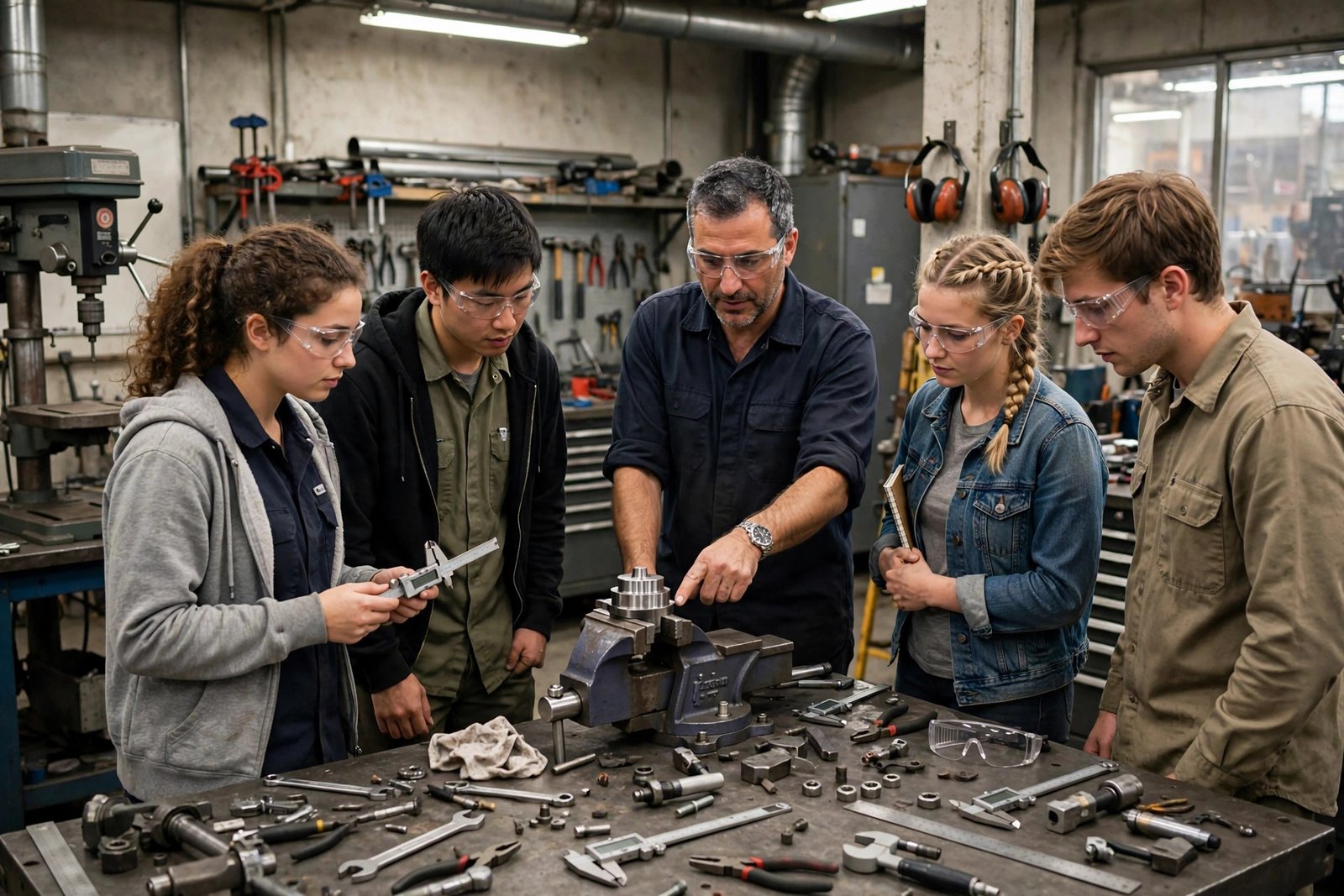
At a Glance: 15 Funded Diploma Routes Compared
| # | Route | Country | Diploma type | Coverage label | Who it is really for |
|---|---|---|---|---|---|
| 1 | MEXT Specialized Training College & Kosen | Japan | Vocational diploma / associate | Fully funded | School-leavers, typically under 25 |
| 2 | Global Korea Scholarship (Associate Degree) | South Korea | Associate degree (2–3 yrs) | Fully funded | School-leavers from invited countries |
| 3 | Brunei Darussalam Government Scholarship | Brunei | Diploma programmes at Bruneian institutions | Fully funded | International applicants meeting age/academic rules |
| 4 | Türkiye Burslari (Associate / Vocational) | Türkiye | Associate degree (2 yrs) | Fully funded | School-leavers, typically under 21 for associate level |
| 5 | Manaaki New Zealand Scholarships | New Zealand | Selected undergraduate diplomas | Fully funded | Citizens of eligible partner countries |
| 6 | Ausbildung (Dual Vocational Training) | Germany | State-recognised vocational qualification (2–3.5 yrs) | Paid training — employer salary, no tuition | Anyone with school-leaving certificate + German (usually B1–B2) |
| 7 | ITEC Programme | India | Short diploma/certificate training courses | Fully funded training | Working officials & professionals aged 25–45 — NOT school-leavers |
| 8 | Albukhary International University Scholarship | Malaysia | Foundation & diploma-to-degree pathways | Fully funded (means-tested) | Students from disadvantaged backgrounds |
| 9 | Singapore Polytechnic Scholarships | Singapore | Full-time polytechnic diploma (3 yrs) | Partial to strong — read profile | Mostly Singapore citizens/PRs; limited international routes |
| 10 | TAFE & State Scholarships | Australia | VET diploma / advanced diploma | Partial — plan a top-up | International VET students by state/institute |
| 11 | Canadian College Entrance Awards | Canada | College diploma (2–3 yrs) | Partial — plan a top-up | New international college students |
| 12 | Stipendium Hungaricum (Partial / Non-degree) | Hungary | Partial studies & preparatory tracks | Mostly funded for eligible tracks — read profile | Students from partner countries via sending partners |
| 13 | Russian Government Scholarship Quota | Russia | Secondary vocational programmes | Tuition funded; living costs partly on you | Applicants via Rossotrudnichestvo country quotas |
| 14 | Erasmus+ VET Mobility | Europe | Work-based learning placements for enrolled VET learners | Fully funded mobility grant | Learners already enrolled with a sending institution |
| 15 | ICCR General Scholarship Scheme | India | Diploma-level courses at Indian institutes (course list varies) | Fully funded for listed courses | International students via Indian missions |
The 15 Routes in Detail
1. MEXT Specialized Training College and Kosen Scholarships — Japan [Fully funded]
Japan’s MEXT programme is the strongest fully funded diploma route in the world, and most students never hear of it because attention goes to the university tracks. The Specialized Training College Students category funds study at a Japanese senshu gakko (specialised training college) — the heart of Japan’s vocational diploma system — after a one-year preparatory education including Japanese language. The College of Technology (Kosen) category places students into Japan’s five-year engineering colleges, typically entering the third year, leading to an associate degree with a strong practical engineering reputation. Both categories carry the standard MEXT package: tuition exemption, a monthly stipend set per fiscal year and category in the official guidelines, and round-trip airfare. Applications run through Japanese embassies, usually in the same April–June window as other MEXT categories, with written exams and interviews, and age limits apply (applicants are generally under 25). Check your embassy’s current guidelines for the exact stipend and dates — do not rely on figures quoted by agents. Our MEXT guide explains the embassy process in full.
2. Global Korea Scholarship — Associate Degree Track [Fully funded]
South Korea’s Global Korea Scholarship (GKS) is famous for degrees, but its undergraduate programme includes an Associate Degree track at designated Korean colleges and universities, typically two to three years of study plus a Korean language year where required. The GKS package for funded scholars covers airfare, tuition, a settlement allowance, a monthly living allowance and language training fees, with amounts set in the annual application guidelines published by the National Institute for International Education (NIIED) — always work from the current year’s guidelines PDF, because rates and country quotas change. You apply either through a Korean embassy in your country or directly to a participating university, depending on the track. Age and academic thresholds apply (under 25 and a strong school record in recent cycles). Korea’s associate degrees feed directly into its manufacturing, IT, design and care industries, which makes this one of the few diploma routes with a designed employment pathway at the end.
3. Brunei Darussalam Government Scholarship [Fully funded]
The Government of Brunei Darussalam Scholarship for foreign students is one of the few national awards whose published eligible programmes explicitly include diploma-level study at Bruneian institutions such as Politeknik Brunei, alongside undergraduate and postgraduate degrees. The award has historically covered tuition fees, economy airfare, monthly personal and subsistence allowances, and accommodation support, with the exact package defined in each cycle’s application pack from Brunei’s Ministry of Foreign Affairs. Intakes follow the Bruneian academic year, applications typically close early in the year, and eligibility is defined by age bands per level and by academic record. Because the scheme is small and the documentation list is specific (including medical and security clearances after selection), start with the Ministry’s current scholarship page rather than any third-party summary.
4. Türkiye Burslari — Associate Degree Level [Fully funded]
Türkiye Scholarships is best known for degrees, but its published levels include associate degrees — Türkiye’s two-year vocational higher-education programmes (önlisans) delivered by vocational schools at Turkish universities. The standard Türkiye Burslari package applies: full tuition, a monthly stipend set per level in the current cycle, free accommodation, health insurance, a one-off flight ticket and a one-year Turkish language course. Applications are made through the single online portal, usually in a January–February window, and age limits apply per level (associate applicants are typically under 21). One honest caveat: the number of associate-level placements is far smaller than for bachelor’s and master’s, and programme availability varies by year — check the level filter inside the application system before you build your plan around it. Compare the postgraduate version of this scheme in our postgraduate scholarships guide.
5. Manaaki New Zealand Scholarships [Fully funded]
New Zealand’s Manaaki Scholarships fund citizens of eligible partner countries to study qualifications that contribute to their home country’s development — and the eligible-qualification lists for many partner countries include undergraduate diplomas at New Zealand institutes of technology and polytechnics, not only degrees. The package is comprehensive: full tuition, a living allowance, an establishment allowance, medical and travel insurance and return airfare. Applications typically run in a February–March window for the following year, selection is country-based, and scholars commit to returning home after study. The critical check is your country’s eligible-qualification list for the current cycle: Manaaki publishes different priority sectors and levels per country, and a diploma that is eligible for one country may not be listed for another.
6. Ausbildung — Germany’s Paid Vocational Training [Paid training]
Ausbildung is not a scholarship, and presenting it honestly matters: it is a dual training contract. You are employed by a company, attend vocational school (Berufsschule) part-time, and earn a monthly training salary that rises each year — training allowances are set by sector and company and commonly start in the region of €1,000 per month before tax in many occupations, though the figure varies widely and some school-based occupations (notably parts of healthcare training have been reformed into paid models, while some school-based programmes still charge or pay nothing) differ. There is no tuition for the standard dual route, and the qualification — a state-recognised vocational diploma across 300+ occupations from mechatronics to nursing to IT — is one of Europe’s most employable credentials. The real gate is language: most employers require German at B1–B2, and the application is a job application, with contracts typically starting in August–September. Non-EU citizens can access Ausbildung with a residence permit for vocational training; you will need to show you can support yourself, and the training salary counts toward that. For many students this is the most realistic “fully funded” diploma in Europe — funded by an employer, not a foundation. Research occupations and requirements via Germany’s official portals, and explore German study routes more broadly in our study abroad section.
7. ITEC — India’s Training Programme for Professionals [Fully funded training — restricted audience]
The Indian Technical and Economic Cooperation (ITEC) programme is fully funded by the Government of India — course fees, international airfare, accommodation, a living allowance, book allowance and study tours across nearly 400 courses at more than 100 Indian institutes — but you must understand its audience before you plan around it. ITEC is a capacity-building programme for people already working: general eligibility expects candidates aged 25–45, with working knowledge of English and typically at least five years of work experience, nominated through their government or employer and the Indian mission in their country. Its courses include diploma- and certificate-level professional training in IT, management, engineering, renewable energy, public administration and dozens of other fields. If you are a school-leaver, ITEC is not for you — look at entries 1–5 instead. If you are a mid-career professional or government official from one of the 160+ partner countries, it may be the single most accessible fully funded training route in the world. Applications open course-by-course on the ITEC portal at itecgoi.in.
8. Albukhary International University Scholarship — Malaysia [Fully funded, means-tested]
Albukhary International University (AIU) in Alor Setar, Malaysia, was founded on a social-business model, and its scholarship is designed for students from disadvantaged backgrounds: it can cover tuition, accommodation and a monthly allowance for the duration of study, assessed on financial need alongside academic merit. AIU’s structure matters for diploma students because entry can begin at foundation level with progression into degree programmes, and AIU has offered diploma pathways within its schools — verify the current intake’s programme list, as offerings change. Malaysia also runs the MTCP scholarship, but be precise: MTCP funds master’s degrees for developing-country citizens (tuition plus an RM 3,500/month bundled allowance), not diplomas — diploma applicants who are told “MTCP will fund your diploma” are being misled. For diploma-level Malaysia, AIU and individual university bursaries are the honest routes.
9. Singapore Polytechnic Scholarships [Partial to strong — read carefully]
Singapore’s five polytechnics run real diploma scholarships, but the fine print matters. The flagship institutional awards — for example the SP Scholarship at Singapore Polytechnic, published as a bond-free award valued at S$4,000 per academic year and renewable across the three-year diploma, and Nanyang Polytechnic’s scholarships, where some awards such as the CSIT–Nanyang Scholarship have combined a full tuition waiver with an annual allowance and a laptop allowance — are aimed primarily at Singapore citizens and permanent residents entering with top school results. International students in Singapore polytechnics more commonly access tuition grants (a Singapore government subsidy in exchange for a work bond, administered separately from scholarships) and smaller merit bursaries. Our honest label: if you are a Singapore citizen or PR with excellent grades, these scholarships plus subsidised fees can come close to full funding; if you are an international applicant, treat Singapore as a subsidised-fee destination, not a fully funded one, and confirm each polytechnic’s current international-student page — start with Singapore Polytechnic’s official scholarships and talent programmes page.
10. TAFE and State Scholarships — Australia [Partial — plan a top-up]
Australia’s VET sector (TAFE institutes and registered training organisations) delivers diplomas and advanced diplomas that international students value for their employment focus. What does not exist is a national fully funded VET scholarship for international students: the big federal schemes are for degrees and research. What does exist is a patchwork of state and institute awards — for example international student scholarships run by state TAFE organisations and destination-study bursaries from state governments — typically structured as fee reductions or fixed bursaries worth a portion of a year’s tuition. Our label is deliberately blunt: partial. A diploma student who combines a TAFE scholarship with part-time work rights can build a workable budget, but you must show full course funds for your student visa regardless of any scholarship, and you should treat any agent promising a “fully funded TAFE scholarship” as a red flag. Compare overall costs with the calculators in our tools section.
11. Canadian College Entrance Awards [Partial — plan a top-up]
Canada’s public colleges are a major diploma destination, and most offer international entrance scholarships — typically one-off or renewable awards in the CAD 1,000–5,000 range, with a smaller number of larger regional or programme-specific awards. Set against international diploma tuition that commonly runs into the mid-teens of thousands of Canadian dollars per year, these are contribution awards, not full funding, and this guide labels them as such. Canada’s genuine full-funding instruments — the tri-agency awards — start at master’s level and above (the doctoral CGRS-D, for example, pays CAD 40,000 a year); there is no Canadian equivalent of MEXT for diplomas. Plan a Canadian diploma as a self-funded route with scholarship top-ups, strong post-graduation work-permit value, and a budget built on the IRCC proof-of-funds requirement: CAD 23,448 for living costs for applications from 1 September 2026, on top of tuition.
12. Stipendium Hungaricum — Partial Studies and Preparatory Tracks [Mostly funded, partner-route only]
Hungary’s Stipendium Hungaricum is a full scholarship for degree programmes, but it also runs partial-study and non-degree tracks — including preparatory and specialisation programmes — whose funding model (tuition waiver, accommodation support and a monthly allowance, with amounts set in the current call) can suit students building toward a diploma or topping up one. Access is only through “sending partners” — the education authority in your home country — and only for listed countries and programme types, which change per cycle. If your country’s sending partner lists a non-degree or partial track you fit, this is a legitimate mostly-funded route into a European vocational-adjacent qualification; if it does not, there is no direct-application workaround.
13. Russian Government Scholarship Quota [Tuition funded]
Russia’s government quota for international students covers more than degrees: the published levels include secondary vocational education programmes at Russian colleges, as well as preparatory-faculty Russian language study. The quota covers tuition at state institutions; students generally receive a standard state academic stipend where applicable and dormitory access at regulated rates, but living costs beyond that are substantially your own — hence our label. Applications run through the quota system in your country (via Rossotrudnichestvo offices and Russian embassies) and competition is by country allocation. Confirm programme availability and stipend terms for the current cycle in the official quota portal before applying, and factor in that instruction on vocational programmes is in Russian, making the preparatory year essential for most applicants.
14. Erasmus+ VET Mobility [Fully funded mobility grant — enrolled learners only]
Erasmus+ funds vocational learners too: students enrolled at a VET institution in a programme country can receive a fully funded mobility grant for a traineeship or study placement in another European country, covering travel and subsistence for placements from two weeks to just under a year. The catch is structural: individuals cannot apply — your school or training provider applies for accredited or project funding and selects its learners. If you are already enrolled in vocational education in Europe, ask your institution’s international office about Erasmus+ VET mobility; if you are outside Europe, this route only becomes available once you are enrolled with a participating provider, so treat it as a bonus inside another plan rather than a plan itself. For degree-level Erasmus funding, see our Erasmus Mundus guide.
15. ICCR General Scholarship Scheme — India [Fully funded for listed courses]
The Indian Council for Cultural Relations (ICCR) General Scholarship Scheme funds international students at Indian universities and institutes, and its course lists have included diploma-level programmes alongside undergraduate and postgraduate degrees — the exact mix depends on the institutes and courses offered in the current cycle on the ICCR admission portal. The scheme’s standard package covers tuition, accommodation support and a living allowance set by course level in the scheme’s financial terms. Applications are made online and processed through Indian missions, and you choose courses and institutes inside the portal. Verify the current cycle’s course list for diploma programmes in your field before investing in the application — availability is the variable, not the funding model.
Eligibility: What Diploma Scholarship Panels Actually Require
Across the genuinely fully funded routes on this list, five requirements recur. First, a school-leaving qualification with strong grades — MEXT’s training-college route, GKS associate degrees and Brunei all select heavily on secondary results, because diploma applicants have no degree record to judge. Second, age limits are stricter than at degree level: under 25 for MEXT categories, under 25 in recent GKS cycles, and under 21 for Türkiye associate level are typical patterns, so check yours before anything else. Third, language readiness: Japanese and Korean schemes include a funded language year but test aptitude for it; Ausbildung effectively requires B1–B2 German before you start; Russian vocational study requires the preparatory year. Fourth, country eligibility: Manaaki, Brunei, GKS and ICCR all work from invited-country or partner frameworks. Fifth, for the professional routes (ITEC), employment status replaces grades as the gate — five years of experience and an employer’s nomination. If you fail one gate, do not argue with it: this list is deliberately wide so that an honest second route exists for almost every profile.
How to Apply: Step by Step
- Classify yourself first. School-leaver, working professional, or already-enrolled VET learner? That single answer removes half this list and focuses the other half.
- Verify the current cycle on the official site. Diploma routes open and close quietly. Bookmark the funder’s page (MEXT via your Japanese embassy, NIIED for GKS, ITEC at itecgoi.in, Manaaki via the NZ MFAT site) and work only from the current guidelines.
- Prepare school documents early. Certified copies of school certificates and transcripts, with translations where required, plus a passport valid well beyond your start date.
- For Ausbildung, apply like a job-seeker. Write a German CV and cover letter, apply to companies directly or via the Federal Employment Agency’s channels, and expect interviews months before the August–September start.
- For embassy-route schemes, respect the mission’s internal deadline, which is often weeks before the funder’s published date.
- Build the honest budget. Even “fully funded” scholars pay for document attestation, medical checks, visa fees and the first weeks before stipends land. For partial routes (Australia, Canada, Singapore internationals), budget the full gap, not the hoped-for gap.
- Keep a second route alive. A MEXT application plus an Ausbildung search plus a Manaaki application is a portfolio; any one alone is a lottery ticket.
Required Documents
- School-leaving certificate and transcripts (certified; translated where required)
- Passport and recent photographs in the scheme’s specified format
- Application form from the official portal — never an agent’s version
- Medical certificate on the scheme’s own form (MEXT, GKS and Brunei all issue one)
- Recommendation letters from school or, for ITEC, from your employer/government nominating authority
- Study or training plan in the scheme’s format; for Ausbildung, a German-language CV and motivation letter
- Proof of language level where required (German B1/B2 evidence for most Ausbildung employers)
- Financial documentation only where the scheme asks for it — fully funded embassy schemes generally do not, which is one way to spot agent scams
Deadlines and Timeline
| Window | Routes in motion | Notes |
|---|---|---|
| Jan–Feb | Türkiye Burslari (incl. associate level); Brunei scholarship typically closes early in the year | Confirm current-cycle dates on the official portals |
| Feb–Mar | Manaaki New Zealand applications | Country eligibility lists published with the round |
| Apr–Jun | MEXT embassy applications (incl. Specialized Training College & Kosen) | Exams and interviews follow in summer |
| Sep–Nov | GKS undergraduate/associate calls (embassy and university tracks) | Dates set in NIIED’s annual guidelines |
| Year-round | ITEC course applications; Ausbildung employer applications | ITEC is course-by-course; Ausbildung hiring peaks 6–10 months before August starts |
| Varies by intake | AIU Malaysia; Stipendium Hungaricum via sending partners; Russian quota; ICCR | All publish per-cycle calendars — work from the current one |
Several 2027-cycle dates for these routes had not been published when this guide was checked in October 2026. The windows above reflect the most recent completed cycles and are labelled as typical, not confirmed.
How to Improve Your Chances
Diploma panels fund trainability and completion. Show both: consistent school grades beat one spectacular result, and any evidence of practical aptitude — a portfolio, a technician course, work experience, a competition, volunteering in the trade — counts heavily at vocational level. For the language-gated routes, starting Japanese, Korean or German six months early is the highest-value preparation you can do; selectors are choosing people who will survive the language year. Write your study plan around your home country’s skills gaps for development schemes (Manaaki, ICCR, ITEC): “my district has no biomedical equipment technicians” is a funding argument. And apply at the right level: a strong school-leaver aiming at MEXT’s training college route faces far less competition than the same student chasing a famous undergraduate scholarship.
Common Mistakes
- Believing “fully funded diploma” marketing. If a scheme cannot name its funder and official portal, it is not a scheme.
- Applying to ITEC as a school-leaver — it is for working professionals aged roughly 25–45 with experience and a nomination.
- Assuming MTCP or other master’s schemes fund diplomas. They do not; that error wastes a full cycle.
- Underestimating the German requirement for Ausbildung and arriving with A2 German and no employer.
- Budgeting a partial scholarship as a full one in Australia or Canada — and then failing the visa financial test.
- Missing age windows. Diploma schemes enforce them strictly because intakes are cohort-based.
Frequently Asked Questions
Are there really fully funded scholarships for diploma students?
Yes, but fewer than for degrees, and they cluster in specific systems: Japan (MEXT training colleges), South Korea (GKS associate degrees), Brunei, Türkiye at associate level, and New Zealand’s Manaaki for eligible countries and qualifications. Germany’s Ausbildung funds you differently — through a training salary rather than a scholarship.
What is the difference between a diploma scholarship and Ausbildung?
A scholarship pays you to study. Ausbildung is an employment contract: a company trains you, pays a monthly training salary, and you attend vocational school part-time. There is no tuition on the standard dual route, and the qualification is a state-recognised vocational diploma.
Can I get a fully funded diploma without strong grades?
The fully funded government routes are grade-competitive because places are few. Realistic alternatives for mid-range grades are Ausbildung (where employers weigh motivation and language heavily) and partial-scholarship destinations where you fund the gap.
Does ITEC fund diploma courses for students?
ITEC funds training courses, including diploma-level professional courses, but its audience is working officials and professionals — generally aged 25–45 with around five years of experience and an official nomination. It is not a route for school-leavers.
Is the Singapore polytechnic route fully funded for international students?
Usually not. The strongest polytechnic scholarships are aimed mainly at Singapore citizens and permanent residents. International students more typically combine subsidised tuition-grant fees with smaller bursaries, so budget Singapore as a part-funded destination.
Which diploma route is best for nursing and healthcare?
Look at MEXT’s training colleges, GKS associate degrees in health fields, and Germany’s nursing Ausbildung, which is now a standardised paid training occupation. Always check that the qualification is recognised where you intend to work afterwards — recognition rules for health professions are strict.
Can a funded diploma lead to a degree later?
Often, yes. Japanese Kosen graduates can transfer into university engineering programmes, Korean associate graduates articulate into bachelor’s degrees, German Ausbildung graduates can progress to Meister and applied-science routes, and New Zealand diplomas carry credit into degrees. Confirm the articulation rules for your specific programme before you start.
How do I spot a diploma scholarship scam?
Three tells: the scheme has no official government or university portal; it charges an “application processing fee” to an agent; or it promises guaranteed selection. Every route in this guide can be verified on a funder’s own website at no cost.
Sources & Verification
Checked in October 2026 against: MEXT application guidelines via Japanese embassies (Specialized Training College and College of Technology categories — tuition exemption, monthly stipend per fiscal-year guidelines, airfare); National Institute for International Education (NIIED) Global Korea Scholarship guidelines (associate degree track, package set annually); Brunei Ministry of Foreign Affairs scholarship documentation (diploma programmes eligible); Türkiye Burslari programme pages (associate level included in the standard package); New Zealand Ministry of Foreign Affairs and Trade Manaaki pages (eligible qualifications set per partner country); German Federal Employment Agency and Make it in Germany guidance on Ausbildung (employer-paid training contract, no standard tuition, German B1–B2 typical); ITEC programme documentation at itecgoi.in and Indian mission pages (fully funded training; eligibility centred on working professionals aged 25–45 with experience and nomination); Albukhary International University scholarship pages; Singapore Polytechnic scholarship pages (SP Scholarship valued at S$4,000 per academic year, bond-free) and Nanyang Polytechnic scholarship information; Australian state TAFE and destination scholarship pages (partial fee support); Canadian college award pages and IRCC proof-of-funds table (CAD 23,448 from 1 September 2026); Stipendium Hungaricum call documents; Russian government quota portal; Erasmus+ programme guide (VET learner mobility via sending institutions); ICCR admission portal.
Disclaimer: Coverage, stipend amounts, eligible countries and deadlines change every cycle, and several 2027 dates in this guide reflect the most recent completed cycle, labelled as such. Always confirm details on the official funder website before applying or paying anyone. StudyGraduate is an independent information portal, not an agency, and cannot guarantee selection, admission or visa approval.
✅ Eligibility Criteria
- Check the official website for full eligibility criteria for your country
🎁 Benefits
- See the official website for the complete list of benefits
⚙️ Application Process
- 1Check your eligibility on the official site
- 2Prepare your documents and statements
- 3Submit the online application before the deadline
- 4Complete interviews or assessments if shortlisted
- 5Await the final selection announcement
📅 Important Dates
Deadlines vary by country and intake. Check the official website for country-specific dates.
📄 Required Documents
- Valid passport
- Academic transcripts & certificates
- Statement of purpose
- Letters of recommendation
- CV / resume
Commonly required — confirm the exact list on the official site.
❓ Frequently Asked Questions

Ready to Take the Next Step?
Explore more scholarships and study opportunities around the world.
Browse Scholarships →