Top 12 Fully Funded Scholarships in Spain 2027
Top 12 Fully Funded Scholarships in Spain 2027 Spain is one of Europe’s most welcoming — and most misunderstood — scholarship destinations. Tuition at public universities is far lower than in the United Kingdom or the United States, Madrid and Barcelona are global student cities, and Spanish is the world’s second most spoken native language. ... <a title="Top 12 Fully Funded Scholarships in Spain 2027" class="read-more" href="https://studygraduate.com/scholarship/top-12-fully-funded-scholarships-in-spain-2027/" aria-label="Read more about Top 12 Fully Funded Scholarships in Spain 2027">Read more</a>
📖 Overview
Top 12 Fully Funded Scholarships in Spain 2027
Spain is one of Europe’s most welcoming — and most misunderstood — scholarship destinations. Tuition at public universities is far lower than in the United Kingdom or the United States, Madrid and Barcelona are global student cities, and Spanish is the world’s second most spoken native language. Yet many international students overlook Spain because its funding system looks different: instead of one giant national scholarship, Spain offers a mosaic of government cooperation grants, foundation awards, European Union programmes hosted by Spanish universities, and salaried doctoral contracts that, taken together, can cover tuition, living costs, insurance and flights in full.
This guide ranks the top 12 fully funded — or, where we say so honestly, closest-to-fully-funded — scholarships in Spain for the 2027 intake. It is written for international students from Bangladesh, India, Pakistan, Nepal, Nigeria, Indonesia, Latin America, Africa and beyond who want a master’s, PhD or research stay in Spain without debt. Every programme named here is real and currently exists. Where a programme funds only part of the cost for some cohorts, we label that clearly rather than calling everything “fully funded.” Where 2027-cycle dates have not yet been published as of 21 October 2026, we say so and give the last cycle’s dates as a guide.
Before you choose, browse our scholarship directory and university profiles, compare Spain in our global rankings, and plan your move with our study abroad guides. If Europe as a whole is your target, read also our Top 30 Fully Funded Scholarships in Europe for International Students 2027.
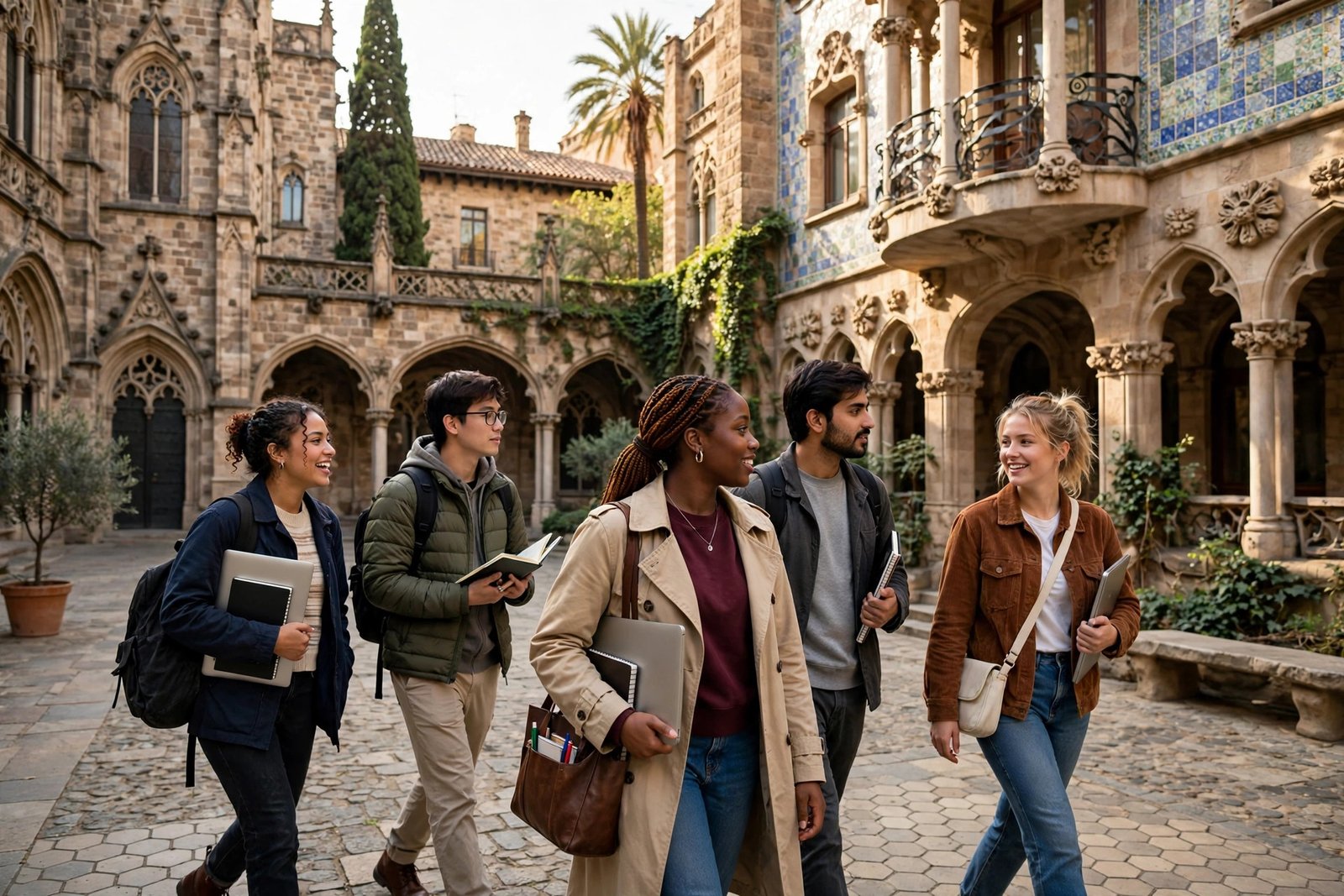
Scholarships in Spain at a Glance
| # | Scholarship | Level | Coverage in Brief | Typical Window |
|---|---|---|---|---|
| 1 | Erasmus Mundus Joint Masters (Spanish partners) | Master’s | Full tuition + €1,400/month for 24 months | Oct–Jan/Feb |
| 2 | MAEC-AECID Scholarships | Master’s, PhD, research | Tuition support + monthly allowance + insurance + travel in most tracks | Early year, varies by annex |
| 3 | Fundación Carolina Scholarships | Master’s, PhD, postdoc, mobility | Tuition + €900/month-type living aid + flight + insurance in many programmes; varies by programme | 12 Jan–2 Mar 2026 for postgraduate in last cycle; PhD to 9 Apr |
| 4 | la Caixa Foundation INPhINIT & Postgraduate Abroad | PhD in Spain/Portugal; master’s/PhD abroad | Salary-based doctoral funding / full postgraduate funding per call | Winter calls |
| 5 | FPU Predoctoral Contracts (Ministerio) | PhD | 4-year salaried contract, approx. €24,000/yr range in recent calls — check call | Jan–Feb typical |
| 6 | FPI Predoctoral Contracts (linked to research projects) | PhD | 4-year salaried contract linked to a funded project | Follows project calls |
| 7 | Marie Skłodowska-Curie Actions hosted in Spain | PhD & postdoc | EU salary + mobility + research costs | Spring/autumn per action |
| 8 | UIC Barcelona International Excellence Scholarships | Bachelor’s, master’s | High tuition coverage for top scorers — check % per call; not always 100% + living | With admission |
| 9 | Barcelona School of Economics (BSE) Scholarships | Master’s | Tuition waivers up to full tuition for merit cohort; living not included | With admission rounds |
| 10 | Fundación Rafael del Pino Excellence Scholarships | Postgraduate abroad / research | Generous postgraduate funding per call | Spring typical |
| 11 | Fundación Ramón Areces Scholarships | Postgraduate abroad, research | Postgraduate study grants per call | Per call |
| 12 | Spanish University & Regional Grants (incl. Becas Generales for residents) | All levels | Tuition + variable components for eligible residents; university merit waivers for internationals vary | Spring–summer |
Honest framing: Only Erasmus Mundus, many MAEC-AECID and Carolina tracks, la Caixa doctoral fellowships, FPU/FPI contracts and MSCA fellowships reliably cover tuition plus living costs in full. University excellence awards (entries 8–9 and parts of 12) are often tuition-only. We include them because, combined with Spain’s comparatively low public tuition and living costs, they are the realistic route many students actually use — but we never pretend a tuition waiver alone pays rent in Madrid.
The Top 12 in Detail
1. Erasmus Mundus Joint Masters — Study in Spain and Across Europe
Erasmus Mundus is the single most generous master’s scholarship that regularly places students in Spain. Funded by the European Union, each Joint Master is run by a consortium of at least three universities in different countries — Spanish partners include universities in Barcelona, Madrid, Valencia, Granada and elsewhere, depending on the programme. You study in at least two countries, graduate with a joint or multiple degree, and receive a scholarship of €1,400 per month for up to 24 months, with participation costs (tuition) covered by the programme. That monthly figure is the current Erasmus Mundus scholarship rate confirmed across programme pages for the 2026 cycle. Apply directly to the consortium, not to Erasmus centrally, between roughly October and January/February for a September start. You may apply to up to three programmes. Competition is fierce — often only 15–25 scholarship places per programme worldwide — so programme fit matters more than generic excellence. See our dedicated Erasmus Mundus scholarship guide and the official Erasmus+ programme site.
2. MAEC-AECID Scholarships — Spain’s Flagship Cooperation Programme
The MAEC-AECID scholarships, run by the Ministry of Foreign Affairs through the Spanish Agency for International Development Cooperation (AECID), are Spain’s flagship offer to partner countries in Latin America, Africa, Asia and the Middle East, including the Philippines. This is not one scholarship but a family of programmes published in annexes: a MASTER programme for public-sector and development-linked master’s study, AFRICA-MED for Africa and the Mediterranean, programmes linked to the Diplomatic School, ASALE for Spanish-language academies, and cultural residencies including at the Royal Academy of Spain in Rome. Coverage in the main tracks typically combines tuition support, a monthly living allowance, health and accident insurance and, in many tracks, travel help — the exact allowance and tuition cap are set in each annex, so you must read the annex for your nationality and track. Do not rely on blog summaries that quote a single euro figure for all AECID awards: amounts differ by programme and city. Applications go through the AECID electronic office, usually in the first part of the year. Eligibility almost always requires citizenship of a listed partner country, a relevant degree, and — for the MASTER track — a link to public service or development work you will return to.
3. Fundación Carolina Scholarships — The Ibero-American Gateway
Fundación Carolina is the best-known name in Spanish postgraduate funding for Latin America, and increasingly relevant for selected African and Asian applicants through specific agreements. For 2026–2027 Carolina announced 736 scholarships in total: 228 postgraduate, 250 institutional studies, 120 doctoral and short postdoctoral stays, 114 doctoral renewals and 24 teacher mobility grants, with a strengthened focus on women in STEM, the Sustainable Development Goals and a human-rights defenders programme run with AECID. A concrete recent example shows how Carolina funding works: one 2026–2027 master’s scholarship offered €8,620 toward a €12,900 tuition fee, plus €900 per month during the stay, a round-trip economy flight and non-pharmaceutical medical insurance, with the student paying the remaining tuition. In other words, some Carolina awards are fully funded in practice and some are high-value co-funded awards — always read your specific programme page. The last cycle opened 12 January 2026, closing 2 March for postgraduate and institutional studies and 9 April for PhD, short stays and mobility. Expect a similar January–March/April shape for 2027 if the pattern holds, but confirm on Fundación Carolina. You apply online, may apply to more than one programme where the rules allow, and are judged heavily on academic record and the development relevance of your plan.
4. la Caixa Foundation — INPhINIT Doctoral Fellowships and Postgraduate Scholarships Abroad
The “la Caixa” Foundation runs two distinct, highly prestigious routes. INPhINIT funds doctoral research at top centres in Spain and Portugal with a salaried, well-structured fellowship that covers living costs through employment-style funding plus research and training support — for a PhD student based in Spain, this is genuinely fully funded. The foundation’s postgraduate scholarships abroad fund master’s and doctoral study outside Spain for Spanish and Portuguese-linked applicants under nationality/residence rules set in each call, so they are not open to all internationals — check eligibility before counting on them. What matters for this list is INPhINIT: if you want a research career and can secure a host centre in Barcelona, Madrid, Granada or elsewhere in Spain, INPhINIT belongs alongside FPU/FPI on your shortlist. Calls open in winter on the la Caixa Foundation site, with separate Incoming and Retaining streams in recent years.
5. FPU Predoctoral Contracts — Train as a University Researcher
Formación de Profesorado Universitario (FPU) is the Spanish ministry’s national predoctoral programme. Instead of a “stipend scholarship,” you receive a four-year employment contract to complete a PhD and train in university teaching. Recent summaries put the salary in the region of €24,000 per year, rising over the contract, with social security — but the exact salary is set in each call, so verify it in the official BOE announcement. FPU is extremely competitive and is judged on your academic record (nota media), the supervisor and department, and your research plan. International graduates with a degree that gives access to a Spanish PhD can apply if they meet the call’s equivalence and admission requirements. If you win FPU, your tuition problem largely disappears (doctoral tuition in Spain is modest) and your living costs are covered by salary — this is fully funded doctoral study in the truest sense.
6. FPI Predoctoral Contracts — A PhD Attached to a Funded Project
Formación de Personal Investigador (FPI) works like FPU in structure — a four-year salaried predoctoral contract — but each contract is attached to a specific funded research project. The principal investigator’s project defines the topic, so fit is everything: you are hired to do that project’s research as your thesis. Universities and CSIC institutes across Spain advertise FPI positions when their projects are funded. Pay, duration structure and mobility support follow the national call and the host institution. For international applicants, FPI is often more accessible than it looks, because project leaders need the best researcher for a defined topic, not only the best national exam record. Watch university research portals and the ministry’s calls from autumn onward, and contact potential supervisors months early with a focused CV and a one-page fit note.

7. Marie Skłodowska-Curie Actions (MSCA) Hosted in Spain
MSCA Doctoral Networks and Postdoctoral Fellowships are EU-funded and can be hosted by Spanish universities, CSIC institutes, hospitals and companies. The funding model is generous and standardised across Europe: a living allowance/salary, a mobility allowance, and — for fellows with family — a family allowance, plus research and networking budgets paid to the host. Spanish hosts are consistently successful in MSCA because Spain has a dense network of excellent research institutes, particularly in Barcelona and Madrid. Doctoral candidates apply to advertised network vacancies (each network recruits its own fellows); postdocs apply with a host supervisor in the annual call. If your goal is a research career rather than a taught degree, MSCA in Spain should be near the top of your list.
8. UIC Barcelona International Excellence Scholarships
The Universitat Internacional de Catalunya (UIC Barcelona) offers International Excellence Scholarships for high-achieving international entrants to bachelor’s and master’s programmes. These are merit awards tied to admission, covering a substantial share of tuition for students with outstanding prior results — the percentage and renewal conditions are set per call and programme, and living costs are not included, so we classify UIC as a top tuition scholarship rather than an unconditional full package. Its value is real, however: UIC is strong in dentistry, medicine, business, law and architecture, Barcelona is a major graduate jobs market, and an excellence award plus part-time work can close the gap for many families. Apply for admission early and tick the scholarship route in the same process.
9. Barcelona School of Economics (BSE) Scholarships and Tuition Waivers
The Barcelona School of Economics, affiliated with Universitat Pompeu Fabra and Universitat Autònoma de Barcelona, funds its highly ranked master’s programmes (economics, finance, data science) through merit waivers awarded at admission. Top applicants receive full or partial tuition waivers, and a small cohort each year studies tuition-free on the strength of their file alone. Living costs in Barcelona are not covered, so BSE is “fully funded on tuition” rather than fully funded overall — we say so plainly. For an economics or data-science applicant with a first-class degree and strong quantitative preparation, BSE is nevertheless one of the highest-value targets in Spain: the degree carries global signalling power far beyond its cost.
10. Fundación Rafael del Pino Excellence Scholarships
The Fundación Rafael del Pino in Madrid has for decades funded Spanish-linked postgraduate excellence, including study at leading universities abroad and research in economics, law, health and public leadership. Its calls are selective, well funded and aimed at candidates with exceptional records and a clear plan to contribute to Spain. Nationality and residency conditions in each call determine whether an international student already based in Spain can apply — read them carefully. We include it because, for eligible applicants, it is one of Spain’s most generous foundation awards, and because many StudyGraduate readers in Spain-linked master’s programmes overlook foundation funding entirely in favour of only government schemes.
11. Fundación Ramón Areces Scholarships
Fundación Ramón Areces funds postgraduate study and research, historically with a strong focus on study abroad in economics, law, health sciences and related fields, as well as research grants in Spain. Like Rafael del Pino, its awards are prestige funding: a strong file, a defined project and excellent references matter more than financial need alone. Eligibility is call-specific and often Spain-linked, so international applicants should confirm whether their nationality/residence and host programme qualify before investing weeks in an application. When you are eligible, an Areces award can transform a partial university waiver into a fully funded package — combining sources, legally and transparently, is a normal strategy in Spain.
12. Spanish University Scholarships and Becas Generales — The System Beneath the Headlines
Beneath the famous names sits the system that funds the largest number of students in Spain: the Ministry’s Becas Generales (general scholarships) for students enrolled in Spanish universities who meet residency, income and academic-progress rules, plus each university’s own merit, need and faculty scholarships and the autonomous communities’ grants. Becas Generales are primarily for Spanish residents — most newly arrived internationals on a student visa will not qualify in year one — but university-level awards at institutions such as the University of Barcelona, Autonomous University of Madrid, University of Granada, Pompeu Fabra and Carlos III do include international merit waivers and departmental assistantships, especially at master’s and PhD level. The honest advice is procedural: once you have an admission offer, ask that university’s international office, in writing, for every fund you can still apply to, with deadlines. Spanish university funding rewards students who ask early and file complete paperwork on time.
Eligibility: Who Can Actually Apply?
Across the twelve, five filters decide most applications. Nationality: AECID and Carolina are nationality-gated by design; Erasmus Mundus, MSCA, FPI and university awards are open worldwide. Degree: master’s awards need a bachelor’s giving access to a Spanish master’s (with homologación/equivalence steps for some non-European degrees); doctoral contracts need a master’s or equivalent and admission to a PhD programme. Language: many Spanish master’s programmes are taught in Spanish (B2 often required); a growing number, plus most Erasmus Mundus and BSE programmes, are in English with IELTS/TOEFL as specified. Timing: your last degree must sometimes be recent (FPU and some AECID tracks favour recent graduates). Return and development intent: cooperation scholarships judge what you will do with the degree at home — a vague plan is the most common reason strong students are rejected.
How to Apply, Step by Step
- Choose two or three programmes, not twelve. One EU programme (Erasmus Mundus), one cooperation programme (AECID or Carolina if eligible) and one university/doctoral route is a balanced portfolio.
- Check your degree’s access route. Confirm with the Spanish university whether your bachelor’s/master’s gives direct access or needs a legalised and sworn-translated file.
- Secure admission or a supervisor where required. Doctoral contracts and several AECID/Carolina programmes need a host, supervisor or admission letter before or alongside the scholarship file.
- Prepare the file in Spanish format. CV in the format the call asks for, transcripts, degree, passport, motivation/project document, references — legalised/apostilled and translated where the call demands it.
- File on the official portal only: AECID Sede Electrónica, Carolina’s online system, the Erasmus consortium site, or the ministry/university portal. Keep the submission receipt.
- Prepare for interview or additional tests. Carolina, la Caixa and FPU-style processes can include panel review of your project and trajectory.
- Apply for the student visa immediately on award. You will need the award letter, admission, insurance, means proof as the consulate requires, and legalised documents. Start legalisations in parallel, not after results.
Required Documents Checklist
- Passport and, where relevant, residence card
- Degree certificate(s) and full transcripts, legalised/apostilled with sworn (traducción jurada) translation into Spanish where required
- CV and academic record summary (nota media / GPA conversion note)
- Motivation letter or research proposal matched to the specific call
- Two academic or professional references
- Language certificates: DELE/SIELE for Spanish-taught study, IELTS/TOEFL for English-taught study, as specified
- Admission letter, supervisor acceptance or host-centre letter where the call requires it
- For AECID/Carolina: proof of nationality, employment/public-service evidence where the track requires it, and a return/development plan
Deadlines and Timeline
| Period | What Happens | Your Move |
|---|---|---|
| Oct–Dec 2026 | Erasmus Mundus applications open; MSCA doctoral vacancies advertised; la Caixa calls approach | Submit Erasmus files; contact PhD supervisors |
| Jan–Mar 2027 | Carolina postgraduate window (last cycle 12 Jan–2 Mar); FPU window typical; university admission rounds | File Carolina/FPU; complete university admissions |
| Feb–Apr 2027 | AECID annex windows in recent cycles; Carolina PhD/mobility to early April (last cycle 9 Apr) | File AECID by annex; finish doctoral routes |
| Apr–Jun 2027 | Results, reserve lists, BSE/UIC admission-linked awards | Accept promptly; start visa legalisations |
| Jun–Sep 2027 | Visa appointments, enrolment, travel | Book consulate early; arrange housing and insurance |
These are planning windows based on the last published cycles. The 2027 calls will set the binding dates — always confirm on the official site before you rely on any date in this table.
How to Improve Your Chances
Spanish selection panels reward coherence. Your degree, your chosen programme, your project and your post-degree plan should read as one story. For cooperation awards, name the institution at home you will return to and the problem you will work on. For doctoral contracts, your supervisor’s letter and the fit between your proposal and the department or project count more than generic prestige. Keep your academic record front and centre — Spain’s system is unusually transparent about grades (nota media) — and if your record has a weak year, explain it briefly and show the upward trend with evidence. Apply in the first weeks of a window, not the last day: Spanish portals are unforgiving about incomplete files at the deadline hour.
Common Mistakes
- Calling a tuition waiver “fully funded” in your budget and arriving without rent money — Barcelona and Madrid rents require a real plan.
- Missing legalisation: starting apostille and sworn translation after results, when consulates are busiest.
- Applying to AECID or Carolina without checking the nationality list for your exact track.
- Submitting an English motivation letter to a Spanish-taught programme that asked for Spanish.
- Ignoring the return commitment in cooperation awards — panels test it, and breaching conditions can require repayment.
Frequently Asked Questions
Can I study in Spain in English on a full scholarship?
Yes. Erasmus Mundus programmes, BSE, many business and STEM master’s programmes and most doctoral research are in English. AECID and Carolina include English-taught options, but Spanish-taught programmes dominate — B2 Spanish widens your choice dramatically.
Is Fundación Carolina only for Latin Americans?
Its core mission is Ibero-America, and most postgraduate places go there. Specific agreements and programmes have included African and Asian applicants — check the current call’s programme pages rather than assuming either way.
Do I need to know Spanish before applying?
Only if your programme is taught in Spanish. For English-taught study you can apply without Spanish, but learning Spanish transforms part-time work, internships and daily life in Spain.
Are FPU and FPI open to non-EU citizens?
Generally yes, if your degree gives access to a Spanish PhD and you can sign an employment contract and obtain the right to work/reside for research. Confirm the current call’s nationality and degree-equivalence wording.
How much does a student need per month in Spain beyond a scholarship?
It varies sharply by city: Madrid and Barcelona are the most expensive; Granada, Valencia, Salamanca and Santiago are markedly cheaper. Build your budget from the university’s own cost-of-living page and our student tools, not from a single national average.
Can I work while studying in Spain?
Student residence in Spain allows part-time work within the limits of your authorisation, and doctoral contract holders are employees. Cooperation scholarship conditions may restrict other work — read your award terms.
What is the biggest advantage of Spain over other European destinations?
Low public tuition, a huge choice of universities, a language spoken across a continent, and multiple overlapping funding systems — government, foundation, EU and salaried doctoral routes — so a rejection from one does not end your plan.
When should I start for the 2027 intake?
Now. Erasmus Mundus windows open in autumn 2026 and Carolina follows in January. Document legalisation alone can take four to eight weeks in peak season.
Sources & Verification
Verified against: Fundación Carolina (2026–2027 call figures and windows: 736 scholarships, 12 January–2 March / 9 April 2026 deadlines, programme-level funding examples), AECID / Ministry of Foreign Affairs programme descriptions (MASTER, AFRICA-MED, ASALE tracks), Erasmus+ / Erasmus Mundus programme pages (€1,400/month scholarship rate), la Caixa Foundation (INPhINIT), Spanish Ministry predoctoral calls (FPU/FPI structure), UIC Barcelona and Barcelona School of Economics scholarship pages. Amounts and dates that vary by programme or annex are presented as ranges or last-cycle guides in the text, as noted.
Disclaimer: Scholarship details change yearly. Always confirm deadlines, amounts, nationality lists and coverage on the official website before applying. StudyGraduate is an information portal, not an agency, and cannot promise selection, admission or visa approval.
✅ Eligibility Criteria
- Check the official website for full eligibility criteria for your country
🎁 Benefits
- See the official website for the complete list of benefits
⚙️ Application Process
- 1Check your eligibility on the official site
- 2Prepare your documents and statements
- 3Submit the online application before the deadline
- 4Complete interviews or assessments if shortlisted
- 5Await the final selection announcement
📅 Important Dates
Deadlines vary by country and intake. Check the official website for country-specific dates.
📄 Required Documents
- Valid passport
- Academic transcripts & certificates
- Statement of purpose
- Letters of recommendation
- CV / resume
Commonly required — confirm the exact list on the official site.
❓ Frequently Asked Questions

Ready to Take the Next Step?
Explore more scholarships and study opportunities around the world.
Browse Scholarships →