
MS in Automotive Engineering Abroad: Eligibility, Fees, Top Universities and Careers
An MS in Automotive Engineering is a specialist master’s for students who want to design, develop, test and manufacture vehicles and their systems. It is not a general mechanical engineering degree with a different label, although it builds on mechanical engineering. It focuses on the vehicle as a system: powertrain, chassis, body, aerodynamics, electronics, software, safety and manufacturing, and increasingly on electrification, batteries, autonomous functions and connected services. For an international student, the appeal is clear. The car industry is global, its supply chains cross borders, and its engineering centres cluster in a small number of countries and regions. Studying in one of those clusters — Germany, the United States, the United Kingdom, Japan, South Korea or China, among others — puts a student close to employers, suppliers, test facilities and research institutes that are difficult to reach from elsewhere. This guide explains what the degree covers, who it suits, what admission requires, what it costs, where it is strongest, and what official labour market data actually say about the careers that follow.
The industry is changing faster than most engineering curricula, and applicants should understand that change before choosing modules. The internal combustion engine has not disappeared, but the growth and investment in many markets is in electric powertrains, battery systems, power electronics, thermal management, charging, software-defined vehicles and driver assistance. That shift changes the skills employers want. A graduate who only knows engine thermodynamics will have a narrower market than a graduate who also understands electric machines, battery safety, control systems and vehicle software. At the same time, traditional skills have not become worthless. Vehicle dynamics, structures, materials, manufacturing and testing remain essential, because an electric vehicle still has to handle, stop, crash safely and be built at scale. The strongest programmes teach both: the fundamentals that do not change, and the new systems that are changing the industry. Applicants should look for that balance in module lists, not just for the word electric in a programme title.
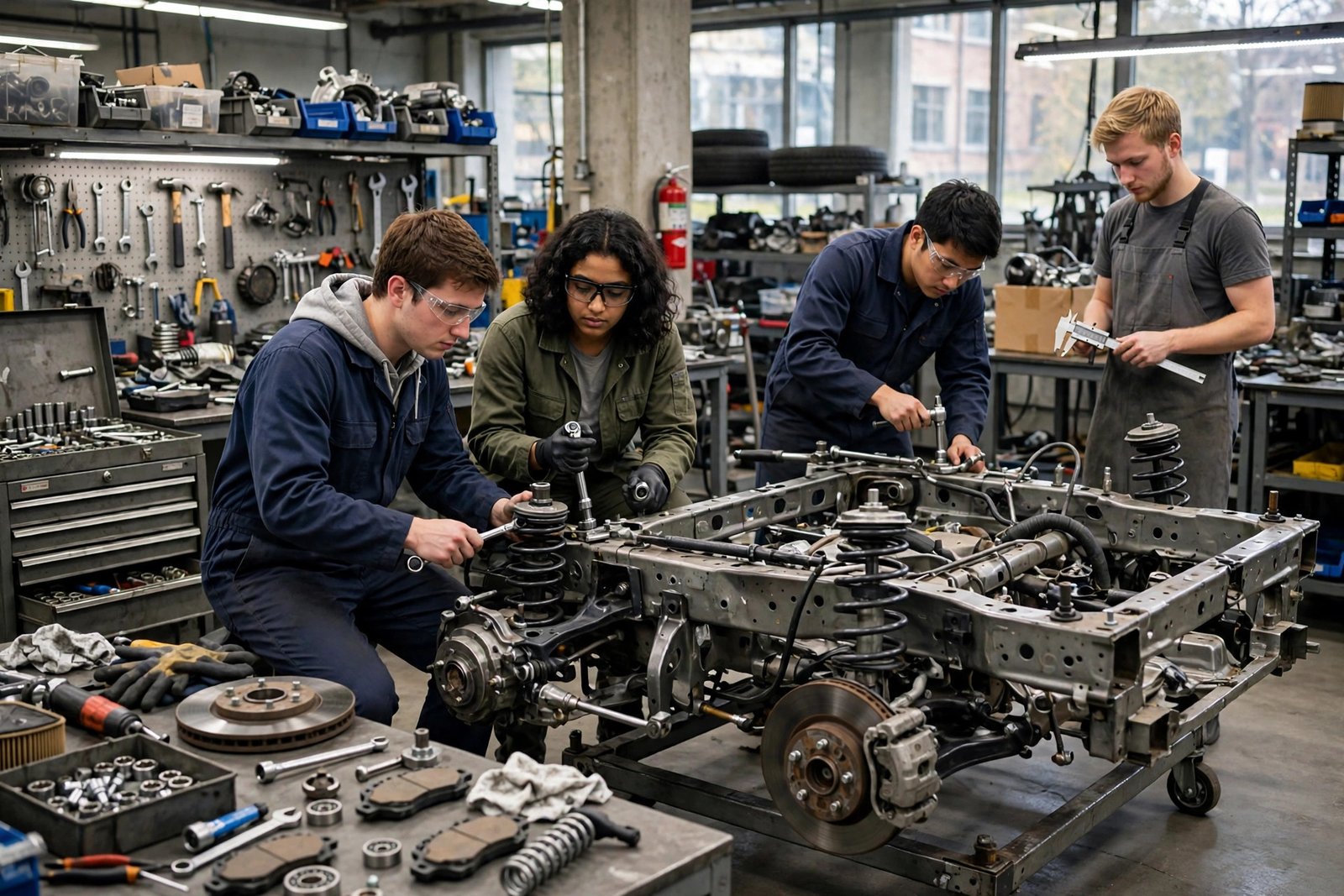
Who this degree suits is narrower than for a general engineering master’s, and that narrowness is a strength when it is honest. It suits mechanical, automotive, electrical, mechatronics or aerospace graduates who already enjoy vehicles, machines and hands-on engineering, and who can point to relevant projects: a Formula Student car, a vehicle dynamics simulation, an electric conversion, a manufacturing internship, a controls project. It suits engineers already working in automotive supply chains who want to move from component work into vehicle-level design, testing or systems engineering. It suits less well a student who likes cars as a hobby but has no engineering project experience, or a student who wants a general management career and sees automotive as a fashionable label. Employers in this sector test practical competence quickly, through technical interviews, design tasks and internships. A degree that is not backed by projects, labs and testing experience will be found out in that process, however good the grades.
At a glance
| Feature | Typical position |
|---|---|
| Degree level | Postgraduate master’s (MS, MSc, MEng or equivalent, depending on country) |
| Typical duration | 1 to 2 years full-time |
| Usual entry qualification | Bachelor’s in mechanical, automotive, electrical, mechatronics or aerospace engineering, or a closely related subject |
| Core subjects | Vehicle dynamics, powertrain and electrification, chassis and body engineering, control systems, aerodynamics, materials and manufacturing, vehicle safety and testing |
| Common capstone | Vehicle design project, industry-sponsored project, Formula Student or equivalent competition vehicle, or applied research thesis |
| Typical destinations | Vehicle design engineer, powertrain engineer, chassis engineer, test engineer, systems engineer, manufacturing engineer |
| Best for | Engineers who want vehicle-level, hands-on engineering careers in automotive and mobility companies |
What you study
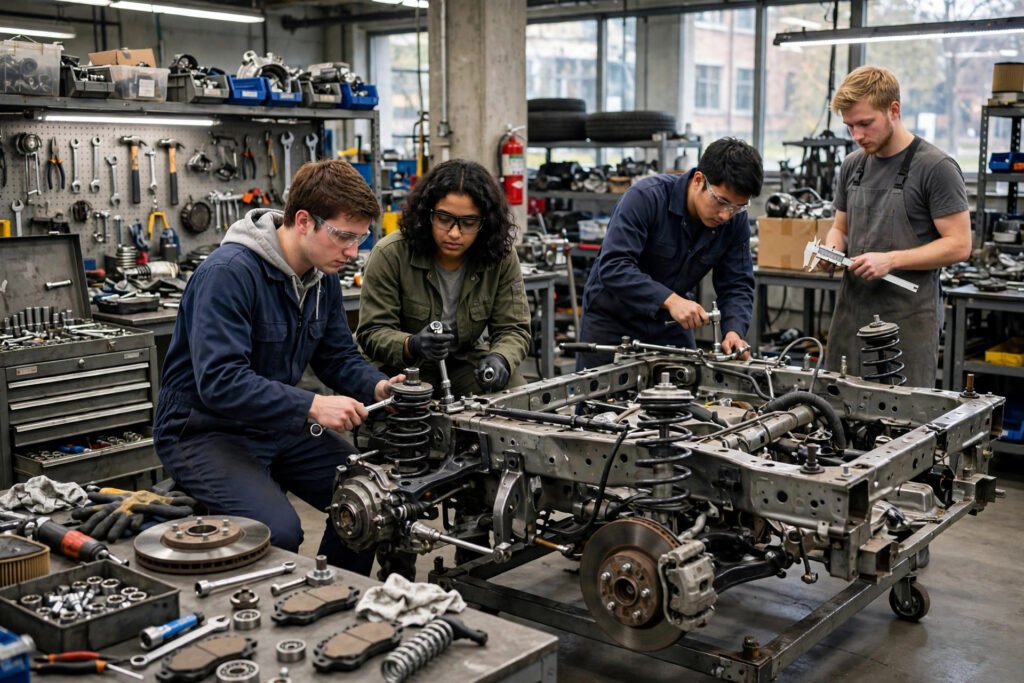
Vehicle dynamics and chassis engineering are at the heart of the degree. Students learn how tyres, suspension, steering and braking interact, how ride and handling are tuned, and how simulation and physical testing are used together. A vehicle that is only simulated is not proven, and a vehicle that is only tested without a model is not understood. Good programmes teach both, with lab work in dynamics rigs, driving simulators or test vehicles where available. Powertrain modules now cover both traditional and electric systems. Internal combustion topics include thermodynamics, emissions and calibration, while electric topics include electric machines, inverters, battery chemistry and management, thermal management and charging. Students should not choose a programme that teaches only one side unless they have a clear reason. The industry still needs engineers who can work across the transition, and a graduate who can compare an electric and a combustion solution on cost, weight, range, safety and manufacturability is more useful than a graduate who can only describe one.
Electronics, software and control systems are the second major block, and their importance grows every year. Modern vehicles contain dozens of control units, millions of lines of code, sensors, actuators and communication networks. Modules in embedded systems, control theory, model-based design, functional safety and automotive software standards teach students how to specify, test and validate systems whose failure can be dangerous. Driver assistance and autonomous driving modules add perception, sensor fusion, decision making and validation, but applicants should be realistic about what a master’s can teach. No one-year degree makes a graduate an autonomous driving expert. It gives a foundation in the systems, the safety case and the testing problem, which is the honest starting point for a career in that area. Aerodynamics, body engineering, materials and lightweighting form another block. Students learn computational fluid dynamics, wind tunnel testing, crash structures, joining methods and material selection, with sustainability and recyclability increasingly part of the brief.
Manufacturing, quality and testing complete the curriculum. Automotive manufacturing is high-volume, high-precision and cost-sensitive, so modules in production systems, automation, robotics, quality control and supply chain management matter even for design engineers. A design that cannot be manufactured at rate, or that fails quality checks, will not reach production. Testing modules cover durability, noise and vibration, emissions and energy consumption testing, and homologation — the regulatory approval process that allows a vehicle to be sold. International students should pay attention to testing and homologation content, because it is where engineering meets regulation, and regulatory knowledge is highly valued by employers and difficult to learn from textbooks alone. Programmes with access to test tracks, dynamometers, battery labs or industry test facilities have a practical advantage that should weigh heavily in a shortlist.
Electives let students specialise, and the choice should follow the target job. A student aiming at electric powertrains should choose battery systems, power electronics and thermal management. A student aiming at vehicle dynamics should choose advanced chassis, tyre mechanics and simulation. A student aiming at software and controls should choose embedded systems, functional safety and model-based design. A student aiming at manufacturing should choose automation, production planning and quality engineering. A capstone or thesis in the same area, ideally with an industry partner, is the strongest signal to an employer. Formula Student and similar competitions are also strong evidence, because they require a team to design, build, test and defend a real vehicle under time and budget pressure. Applicants who have not done such a project should ask whether the master’s programme offers an equivalent team project, and should not assume that lectures alone will substitute for it.
Eligibility and entry requirements
Most programmes ask for a bachelor’s in mechanical engineering, automotive engineering, electrical engineering, mechatronics, aerospace engineering or a closely related discipline, with a strong grade in mathematics, mechanics, thermodynamics or control subjects relevant to the programme. In the United Kingdom, a second-class honours degree or equivalent is a common threshold. In the United States, a GPA around 3.0 on a 4.0 scale is a common benchmark, with competitive programmes expecting higher. In Canada, a four-year bachelor’s with a mid-B average or better is typical. In Germany, admission depends on degree recognition and on whether the applicant’s prior credits match the programme’s requirements, which can be strict for specialist master’s degrees, and some programmes ask for a specific number of credits in mechanical or automotive subjects. In Australia, a recognised bachelor’s in engineering or a related field is the usual starting point. Applicants whose first degree is in a general science or a non-engineering subject should expect to be asked for additional evidence, such as relevant work experience or bridging study, and should check before applying rather than after a rejection.
Project experience and a clear statement of purpose carry unusual weight in this field. A statement that says the applicant loves cars is not enough. A strong statement names a project, explains the applicant’s role, describes a technical problem and a decision, and connects that experience to specific modules and a career target. References from project supervisors or engineering employers are more persuasive than generic academic references. Some programmes ask for a portfolio, a design report or evidence of software and simulation skills, such as MATLAB, Simulink, CAD, finite element analysis or computational fluid dynamics tools. Applicants should list tools honestly, with the level they can actually use, because a technical interview will test the claim. English requirements are typically IELTS around 6.5 overall, with no band below 6.0, or a TOEFL equivalent, though thresholds vary. For Germany, English-taught programmes have English requirements, while German-taught programmes require German language proof, and applicants should not confuse the two.
Visa requirements are separate from admission and must be planned in parallel. Financial evidence, health insurance and, in some countries, blocked accounts or proof-of-funds documents take time to arrange. In Germany, the blocked account requirement for 2026 is EUR 11,904. In the United Kingdom, student visa maintenance is GBP 1,529 per month in London and GBP 1,171 outside London under current guidance, rising to GBP 1,570 and GBP 1,203 respectively for applications on or after 30 November 2026. In Australia, living costs of AUD 29,710 for the main applicant are referenced in current visa guidance. These are not tuition figures, and they do not include tuition. Applicants should build a timeline that allows for document attestation, English tests, university decisions and visa processing, and should keep every document consistent across forms.
Tuition and living costs
Tuition varies by country and by public or private status, and applicants should compare the international rate for the specific programme. In the United States, private universities and out-of-state public rates can be high, while some public programmes offer assistantships that reduce cost. In the United Kingdom, a one-year MSc is intensive and expensive in tuition, but the short duration reduces living costs and time out of employment. In Germany, many public universities charge low or no tuition for consecutive master’s programmes, which makes Germany attractive for automotive engineering, given its industry base, but living costs, insurance and the blocked account must still be funded. In Canada and Australia, international tuition is substantial, with variation by institution and province or state. Applicants should also budget for a laptop capable of running simulation and CAD software, for travel to test facilities or competitions, and for professional clothing and safety equipment where required. These small costs add up and are often forgotten in a first budget.
Living costs depend heavily on city. Stuttgart, Munich, Detroit, Coventry, Turin and other automotive centres are not always the cheapest cities, but they offer proximity to employers and internships that can outweigh a higher rent. A cheaper city with no automotive employer nearby may save money in the short term and cost opportunity in the long term. Applicants should use the study abroad budget planner, the tuition fee calculator and the cost of living calculator to compare options, and should treat part-time work as a supplement, not as a funding plan. Work rules differ by visa and country, and in the United States, on-campus work and practical training rules are strict. In the United Kingdom, term-time work limits apply. In Canada and Australia, work conditions are tied to the study permit or visa. None of these should be relied on to pay tuition.
| Country or region | Strength for automotive engineering | Cost and planning note |
|---|---|---|
| Germany | Manufacturers, suppliers and research institutes; strong mechanical and production tradition | Low or no tuition at many public universities; blocked account EUR 11,904 (2026); language and credit recognition matter |
| United States | Detroit, Silicon Valley mobility, EV and battery manufacturing, aerospace crossover | Wide tuition range; check assistantships and STEM practical training eligibility with the university |
| United Kingdom | Motorsport, premium vehicles, powertrain research, Formula Student tradition | One-year MSc; visa maintenance GBP 1,529 London / GBP 1,171 outside London, rising from 30 November 2026 |
| Canada | Ontario automotive corridor, EV and battery investment, manufacturing engineering | International tuition plus living costs; co-op options can add experience |
| Australia | Engineering schools with automotive and mechatronics research; mining and transport crossover | High international tuition; living costs AUD 29,710 for the main applicant under current guidance |
Top universities and countries
Germany is the first country most automotive applicants consider, for good reason. Its manufacturers and suppliers, its technical universities and its applied sciences universities offer a depth of automotive teaching, research and industry placement that is hard to match. Applicants should look at programmes in Stuttgart, Munich, Aachen, Braunschweig and other automotive regions, and should check whether a programme is taught in English, what German language support exists, and what industry links it publishes. The United States offers a different strength: scale, EV and battery investment, software-defined vehicle work, and a large employer market. Programmes near Detroit, California and other automotive and technology clusters offer internships and capstones that a remote programme cannot. The United Kingdom offers motorsport and premium vehicle expertise, a strong Formula Student culture, and one-year master’s degrees that suit students who want to return to work quickly. Canada’s Ontario corridor, with vehicle assembly, parts suppliers and EV investment, offers manufacturing and systems opportunities, often with co-op terms. Japan and South Korea have world-leading manufacturers, but language and admission routes differ, and applicants should research those systems separately rather than assuming an English-taught route is equivalent.
When comparing universities, applicants should look beyond a general ranking. A university that is highly ranked overall may have a small automotive group, while a less famous technical university may have a large automotive department, a test track, a battery lab and deep supplier links. Useful evidence includes Formula Student results, industry-sponsored projects, published graduate destinations, lab facilities and faculty research in the applicant’s target area. The universities directory, the Courses and Programs directory and the Bachelor of Engineering profile can help structure that comparison, and the university comparison tool is useful for weighing fees, duration and specialisation. Applicants should also check accreditation. In the United States, ABET accreditation is the recognised standard for many undergraduate engineering programmes. In the United Kingdom, professional body accreditation can matter for some routes. In Germany, degree recognition and programme structure matter more than a single label. Ask each university what its programme is accredited for and where its graduates work, and treat vague answers as information.
Careers and salaries
There is no single official occupation called automotive engineer in United States labour statistics, so honest salary reporting must use the closest official benchmarks and say so. The BLS Occupational Outlook Handbook reports a 2025 median pay of $104,110 for mechanical engineers, the broad occupation that covers much vehicle design, powertrain, chassis and manufacturing work. BLS field-of-degree data project 9 percent employment growth for mechanical engineers from 2024 to 2034, which is faster than the average for all occupations. For graduates who move into management, the BLS 2025 median pay for architectural and engineering managers is $171,270, and for industrial engineers it is $102,440. These figures are national medians for established occupations, not starting salaries for new master’s graduates, and not automotive-specific pay. They are useful because they anchor expectations: a new automotive engineer should expect to start below the experienced median, and to approach or exceed it with experience, specialisation and scope. Any article that quotes a single automotive salary without naming the occupation, source and year should be treated with caution.
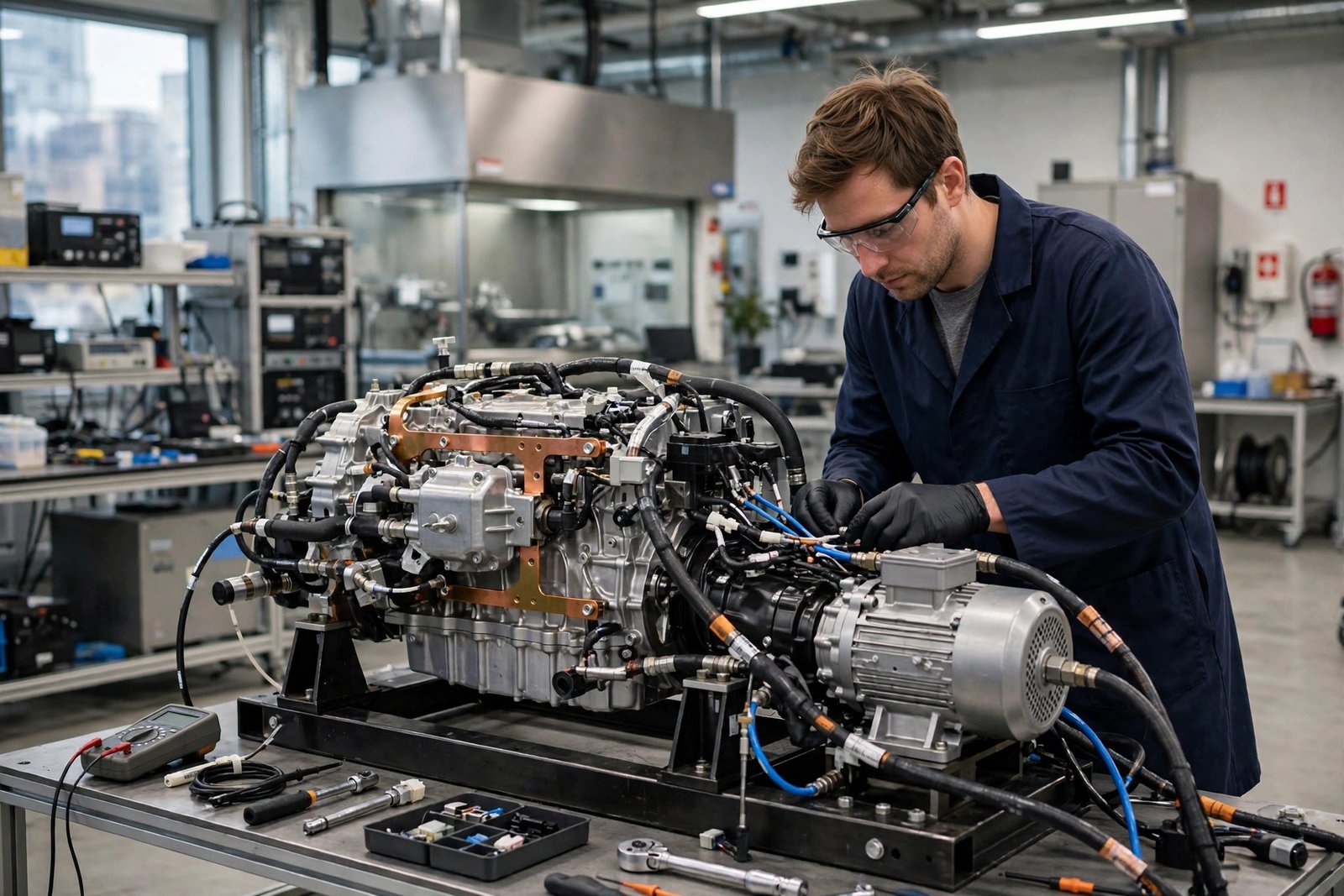
Career paths in automotive engineering divide by system and by stage of the vehicle lifecycle. Design engineers work on components and systems, using CAD, simulation and prototyping. Powertrain engineers work on engines, electric machines, batteries, transmissions and thermal systems. Chassis and body engineers work on structures, suspension, steering, braking and crash performance. Controls and software engineers work on embedded systems, driver assistance and vehicle software. Test and validation engineers prove that a vehicle meets performance, safety, durability and regulatory requirements. Manufacturing engineers turn designs into production at rate and quality. Systems engineers integrate all of these, managing requirements, interfaces and trade-offs across the vehicle. Each path has different daily work. Design is creative and analytical. Testing is methodical and evidence-driven. Manufacturing is practical and time-pressured. Systems engineering is integrative and communicative. Students should use internships and projects to test which daily work they actually enjoy, because a job title that sounds exciting can involve work that does not suit them.
| Role or benchmark occupation | Official figure | Source and year |
|---|---|---|
| Mechanical engineers (USA, closest broad benchmark) | $104,110 median pay; 9% projected growth 2024–2034 | BLS Occupational Outlook Handbook and field-of-degree projections |
| Industrial engineers (USA, manufacturing benchmark) | $102,440 median pay | BLS Occupational Outlook Handbook, 2025 median pay |
| Architectural and engineering managers (USA, management benchmark) | $171,270 median pay | BLS Occupational Outlook Handbook, 2025 median pay |
| Engineering managers (Australia) | $3,519 median weekly earnings; 33,500 employed | Jobs and Skills Australia, occupation profile |
Post-study work and employer sponsorship shape outcomes as much as the degree. In the United States, STEM-designated programmes can affect Optional Practical Training eligibility, and applicants should confirm a programme’s STEM designation with the university, not assume it from the title. In the United Kingdom, the Graduate Route currently offers two years for master’s graduates, with an announced shortening to 18 months from 1 January 2027 that must be kept separate from current rules. In Canada, the Post-Graduation Work Permit depends on programme length and conditions. In Germany, graduates can seek a residence permit to look for work after graduation, and German language ability strongly affects employability in many automotive firms, even when the degree is taught in English. In Australia, post-study work rights depend on qualification, location and current policy. Applicants should verify all of these on official government pages and with the university’s international office, and should use the visa requirement checker and the career path explorer to organise, not replace, that verification.
Scholarships for this field
Scholarships specifically for automotive engineering exist, but most funding comes from broader sources: university merit awards, government scholarships, industry sponsorships and country-specific schemes. In Germany, DAAD programmes and university awards are worth checking early, because deadlines are often months ahead. In the United Kingdom and Canada, university merit scholarships for engineering students are common, though they are usually partial. In the United States, assistantships and departmental awards can be more valuable than a headline scholarship, because they provide experience as well as funding. Applicants should search the scholarships directory and the scholarship finder by country and level, and should apply to several schemes. A scholarship essay should be specific: the project, the technical problem, the result, and the contribution after study. It should not promise employment or claim a salary. Funders, like employers, are sceptical of promises that cannot be evidenced.
How to choose and apply
A practical shortlist has three to five programmes, chosen by specialisation, lab facilities, industry links, total cost and post-study work rules, not by ranking alone. Applicants should read module lists for electrification, controls, dynamics and manufacturing content, check whether a Formula Student or industry project is available, and ask about internship and placement rates. They should contact programme coordinators with specific questions: what test facilities exist, who sponsors capstones, what software and simulation tools are taught, and where recent graduates work. An application should be built around evidence: transcripts, project reports, a portfolio where asked, references from supervisors who saw the work, and a statement that connects a real project to specific modules. Deadlines for scholarships, housing and visas often fall before the academic start, so a timeline working backwards from the earliest deadline is essential. Applicants from Bangladesh and other countries should prepare attested documents early, keep names and dates consistent across forms, and have a genuinely acceptable second choice in case a first choice is unaffordable or oversubscribed.
Frequently asked questions
Is automotive engineering the same as mechanical engineering?
No, although it builds on mechanical engineering. Automotive engineering applies mechanical, electrical, materials and software engineering to the vehicle as a system, with specialist modules in vehicle dynamics, powertrain, chassis, safety and manufacturing. A mechanical degree is broader. An automotive degree is deeper in vehicles, which is an advantage for automotive jobs and a limitation if you later want a completely different sector.
Do I need to know about electric vehicles before applying?
Not in depth, but you should understand the shift towards electrification and be able to discuss it intelligently. Programmes teach electric powertrains, batteries and power electronics, but applicants with a basic project or module in electric machines, controls or energy systems will find the material easier and will be more credible to employers.
Can I study automotive engineering with an electrical engineering degree?
Often yes, especially for powertrain, controls, electronics and software tracks, though some programmes may ask for additional mechanical background or bridging study. Check the programme’s prerequisite credits and target track before applying, and be ready to explain how your electrical background fits the vehicle system.
Is Germany the best country for automotive engineering?
Germany is exceptionally strong for automotive engineering, with manufacturers, suppliers and technical universities, and low tuition at many public universities. Whether it is best for an individual depends on language, degree recognition, living costs and career target. The United States, United Kingdom and Canada also have strong automotive ecosystems, and the right choice depends on the specialisation and the employer market you target.
What salary can I expect?
No guide can promise a salary. The closest official United States benchmark is mechanical engineers, with a BLS 2025 median pay of $104,110, which is a median for the whole occupation, not a graduate starting salary and not an automotive-specific figure. Pay varies by country, region, employer, specialisation and experience, and should be researched by exact job title in national statistics.
Will a master’s guarantee a job in the car industry?
No. A master’s improves access to graduate roles, internships and specialist knowledge, but employers hire on project evidence, technical interviews, internships and, in many countries, language and visa eligibility. A programme with industry projects and placement support gives a stronger chance than a programme without them, but no university can guarantee employment.
Should I choose a programme with Formula Student?
If you want vehicle design, dynamics or manufacturing work, a Formula Student or equivalent competition project is strong evidence and a useful learning experience. It is not essential for every track — controls, software and battery specialists can build evidence through other projects — but for vehicle-level roles it is one of the most persuasive things on a CV.
Do I need German to study automotive engineering in Germany?
Not necessarily for an English-taught programme, which will have English requirements instead. For employment in many German automotive firms, German language ability is a significant advantage and sometimes a requirement, so students who plan to work in Germany should learn German during their degree, even when the programme is taught in English.
Sources and verification
Sources consulted include the U.S. Bureau of Labor Statistics Occupational Outlook Handbook, including mechanical engineers, industrial engineers and architectural and engineering managers profiles and field-of-degree employment projections; Jobs and Skills Australia, engineering managers occupation profile; ABET, on what programmes it accredits; and current government and university guidance on student visa financial requirements referenced in the StudyGraduate guides brief, including UK maintenance rates, the Germany blocked account and Australia living costs. Salary figures are stated with their source and year and are medians for the occupations named, not automotive-specific guarantees. Fees, English thresholds and visa rules change yearly and vary by institution, so confirm fees and requirements on the official university page and the official government immigration page before applying. StudyGraduate is an information portal, not an agency — it never promises admission, jobs, salaries or visa or permanent residence outcomes.
External sources: BLS — Architectural and Engineering Managers; BLS — Field of Degree: Engineering; Jobs and Skills Australia — Engineering Managers; ABET — What Programs Does ABET Accredit?