
BSc Dental Hygiene Abroad: Eligibility, Fees, Top Universities and Careers
Dental hygienists are the preventive specialists of the dental team. They examine patients for signs of oral disease, remove plaque and tartar above and below the gum line, apply fluoride and fissure sealants, take radiographs, screen soft tissues for abnormalities, and — most importantly over a patient’s lifetime — teach people how to keep their own mouths healthy between visits. A BSc in dental hygiene abroad trains you for that role through a blend of biomedical science, hands-on clinical practice on real patients, and communication skills, and in most countries it leads to a protected professional title that you may only use once you are registered with the relevant regulator. This guide explains what the degree involves, what you need to get in, what it costs, where to study it, and what the career looks like afterwards, with the licensing picture kept honest throughout: a degree is an eligibility route, not a promise of registration or of a right to practise in any particular country.
The appeal of dental hygiene as a study-abroad choice is easy to understand. It is a hands-on, patient-facing health profession with a clear qualification route, a degree that is usually three years rather than five, and a working life that can be full-time, part-time or portfolio-based across several practices. Many hygienists work part-time by choice, and many combine clinical work with teaching, health promotion, sales or management roles in the dental industry. The cautions are equally clear. Entry is competitive and often requires science subjects. Clinical training is demanding, with early mornings, strict infection-control routines and the need to work precisely in a small, sensitive space while keeping a nervous patient at ease. And registration is country-specific: a qualification approved in one country does not automatically entitle you to practise in another, and international graduates commonly face additional assessments, language tests or supervised practice requirements. Choose the degree with the country where you intend to practise in mind from the first shortlist, not as an afterthought.
Terminology varies, so it helps to fix it early. In the United Kingdom, the qualification is often a BSc in Dental Hygiene and Dental Therapy, a combined degree that qualifies you for both roles, or a BSc in Dental Hygiene alone; the combined degree is the more common route and the more flexible one. In the United States, dental hygiene is usually studied as an associate degree or a bachelor’s degree (BS in Dental Hygiene), and the bachelor’s route is the one most relevant to international students. In Canada, dental hygiene is offered as a diploma or a bachelor’s degree, depending on the institution. In Australia, the Bachelor of Oral Health or Bachelor of Dental Science (Dental Hygiene) pathways differ by university. When you compare programmes, look past the degree title to the regulator’s approval: in the UK that means a course approved by the General Dental Council (GDC); elsewhere it means the equivalent national or state approval. A programme that is not approved by the regulator of its own country will not help you register anywhere else either.
At a Glance: BSc Dental Hygiene
| Feature | What to expect |
|---|---|
| Degree level | Bachelor’s degree (BSc, BS or equivalent), sometimes combined with dental therapy |
| Typical duration | 3 years full-time for a BSc in the UK; 2–4 years depending on route and country |
| Core subjects | Anatomy and physiology, oral biology, dental pathology, preventive dentistry, radiography, patient care and management |
| Clinical training | Supervised treatment of real patients in university clinics and outreach placements, from early in the course |
| Who it suits | School leavers with science subjects, dental nurses seeking to qualify, and career changers with a science background |
| Key decision | Whether the course is approved by the regulator in the country where you plan to practise |
What You Study: Curriculum and Clinical Training
The first year of a dental hygiene degree is usually science-heavy. You study anatomy and physiology, with emphasis on the head, neck and oral cavity; oral biology, including tooth development, saliva and the oral microbiome; and general pathology, so that you can recognise when a mouth finding signals a wider health problem. Alongside the science, you learn the foundations of preventive dentistry: how plaque and calculus form, how periodontal disease progresses, how diet and fluoride influence decay, and how to assess risk for individual patients. Communication and professionalism teaching begins early too, because a hygienist who cannot explain a treatment plan clearly, motivate a reluctant patient, or handle a complaint well will struggle however good their clinical technique becomes.
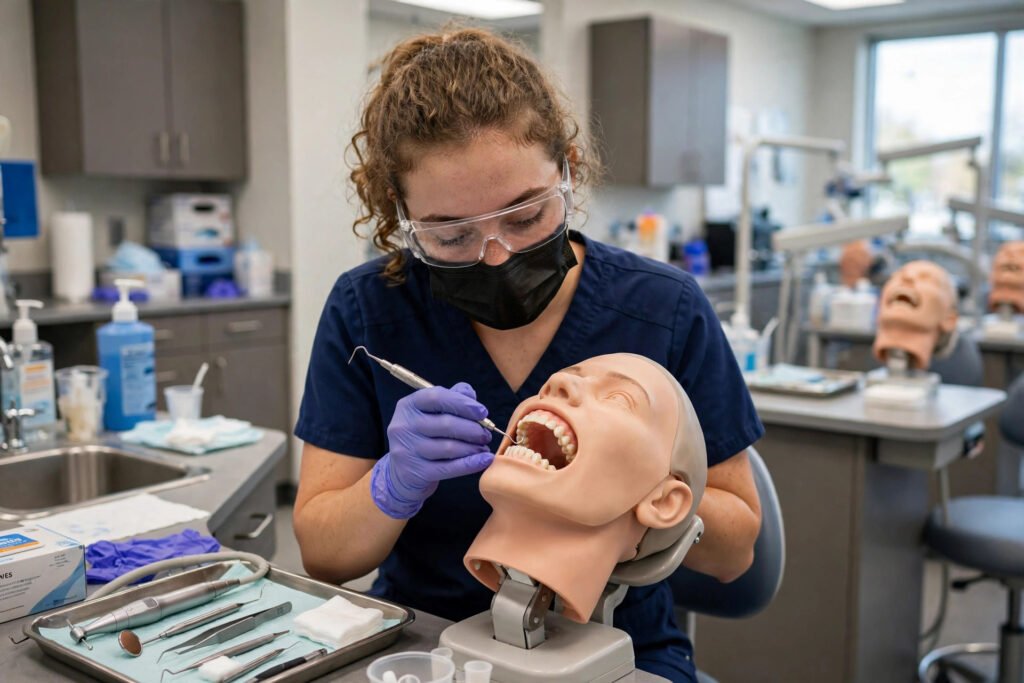
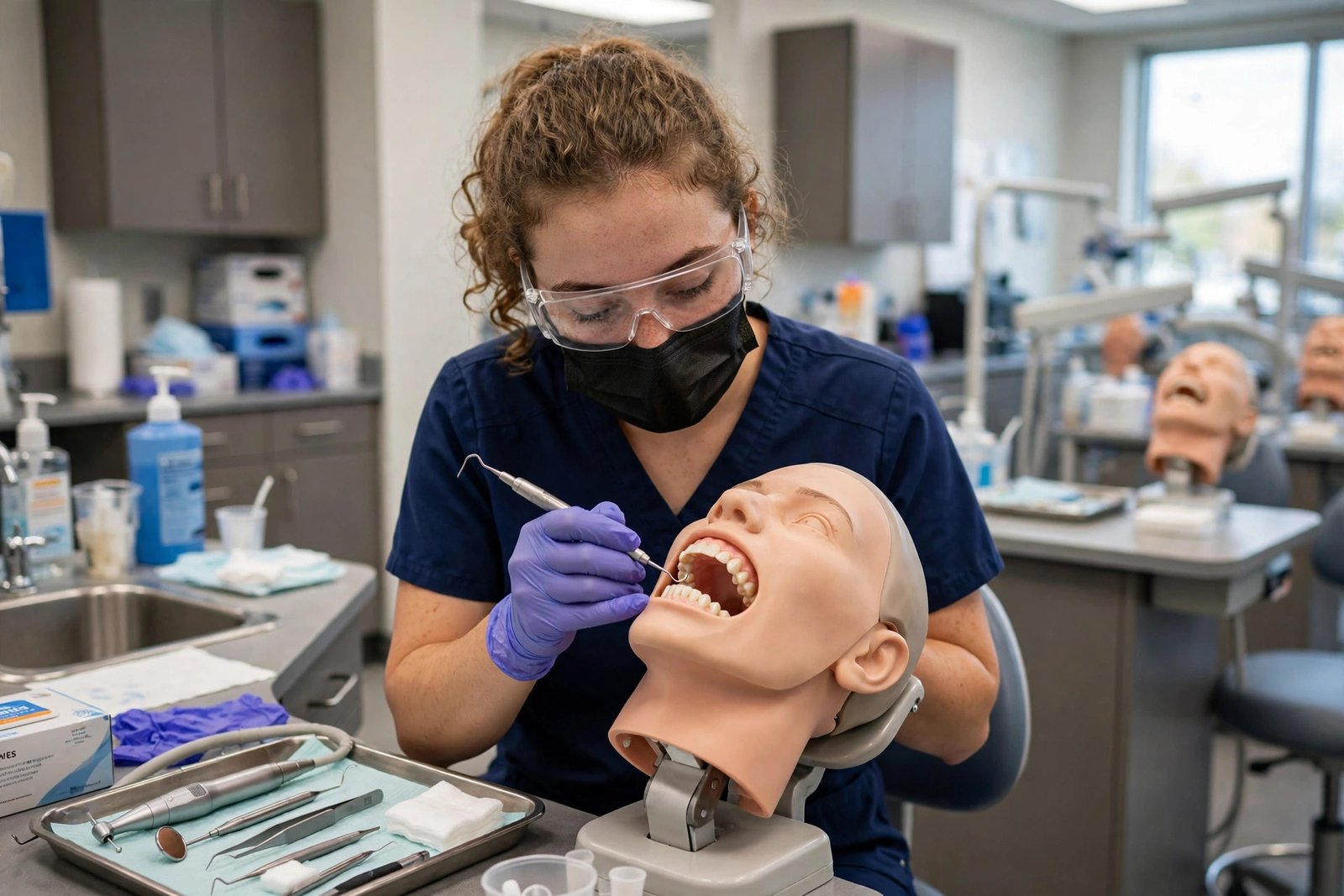
Clinical skills training starts in simulation before it moves to real patients. Most programmes have phantom-head laboratories where you practise instrumentation, scaling and polishing, radiography positioning and infection-control routines on mannequins, with tutors checking your posture, instrument handling and ergonomics. Ergonomics matters more than applicants expect: hygienists work in sustained, precise postures for long periods, and musculoskeletal strain is a well-known occupational issue, so good programmes teach positioning, seating and instrument grasp from the first term. Once you are assessed as safe in simulation, you begin treating patients in the university dental clinic under close supervision, gradually taking on more complex cases: patients with periodontal disease, patients with medical conditions such as diabetes that affect oral health, nervous patients, children, and older adults with complex needs.
Later years add radiography and radiation protection, dental health education and health promotion, the management and care of patients with special needs, and — on combined hygiene and therapy degrees — restorative skills such as fillings and, on children’s teeth, extractions and preformed crowns. You also learn to recognise oral cancer and other soft-tissue abnormalities, to take and interpret radiographs, to record findings accurately, and to refer appropriately to dentists and specialists. A final-year project or dissertation is common on BSc programmes, and it is your chance to show that you can read research critically rather than simply follow protocols. Throughout, assessment is a mix of written examinations, practical examinations on simulated and real patients, and continuous assessment of your clinical competence. Failing a clinical competency is not like failing an essay: patient safety is the standard, and programmes will require you to repeat clinical training until you meet it.
Outreach placements are a distinctive strength of many dental hygiene degrees. Universities often run community clinics, school programmes and care-home visits where students provide preventive care to people who rarely attend a dental practice. These placements teach you to work in unfamiliar settings, to adapt to limited equipment, and to communicate with people from many backgrounds. They also show you the public-health side of the profession: much of the disease a hygienist treats is preventable, and the most valuable work you do may be a conversation that changes how a family brushes, rather than a scale and polish. Ask each university where its outreach placements take place and how much patient contact you can expect per week in your final year. Two programmes with identical module lists can offer very different amounts of real clinical experience.
Eligibility and Entry Requirements by Country
In the United Kingdom, entry to a BSc in dental hygiene or dental hygiene and therapy typically requires five GCSEs at grades 4–9, including English and maths, plus two or three A levels, often including biology or another science subject. Some universities accept a recognised dental nursing qualification in place of one A level, which makes the degree accessible to dental nurses who want to qualify as hygienists. You will need an enhanced Disclosure and Barring Service (DBS) check and occupational health clearance, including evidence of hepatitis B immunity, before you treat patients. Interviews are common, and selectors look for manual dexterity, communication skills, empathy and a realistic understanding of clinical work. If you already work as a dental nurse, that experience is a genuine advantage, but it does not replace the science requirement: check each university’s subject requirements before you apply.
In the United States, admission to a bachelor’s degree in dental hygiene normally requires a high-school diploma with science coursework, and many programmes are completed in two stages: prerequisite college courses in biology, chemistry, anatomy and physiology, followed by the professional programme itself. Some programmes require an entrance examination or a minimum grade point average in prerequisites, and competition for places is strong. In Canada, dental hygiene programmes generally require a high-school diploma with biology and chemistry, and some universities offer a degree-completion route for diploma holders. In Australia, entry to a Bachelor of Oral Health typically requires completion of secondary school with science subjects and a competitive selection rank; some universities also consider prior health qualifications. Wherever you apply, confirm whether the programme is accredited or approved by the relevant regulator — the GDC in the UK, the Commission on Dental Accreditation (CODA) in the United States, or the equivalent body elsewhere — because approval is what connects the degree to registration.
International applicants face two additional hurdles that deserve early planning. The first is language: clinical communication with patients is assessed, so universities set English requirements that reflect the need to explain treatment, take medical histories and write clinical records accurately. The second is recognition of prior qualifications: if you already hold a dental or health qualification from your home country, some universities and regulators will assess it for exemptions, but exemptions are never guaranteed and are decided case by case. If you are preparing for an English test, use the test preparation resources to plan your timeline, and book early enough to allow a retake. If you are a qualified dental nurse or hold another health qualification, contact the university admissions team directly with your transcripts before you submit a formal application, so that you apply to the right entry route.
Tuition Fees and Living Costs
Tuition fees for dental hygiene degrees vary by country and by home or international status, and you should confirm the current figure on the university’s official fees page before you budget. UK universities publish separate home and international fees, and international fees for clinical health degrees are typically much higher than home fees. United States programmes vary widely between public and private institutions and between resident and non-resident rates. Canadian and Australian fees are published per year for the full programme, and clinical programmes may add costs for instruments, uniforms, immunisations and travel to outreach placements. Some students also need to buy loupes (magnifying glasses) and other personal clinical equipment, so ask each university for a full list of additional costs rather than budgeting on tuition alone.
Funding help exists, but it is specific and should never be assumed. In the UK, students on GDC-approved dental hygiene courses at level 5 or 6 may be eligible for at least £5,000 a year through the NHS Learning Support Fund, depending on personal circumstances, and this funding does not need to be repaid; eligibility for international students is restricted, so confirm your own position before relying on it. University scholarships for international students, home-country government scholarships, and employer sponsorship from a dental practice are other possibilities, but each has its own deadline and eligibility rules. Use the scholarship finder and the scholarships directory to search systematically, and keep a spreadsheet of deadlines, because scholarship applications often close months before course applications.
Visa financial requirements are separate from tuition and must be planned alongside it. The government-set figures below are the ones to use for planning, not estimates from agents or blogs.
| Destination | Visa financial requirement (as specified in the task brief) | Notes |
|---|---|---|
| United Kingdom | £1,529 per month in London; £1,171 per month outside London | Student visa maintenance; rising to £1,570 / £1,203 for applications on or after 30 November 2026 |
| Germany | €11,904 blocked account | Annual proof of funds for a student visa |
| Australia | AUD 29,710 | Annual living-cost requirement for a student visa |
| Canada | CAD 22,895, rising to CAD 23,448 | Proof of funds for a study permit, excluding Quebec |
Model your total cost with the tuition fee calculator and the cost of living calculator, and remember that clinical students have less flexibility for part-time work than classroom-based students. Clinic hours are fixed, outreach placements may involve travel, and the academic load in a clinical degree leaves fewer free days. A budget that depends on substantial part-time earnings during term time is risky for this degree, and a budget that depends on a bursary you have not yet confirmed is riskier still.
Top Universities and Countries for Dental Hygiene
The United Kingdom is a strong choice for international students who want a combined hygiene and therapy qualification, because the combined BSc is widely offered, GDC approval is clearly published, and the degree qualifies you for two registerable roles rather than one. Universities with established dental schools and their own clinics — where you treat patients in a teaching hospital or a purpose-built dental academy — generally offer the most clinical experience, and the presence of a phantom-head skills laboratory, radiography facilities and outreach clinics is a better guide to quality than a general university ranking. The United States offers the largest number of programmes and the most established bachelor’s route, with the advantage of a large, flexible labour market and the disadvantage of a state-by-state licensing system: you must satisfy the licensing board of the state where you intend to practise, and requirements differ.
Canada offers well-regarded diploma and degree routes with strong preventive and community-health traditions, and its dental hygiene profession is regulated at provincial level, so again the province of practice matters. Australia offers Bachelor of Oral Health degrees with a strong emphasis on preventive care and rural and community placements, and graduates may find opportunities in both private practice and public dental services. Germany and other European countries may offer lower tuition at public institutions, but dental hygiene as a distinct, degree-level profession is organised differently there, and clinical work requires the local language, so these destinations suit only students who already speak the language well and who have researched the local professional structure carefully.
When you shortlist, judge programmes on regulator approval, the size and quality of the teaching clinic, the number of patients you will treat, the availability of combined hygiene and therapy training, and graduate employment. Browse the universities directory and the Courses and Programs directory, then verify approval on the regulator’s own list. If you are comparing health degrees more broadly, the Master of Public Health profile shows a contrasting, population-level health career, while dental hygiene is an individual, clinical one. For ranking context, see the rankings section, keeping QS and THE figures separate as published.
Careers and Salaries
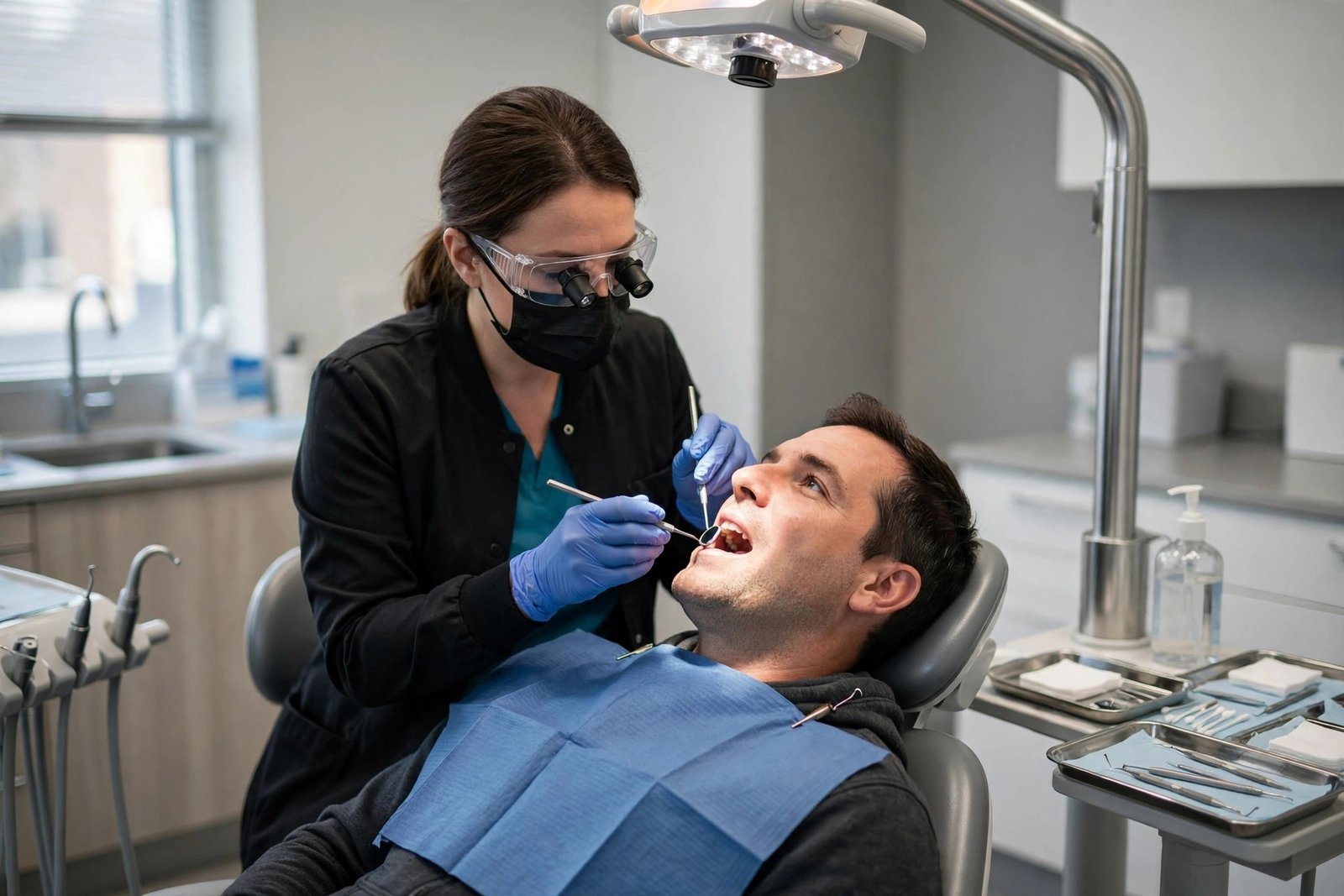
Most dental hygienists work in general dental practice, either employed by a practice or self-employed and working across several practices. Hospital dental services, community dental services, the armed forces, prisons and corporate dental providers employ hygienists too, and some hygienists work in health promotion, education, research or the dental industry. With experience, hygienists progress into education and supervisory roles, take further training in areas such as sedation or the management of patients with specific health conditions such as diabetes, and may move into practice management or wider public-health roles delivering oral-health training to other professionals. A combined hygiene and therapy qualification widens the scope further, because therapists also carry out fillings, extract children’s teeth and place preformed crowns on children’s teeth, which makes them versatile members of a dental team.
The strongest official salary benchmark for the United States comes from the U.S. Bureau of Labor Statistics (BLS). The median annual wage for dental hygienists was $98,100 in May 2025 (BLS, Occupational Outlook Handbook). As with any median, half of workers earned more and half earned less, so do not treat this as a starting salary. The lowest 10 percent earned less than $74,880 and the highest 10 percent earned more than $126,050 in the same release. By industry, the May 2025 medians were $98,280 in offices of dentists, $91,160 in offices of physicians, and $80,830 in government excluding state and local education and hospitals. BLS projects employment of dental hygienists to grow 8 percent from 2025 to 2035, much faster than the average for all occupations, with about 15,000 openings projected each year on average over the decade. Many hygienists work part-time, and dentists may hire a hygienist for only a few days a week, so some hygienists work for more than one dentist — which means annual earnings depend heavily on how many days and hours you work, not only on the hourly or daily rate.
| Setting (USA) | Median annual wage, May 2025 (BLS) |
|---|---|
| All dental hygienists | $98,100 |
| Offices of dentists | $98,280 |
| Offices of physicians | $91,160 |
| Government, excluding state and local education and hospitals | $80,830 |
| Lowest 10 percent, all settings | Less than $74,880 |
| Highest 10 percent, all settings | More than $126,050 |
| Projected employment growth, 2025–35 (BLS) | 8 percent; about 15,000 openings per year on average |
Pay in the UK, Canada and Australia is published on different bases and is not merged into this table. In the UK, hygienists may be employed or self-employed, hours and pay vary by practice, some evening or weekend work may be required, and NHS hospital or community posts are typically paid at Agenda for Change Bands 5 or 6 at entry. In Canada and Australia, pay depends on province or state, sector and experience. Before you make financial plans on the basis of any salary figure, check the current official or professional-body guidance for the jurisdiction where you intend to work, and remember that part-time working patterns make annual comparisons misleading unless hours are stated.
Registration: What a Degree Does and Does Not Guarantee
This section matters more than any other for international students, so read it carefully. In the UK, to practise as a dental hygienist you must complete a GDC-approved course and then register with the GDC; only people on the GDC register may legally work as dental care professionals in the UK. Graduation from an approved UK course makes you eligible to apply for registration, but registration itself is a separate step with its own checks, including character, health and language requirements. If you qualify outside the UK and then wish to practise in the UK, you must apply through the GDC’s route for overseas-qualified professionals, which involves assessment of your qualification and may require further examinations or training. The same principle applies in reverse: a UK qualification does not automatically entitle you to practise in the United States, Canada or Australia, where state, provincial or national boards set their own requirements.
Practical advice follows from that principle. First, decide where you most want to practise, and study in that country if you can, because the local approved programme is the simplest route to local registration. Second, if you study in one country and intend to practise in another, research the destination regulator’s overseas route before you enrol, and keep full records of your curriculum, clinical hours and patient experience, because regulators commonly ask for detailed evidence. Third, never accept a promise from an agent or a university representative that a degree “guarantees” registration or a job; regulators, not universities, grant registration, and employers, not universities, offer jobs. Fourth, budget for the costs and time of any overseas-registration process, including examinations, English tests and possible supervised practice, as part of your overall plan rather than as an unexpected expense after graduation.
Frequently Asked Questions
What is the difference between a dental hygienist and a dental therapist?
Both provide preventive oral care, but dental therapists are also trained to carry out some of the work dentists do, including fillings, extracting children’s teeth and placing preformed crowns on children’s teeth. A combined BSc in Dental Hygiene and Dental Therapy qualifies you for both roles in the UK, which gives you more flexibility than a hygiene-only qualification.
Do I need science A levels to study dental hygiene?
Most UK programmes ask for two or three A levels, often including biology or another science, alongside GCSE English and maths. Some accept a recognised dental nursing qualification in place of one A level. Requirements vary by university, so check each course page rather than assuming a single rule.
How long does a dental hygiene degree take?
A BSc in the UK usually takes three years full-time. Diploma routes can take two years or 27 months where therapy is included, and degree routes in other countries range from two to four years depending on the structure and on whether prerequisites are included.
Can I practise in the UK if I qualify abroad?
Only after you satisfy the General Dental Council’s requirements for overseas-qualified professionals, which involve assessment of your qualification and may require further examinations or training. A foreign qualification alone does not entitle you to practise in the UK, and the same principle applies in other countries.
Is dental hygiene a good career for part-time work?
Yes, in the sense that part-time and portfolio working patterns are common: many hygienists work for several practices on different days. But part-time work means part-time annual earnings, so compare hourly or daily rates and total hours, not just headline annual salaries, when you judge the financial picture.
What is the salary for a dental hygienist?
In the United States, the BLS median annual wage for dental hygienists was $98,100 in May 2025, with the lowest 10 percent below $74,880 and the highest 10 percent above $126,050. Pay in other countries is published on different bases, depends on sector, location and hours, and should be checked against official or professional-body guidance for the jurisdiction where you intend to work.
Can dental nurses become dental hygienists?
Yes, and it is a common route. Qualified dental nurses often meet the experience and, in some cases, the entry requirements for hygiene degrees, and some universities accept a dental nursing qualification in place of one A level. You will still need to meet the science and other academic requirements of the specific programme.
Is the NHS Learning Support Fund available for dental hygiene students?
Students on eligible GDC-approved courses at level 5 or 6 in the UK may receive at least £5,000 a year through the NHS Learning Support Fund, depending on personal circumstances, and it does not need to be repaid. Eligibility rules are specific, particularly for international students, so confirm your own position with the university before relying on it.
Sources & Verification
Sources consulted for this article: U.S. Bureau of Labor Statistics, Occupational Outlook Handbook — Dental Hygienists (median annual wage $98,100, May 2025; lowest 10 percent below $74,880, highest 10 percent above $126,050; projected growth 8 percent, 2025–35; about 15,000 openings per year); NHS Health Careers, Dental Hygienist role page (GDC-approved course and GDC registration requirement; subjects studied including anatomy and physiology, preventive dentistry, dental health education, dental pathology and patient management; NHS Learning Support Fund of at least £5,000 a year for eligible students; Agenda for Change Bands 5 or 6 for NHS hospital or community posts); General Dental Council approval framework for dental hygiene and dental therapy courses; visa financial figures as specified in the StudyGraduate programme brief (UK £1,529 / £1,171, Germany €11,904, Australia AUD 29,710, Canada CAD 22,895 rising to CAD 23,448). Figures change yearly — confirm fees and requirements on the official university page before you apply. StudyGraduate is an information portal, not an agency — we never promise admission, jobs, salaries or visa or permanent-residence outcomes.